
NUR163 — Final Exam Review Concepts of Practical Nursing in the Care of Elderly Patients | 2026/2027
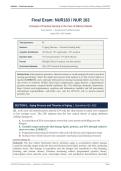
Final Exam: NUR163 / NUR 163
Concepts of Practical Nursing in the Care of Elderly Patients
Exam Review — Questions and Verified Answers
Latest Update
Total Questions: 80
Sections: 9 (Aging Theories → Practical Nursing Role)
Cognitive Distribution: 30% Recall · 50% Application · 20% Analysis
Question Style: 75% Scenario-Based · 25% Direct Recall
Format: Multiple Choice (4 options, one best answer)
Curriculum Standard: 2026–2027 Practical Nursing Gerontology
Instructions: Each question presents a clinical scenario or recall prompt relevant to practical
nursing gerontology. Select the single best answer from options A–D. The correct option is
marked [CORRECT], and a rationale with practical nursing reasoning follows each item. Use
this review to reinforce NUR163 final exam competencies: aging theories, comprehensive
geriatric assessment, common health conditions, the 3 D's (delirium, dementia, depression),
Beers Criteria and polypharmacy, nutrition and elimination, mobility and fall prevention,
ethical/legal responsibilities, end-of-life care, and the LPN/LVN role in person-centered
geriatric care.
SECTION 1: Aging Process and Theories of Aging | Questions Q1–Q12
Q1. An 82-year-old retired teacher asks the LPN why her skin bruises so easily now compared
to her younger years. The LPN explains that the free radical theory of aging attributes
cellular damage to:
A. Accumulation of DNA transcription errors that cause protein misfolding over the
lifespan
B. Unstable oxygen molecules that damage lipids, proteins, and DNA through oxidative
stress over time [CORRECT]
C. Programmed shortening of telomeres with each cell division until replication stops
D. Gradual wear of body tissues from cumulative mechanical and chemical stressors
Correct Answer: B
Rationale: The free radical (Stochastic) theory attributes aging to accumulated cellular damage
caused by unstable oxygen molecules that steal electrons from lipids, proteins, and DNA, producing
oxidative stress. This damage is cumulative over the lifespan and contributes to skin thinning,
bruising, and chronic disease. Telomere shortening reflects programmed (genetic) theory;
transcription errors describe error catastrophe theory; and mechanical deterioration describes
NUR163 Final Exam Review — Questions & Verified Answers Page 1
,NUR163 — Final Exam Review Concepts of Practical Nursing in the Care of Elderly Patients | 2026/2027
wear-and-tear theory—each is a distinct mechanism the LPN should not confuse.
Q2. Which statement by a nursing student best differentiates programmed (non-stochastic)
theory from the wear-and-tear (stochastic) theory of aging?
A. Aging is the result of accumulated random cellular damage from environmental toxins
and metabolism.
B. Aging follows a genetically predetermined biological timetable with built-in cellular
senescence. [CORRECT]
C. Aging occurs because the immune system gradually loses its ability to distinguish self
from nonself.
D. Aging results from progressive decline in hormonal regulation of metabolism and
reproduction.
Correct Answer: B
Rationale: Programmed (non-stochastic) theory proposes that aging follows a genetically
predetermined biological timetable, including phenomena such as apoptosis and programmed
cellular senescence—essentially the lifespan is biologically 'coded.' Wear-and-tear theory (stochastic)
describes accumulated random damage over time; immunologic theory focuses on immune
dysfunction; and neuroendocrine theory attributes aging to declining hormonal regulation. The LPN
must distinguish biologically timed senescence from damage-accumulation models when teaching
patients.
Q3. A gerontology instructor asks the class to identify the theory best matching the error
catastrophe theory of aging. Which response is correct?
A. Errors in protein synthesis accumulate until cellular function becomes critically
impaired. [CORRECT]
B. The thymus shrinks, leading to decreased T-cell-mediated immunity and higher cancer
risk.
C. Cross-linking of collagen and elastin causes tissue stiffening and arterial rigidity.
D. Telomere shortening eventually triggers replicative senescence in somatic cells.
Correct Answer: A
Rationale: Error catastrophe theory (Orgel) proposes that errors in DNA transcription and protein
synthesis accumulate over time until they reach a threshold that catastrophically impairs cellular
function. Thymic shrinkage reflects immunologic theory; collagen cross-linking is part of
cross-linking/wear-and-tear models; and telomere shortening describes programmed (replicative
senescence) theory. The LPN should recognize that error catastrophe is a stochastic (damage-based)
theory distinct from genetically programmed senescence.
Q4. Which assessment finding in a 78-year-old patient is most consistent with the
immunologic theory of aging?
A. Decreased reaction time and slowed deep tendon reflexes on neurologic exam
B. Reduced reactivity to antigens demonstrated by decreased T-cell function and
thymic involution [CORRECT]
C. Loss of subcutaneous fat and decreased skin elasticity over the dorsal hands
D. Decreased glomerular filtration rate despite normal serum creatinine level
Correct Answer: B
NUR163 Final Exam Review — Questions & Verified Answers Page 2
, NUR163 — Final Exam Review Concepts of Practical Nursing in the Care of Elderly Patients | 2026/2027
Rationale: The immunologic theory of aging attributes declines in immune surveillance to thymic
involution and reduced T-cell function, leading to increased susceptibility to infection, autoimmune
disease, and malignancy. Slowed reflexes reflect neurologic aging changes; loss of subcutaneous fat is
integumentary change; and a decreased GFR with normal creatinine reflects renal aging. The LPN
observing frequent infections or reactivation of latent viruses in older adults is seeing immunologic
theory in clinical practice.
Q5. According to the neuroendocrine theory of aging, which physiological change is the
primary driver of biological senescence?
A. Progressive telomere shortening leading to replicative senescence
B. Accumulation of lipofuscin pigment in neurons and cardiac muscle cells
C. Declining production and regulation of hormones, particularly from the
hypothalamic-pituitary axis [CORRECT]
D. Increased cross-linking of glucose molecules with proteins causing tissue stiffness
Correct Answer: C
Rationale: The neuroendocrine theory attributes aging to progressive decline in hormonal production
and regulation, particularly within the hypothalamic-pituitary axis, affecting growth hormone,
melatonin, DHEA, estrogen, and testosterone. Telomere shortening is programmed theory; lipofuscin
accumulation is wear-and-tear; and glycation cross-linking is a separate stochastic process. The LPN
should recognize this theory when caring for patients with thyroid disorders, menopause, or
andropause—conditions reflecting hormonal aging changes.
Q6. A nursing instructor asks the student to explain the genetic theory of aging. Which
response demonstrates accurate understanding?
A. Aging results from decreased antibody production and impaired cellular immunity over
time.
B. Maximum lifespan is determined by inherited genes that regulate DNA repair and
cellular senescence. [CORRECT]
C. Free radicals progressively damage mitochondrial DNA until cellular energy production
fails.
D. Long-term psychological stress shortens lifespan by accelerating neuroendocrine
decline.
Correct Answer: B
Rationale: The genetic theory proposes that lifespan is largely determined by inherited genes that
regulate DNA repair mechanisms, telomere length, and cellular senescence, which is why longevity
tends to run in families. Antibody decline reflects immunologic theory; mitochondrial DNA damage is
a free radical mechanism; and stress-related neuroendocrine decline is a different model. The LPN
gathering family history of centenarians or early-onset Alzheimer's is collecting data relevant to
genetic theory.
Q7. An 80-year-old patient in a long-term care facility frequently expresses regret over past
decisions and states, 'My life was a waste.' Based on Erikson's psychosocial stages, which
developmental conflict is this patient struggling with?
A. Industry vs. Inferiority
B. Identity vs. Role Confusion
C. Generativity vs. Stagnation
NUR163 Final Exam Review — Questions & Verified Answers Page 3
Final Exam: NUR163 / NUR 163
Concepts of Practical Nursing in the Care of Elderly Patients
Exam Review — Questions and Verified Answers
Latest Update
Total Questions: 80
Sections: 9 (Aging Theories → Practical Nursing Role)
Cognitive Distribution: 30% Recall · 50% Application · 20% Analysis
Question Style: 75% Scenario-Based · 25% Direct Recall
Format: Multiple Choice (4 options, one best answer)
Curriculum Standard: 2026–2027 Practical Nursing Gerontology
Instructions: Each question presents a clinical scenario or recall prompt relevant to practical
nursing gerontology. Select the single best answer from options A–D. The correct option is
marked [CORRECT], and a rationale with practical nursing reasoning follows each item. Use
this review to reinforce NUR163 final exam competencies: aging theories, comprehensive
geriatric assessment, common health conditions, the 3 D's (delirium, dementia, depression),
Beers Criteria and polypharmacy, nutrition and elimination, mobility and fall prevention,
ethical/legal responsibilities, end-of-life care, and the LPN/LVN role in person-centered
geriatric care.
SECTION 1: Aging Process and Theories of Aging | Questions Q1–Q12
Q1. An 82-year-old retired teacher asks the LPN why her skin bruises so easily now compared
to her younger years. The LPN explains that the free radical theory of aging attributes
cellular damage to:
A. Accumulation of DNA transcription errors that cause protein misfolding over the
lifespan
B. Unstable oxygen molecules that damage lipids, proteins, and DNA through oxidative
stress over time [CORRECT]
C. Programmed shortening of telomeres with each cell division until replication stops
D. Gradual wear of body tissues from cumulative mechanical and chemical stressors
Correct Answer: B
Rationale: The free radical (Stochastic) theory attributes aging to accumulated cellular damage
caused by unstable oxygen molecules that steal electrons from lipids, proteins, and DNA, producing
oxidative stress. This damage is cumulative over the lifespan and contributes to skin thinning,
bruising, and chronic disease. Telomere shortening reflects programmed (genetic) theory;
transcription errors describe error catastrophe theory; and mechanical deterioration describes
NUR163 Final Exam Review — Questions & Verified Answers Page 1
,NUR163 — Final Exam Review Concepts of Practical Nursing in the Care of Elderly Patients | 2026/2027
wear-and-tear theory—each is a distinct mechanism the LPN should not confuse.
Q2. Which statement by a nursing student best differentiates programmed (non-stochastic)
theory from the wear-and-tear (stochastic) theory of aging?
A. Aging is the result of accumulated random cellular damage from environmental toxins
and metabolism.
B. Aging follows a genetically predetermined biological timetable with built-in cellular
senescence. [CORRECT]
C. Aging occurs because the immune system gradually loses its ability to distinguish self
from nonself.
D. Aging results from progressive decline in hormonal regulation of metabolism and
reproduction.
Correct Answer: B
Rationale: Programmed (non-stochastic) theory proposes that aging follows a genetically
predetermined biological timetable, including phenomena such as apoptosis and programmed
cellular senescence—essentially the lifespan is biologically 'coded.' Wear-and-tear theory (stochastic)
describes accumulated random damage over time; immunologic theory focuses on immune
dysfunction; and neuroendocrine theory attributes aging to declining hormonal regulation. The LPN
must distinguish biologically timed senescence from damage-accumulation models when teaching
patients.
Q3. A gerontology instructor asks the class to identify the theory best matching the error
catastrophe theory of aging. Which response is correct?
A. Errors in protein synthesis accumulate until cellular function becomes critically
impaired. [CORRECT]
B. The thymus shrinks, leading to decreased T-cell-mediated immunity and higher cancer
risk.
C. Cross-linking of collagen and elastin causes tissue stiffening and arterial rigidity.
D. Telomere shortening eventually triggers replicative senescence in somatic cells.
Correct Answer: A
Rationale: Error catastrophe theory (Orgel) proposes that errors in DNA transcription and protein
synthesis accumulate over time until they reach a threshold that catastrophically impairs cellular
function. Thymic shrinkage reflects immunologic theory; collagen cross-linking is part of
cross-linking/wear-and-tear models; and telomere shortening describes programmed (replicative
senescence) theory. The LPN should recognize that error catastrophe is a stochastic (damage-based)
theory distinct from genetically programmed senescence.
Q4. Which assessment finding in a 78-year-old patient is most consistent with the
immunologic theory of aging?
A. Decreased reaction time and slowed deep tendon reflexes on neurologic exam
B. Reduced reactivity to antigens demonstrated by decreased T-cell function and
thymic involution [CORRECT]
C. Loss of subcutaneous fat and decreased skin elasticity over the dorsal hands
D. Decreased glomerular filtration rate despite normal serum creatinine level
Correct Answer: B
NUR163 Final Exam Review — Questions & Verified Answers Page 2
, NUR163 — Final Exam Review Concepts of Practical Nursing in the Care of Elderly Patients | 2026/2027
Rationale: The immunologic theory of aging attributes declines in immune surveillance to thymic
involution and reduced T-cell function, leading to increased susceptibility to infection, autoimmune
disease, and malignancy. Slowed reflexes reflect neurologic aging changes; loss of subcutaneous fat is
integumentary change; and a decreased GFR with normal creatinine reflects renal aging. The LPN
observing frequent infections or reactivation of latent viruses in older adults is seeing immunologic
theory in clinical practice.
Q5. According to the neuroendocrine theory of aging, which physiological change is the
primary driver of biological senescence?
A. Progressive telomere shortening leading to replicative senescence
B. Accumulation of lipofuscin pigment in neurons and cardiac muscle cells
C. Declining production and regulation of hormones, particularly from the
hypothalamic-pituitary axis [CORRECT]
D. Increased cross-linking of glucose molecules with proteins causing tissue stiffness
Correct Answer: C
Rationale: The neuroendocrine theory attributes aging to progressive decline in hormonal production
and regulation, particularly within the hypothalamic-pituitary axis, affecting growth hormone,
melatonin, DHEA, estrogen, and testosterone. Telomere shortening is programmed theory; lipofuscin
accumulation is wear-and-tear; and glycation cross-linking is a separate stochastic process. The LPN
should recognize this theory when caring for patients with thyroid disorders, menopause, or
andropause—conditions reflecting hormonal aging changes.
Q6. A nursing instructor asks the student to explain the genetic theory of aging. Which
response demonstrates accurate understanding?
A. Aging results from decreased antibody production and impaired cellular immunity over
time.
B. Maximum lifespan is determined by inherited genes that regulate DNA repair and
cellular senescence. [CORRECT]
C. Free radicals progressively damage mitochondrial DNA until cellular energy production
fails.
D. Long-term psychological stress shortens lifespan by accelerating neuroendocrine
decline.
Correct Answer: B
Rationale: The genetic theory proposes that lifespan is largely determined by inherited genes that
regulate DNA repair mechanisms, telomere length, and cellular senescence, which is why longevity
tends to run in families. Antibody decline reflects immunologic theory; mitochondrial DNA damage is
a free radical mechanism; and stress-related neuroendocrine decline is a different model. The LPN
gathering family history of centenarians or early-onset Alzheimer's is collecting data relevant to
genetic theory.
Q7. An 80-year-old patient in a long-term care facility frequently expresses regret over past
decisions and states, 'My life was a waste.' Based on Erikson's psychosocial stages, which
developmental conflict is this patient struggling with?
A. Industry vs. Inferiority
B. Identity vs. Role Confusion
C. Generativity vs. Stagnation
NUR163 Final Exam Review — Questions & Verified Answers Page 3


