

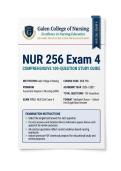
,NUR 256 Exam 4 | Mental Health Nursing
(2026/2027) PDF | Nursing | Galen College
1. A family member of a recently deceased client says, “My father took me
fishing all the time. He can’t physically take me anymore, but he will be
watching over me. I really miss him.” Which term best describes this
expression?
A) Mourning
B) Anticipatory grief
C) Disenfranchised grief
D) Bereavement
Correct Answer: A) Mourning
Rationale: Mourning is the outward expression of grief and sorrow following a
loss, often culturally influenced. The family member is processing the loss and
expressing ongoing emotional attachment, which reflects mourning.
Anticipatory grief occurs before the loss, disenfranchised grief is not socially
recognized, and bereavement is the broader state of loss.
2. A nurse educator is providing an in-service to staff on a unit with increased
client deaths. Which recommendation is the priority for nurses struggling to
cope with loss?
A) Work additional shifts to support each other
B) Implement sustainable self-care and balance
C) Volunteer on days off to stay busy
D) Transfer to a unit with fewer terminal diagnoses
,Correct Answer: B) Implement sustainable self-care and balance
Rationale: Compassion fatigue and burnout are significant risks for nurses
working with dying patients. Sustainable self-care promotes resilience and
prevents emotional exhaustion. Working extra shifts or avoiding the unit are
maladaptive coping strategies.
3. A client’s spouse of 52 years suddenly died. Which statement by the nurse is
most therapeutic?
A) “Your loved one is no longer in pain; you should be happy.”
B) “You can be grateful for the time you had together.”
C) “Your loved one was very special and will not be replaceable.”
D) “I know exactly how you feel.”
Correct Answer: C) “Your loved one was very special and will not be
replaceable.”
Rationale: This statement validates the uniqueness of the relationship and
acknowledges the loss without false reassurance or platitudes. Telling a grieving
person to be happy or grateful invalidates feelings, and claiming to know exactly
how they feel shifts focus to the nurse.
4. A client with Alzheimer’s disease is unable to recognize familiar objects such
as a hairbrush despite intact vision. How should the nurse document this
finding?
A) Aphasia
B) Apraxia
, C) Amnesia
D) Agnosia
Correct Answer: D) Agnosia
Rationale: Agnosia is the inability to interpret sensory information and
recognize objects or people despite intact sensory function. Aphasia is difficulty
with language, apraxia is difficulty with motor planning, and amnesia is memory
loss.
5. A client with borderline personality disorder frequently tells the day nurse
that the night nurse is incompetent and mean. What is this behavior called?
A) Splitting
B) Idealization
C) Projective identification
D) Rationalization
Correct Answer: A) Splitting
Rationale: Splitting is a defense mechanism in borderline personality disorder
where people are viewed as all good or all bad, often causing staff conflict.
Consistent team communication minimizes its effect. Idealization, projective
identification, and rationalization are different mechanisms.
6. Which assessment finding is most critical for a nurse to monitor in a client
diagnosed with anorexia nervosa?
A) Amenorrhea
(2026/2027) PDF | Nursing | Galen College
1. A family member of a recently deceased client says, “My father took me
fishing all the time. He can’t physically take me anymore, but he will be
watching over me. I really miss him.” Which term best describes this
expression?
A) Mourning
B) Anticipatory grief
C) Disenfranchised grief
D) Bereavement
Correct Answer: A) Mourning
Rationale: Mourning is the outward expression of grief and sorrow following a
loss, often culturally influenced. The family member is processing the loss and
expressing ongoing emotional attachment, which reflects mourning.
Anticipatory grief occurs before the loss, disenfranchised grief is not socially
recognized, and bereavement is the broader state of loss.
2. A nurse educator is providing an in-service to staff on a unit with increased
client deaths. Which recommendation is the priority for nurses struggling to
cope with loss?
A) Work additional shifts to support each other
B) Implement sustainable self-care and balance
C) Volunteer on days off to stay busy
D) Transfer to a unit with fewer terminal diagnoses
,Correct Answer: B) Implement sustainable self-care and balance
Rationale: Compassion fatigue and burnout are significant risks for nurses
working with dying patients. Sustainable self-care promotes resilience and
prevents emotional exhaustion. Working extra shifts or avoiding the unit are
maladaptive coping strategies.
3. A client’s spouse of 52 years suddenly died. Which statement by the nurse is
most therapeutic?
A) “Your loved one is no longer in pain; you should be happy.”
B) “You can be grateful for the time you had together.”
C) “Your loved one was very special and will not be replaceable.”
D) “I know exactly how you feel.”
Correct Answer: C) “Your loved one was very special and will not be
replaceable.”
Rationale: This statement validates the uniqueness of the relationship and
acknowledges the loss without false reassurance or platitudes. Telling a grieving
person to be happy or grateful invalidates feelings, and claiming to know exactly
how they feel shifts focus to the nurse.
4. A client with Alzheimer’s disease is unable to recognize familiar objects such
as a hairbrush despite intact vision. How should the nurse document this
finding?
A) Aphasia
B) Apraxia
, C) Amnesia
D) Agnosia
Correct Answer: D) Agnosia
Rationale: Agnosia is the inability to interpret sensory information and
recognize objects or people despite intact sensory function. Aphasia is difficulty
with language, apraxia is difficulty with motor planning, and amnesia is memory
loss.
5. A client with borderline personality disorder frequently tells the day nurse
that the night nurse is incompetent and mean. What is this behavior called?
A) Splitting
B) Idealization
C) Projective identification
D) Rationalization
Correct Answer: A) Splitting
Rationale: Splitting is a defense mechanism in borderline personality disorder
where people are viewed as all good or all bad, often causing staff conflict.
Consistent team communication minimizes its effect. Idealization, projective
identification, and rationalization are different mechanisms.
6. Which assessment finding is most critical for a nurse to monitor in a client
diagnosed with anorexia nervosa?
A) Amenorrhea


