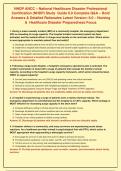
NHDP ANCC – National Healthcare Disaster Professional
Certification (NHDP) Study Guide 6.0 Complete Q&A – Bold
Answers & Detailed Rationales Latest Version: 6.0 – Nursing
& Healthcare Disaster Preparedness Focus
1. During a mass casualty incident (MCI) at a community hospital, the emergency department
(ED) is exceeding its surge capacity. The hospital incident command system has been
activated, and the medical officer in charge must decide on the next best action. Which action
is most appropriate to maintain patient flow and safety?
A. Discharge all stable patients from the ED to the waiting room to free up beds for incoming casualties.
B. Implement a hospital-wide elective procedure hold and transfer stable inpatients to an alternate care facility.
C. Begin diverting all ambulances to the nearest tertiary care center, regardless of their current capacity.
D. Open the hospital's decontamination area to the public for primary care of minor injuries.
Answer: B. Implement a hospital-wide elective procedure hold and transfer stable inpatients to
an alternate care facility.
2. Following a large-scale disaster, a hospital's emergency operations plan is activated. The
incident commander is faced with a surge of patients that exceeds the facility's normal
capacity. According to the hospital's surge capacity framework, which action should be taken
FIRST to expand capacity?
A. Convert post-anesthesia care unit (PACU) and operating rooms into critical care beds.
B. Discharge all patients who are medically stable and can be safely sent home.
C. Activate a mutual aid agreement with neighboring hospitals to transfer patients.
D. Begin triaging patients using the Simple Triage and Rapid Treatment (START) algorithm.
Answer: B. Discharge all patients who are medically stable and can be safely sent home.
3. A hospital is experiencing a surge of patients from a nearby chemical release. The
emergency department is overwhelmed and the hospital is at 120% capacity. Which strategy is
MOST effective for increasing surge capacity in the short term?
A. Increase staffing by calling in off-duty personnel and using volunteer nurses.
B. Discharge all patients with chronic conditions who are clinically stable.
C. Open unused wings of the hospital that are under renovation.
D. Transfer all non-critical patients to skilled nursing facilities.
Answer: B. Discharge all patients with chronic conditions who are clinically stable.
4. A disaster strikes in a community, and many survivors are experiencing acute stress
reactions. As a healthcare provider trained in psychological first aid (PFA), which action is
MOST appropriate when approaching a distraught survivor?
A. Encourage the survivor to talk about the event in detail to process the trauma.
B. Provide practical assistance, such as water, warmth, and information about family services.
C. Tell the survivor to 'stay strong' and avoid displaying emotions to prevent panic.
D. Immediately refer the survivor for professional counseling and debriefing sessions.
Answer: B. Provide practical assistance, such as water, warmth, and information about family
services.
,5. A public health nurse is providing psychological first aid (PFA) to a family who lost their
home in a flood. The mother is wailing and the father appears withdrawn. Which intervention is
the MOST appropriate initial step?
A. Help the family find temporary shelter and reunite with relatives.
B. Encourage the mother to express her emotions through crying and talking.
C. Tell the father that it is okay to cry and that he should share his feelings.
D. Provide the family with educational pamphlets on coping with disaster stress.
Answer: A. Help the family find temporary shelter and reunite with relatives.
6. During a mass casualty event, a triage officer is using psychological first aid principles to
communicate with victims. Which message aligns BEST with PFA guidelines?
A. "You need to be strong for your family; don't show your fear."
B. "Everything will be fine soon; just try to relax."
C. "I am here to help you stay safe and connect you with your loved ones."
D. "You must talk about what happened to prevent long-term problems."
Answer: C. "I am here to help you stay safe and connect you with your loved ones."
7. A hospital is overwhelmed by a pandemic and is forced to allocate scarce ventilators. The
triage team applies a crisis standards of care plan. A 40-year-old patient with a severe chronic
illness has a poor prognosis, while a 20-year-old patient with a treatable condition has a good
prognosis. There is only one ventilator available. Based on utilitarian principles, which patient
should receive the ventilator?
A. The 20-year-old, because they have a higher chance of survival and more life-years to gain.
B. The 40-year-old, because they have a family and dependents.
C. The 20-year-old, because they are younger and have a longer potential lifespan.
D. The 40-year-old, because they have been waiting longer in the emergency department.
Answer: A. The 20-year-old, because they have a higher chance of survival and more life-years
to gain.
8. A local hospital has an ethical dilemma when a mass casualty event leaves limited available
resources. Which principle of disaster ethics emphasizes the duty to provide care to the
greatest number of people?
A. Deontology
B. Utilitarianism
C. Virtue ethics
D. Principlism
Answer: B. Utilitarianism
9. A healthcare provider is asked to participate in a forensic examination of a deceased disaster
victim. According to legal and ethical guidelines, what is the provider's primary responsibility?
A. Preserve evidence and maintain the chain of custody.
B. Provide emotional support to the family.
C. Determine the cause of death.
D. Document the victim's personal belongings.
Answer: A. Preserve evidence and maintain the chain of custody.
10. During a public health emergency, a nurse is told to administer an investigational vaccine
, that has not been fully approved. According to legal and ethical standards, what must the nurse
consider FIRST?
A. The patient's right to informed consent and the availability of an emergency use authorization (EUA).
B. The risk of liability if the vaccine causes harm.
C. The need to protect the community by vaccinating as many people as possible.
D. The instructions from the incident commander that override individual patient rights.
Answer: A. The patient's right to informed consent and the availability of an emergency use
authorization (EUA).
11. A hospital is implementing an infection control plan during a pandemic. Which practice is
MOST effective in preventing the spread of a respiratory virus among patients and staff?
A. Placing all patients in negative pressure rooms.
B. Emphasizing hand hygiene and use of appropriate personal protective equipment (PPE).
C. Administering antiviral medications to all staff as prophylactic.
D. Limiting visitor access to the hospital.
Answer: B. Emphasizing hand hygiene and use of appropriate personal protective equipment
(PPE).
12. A patient arrives at the emergency department after a chemical explosion and is grossly
contaminated with a hazardous substance. What is the FIRST step in patient management?
A. Remove contaminated clothing and initiate decontamination.
B. Stabilize the patient's airway, breathing, and circulation (ABCs).
C. Administer the specific antidote for the chemical.
D. Move the patient to a clean area and observe for signs of toxicity.
Answer: B. Stabilize the patient's airway, breathing, and circulation (ABCs).
13. In a hospital decontamination corridor, a healthcare worker notices that the runoff water
from decontamination is flowing into a storm drain. What is the appropriate action?
A. Continue decontamination but use less water to minimize runoff.
B. Stop decontamination and contain the runoff to prevent environmental contamination.
C. Ignore the runoff because it is diluted and will not cause harm.
D. Direct the runoff into a sanitary sewer if it is nearby.
Answer: B. Stop decontamination and contain the runoff to prevent environmental
contamination.
14. A nurse is preparing to care for a patient with suspected Ebola virus disease. Which type of
personal protective equipment (PPE) is REQUIRED according to standard precautions for
high-consequence infectious diseases?
A. Surgical mask, gloves, and gown.
B. N95 respirator, face shield, gown, double gloves, and shoe covers.
C. N95 respirator and gloves only.
D. Powered air-purifying respirator (PAPR) for all staff.
Answer: B. N95 respirator, face shield, gown, double gloves, and shoe covers.
15. A community health center is developing a disaster preparedness plan. Which component
is essential to ensure effective response?
A. A detailed list of all staff members' home addresses and phone numbers.
Certification (NHDP) Study Guide 6.0 Complete Q&A – Bold
Answers & Detailed Rationales Latest Version: 6.0 – Nursing
& Healthcare Disaster Preparedness Focus
1. During a mass casualty incident (MCI) at a community hospital, the emergency department
(ED) is exceeding its surge capacity. The hospital incident command system has been
activated, and the medical officer in charge must decide on the next best action. Which action
is most appropriate to maintain patient flow and safety?
A. Discharge all stable patients from the ED to the waiting room to free up beds for incoming casualties.
B. Implement a hospital-wide elective procedure hold and transfer stable inpatients to an alternate care facility.
C. Begin diverting all ambulances to the nearest tertiary care center, regardless of their current capacity.
D. Open the hospital's decontamination area to the public for primary care of minor injuries.
Answer: B. Implement a hospital-wide elective procedure hold and transfer stable inpatients to
an alternate care facility.
2. Following a large-scale disaster, a hospital's emergency operations plan is activated. The
incident commander is faced with a surge of patients that exceeds the facility's normal
capacity. According to the hospital's surge capacity framework, which action should be taken
FIRST to expand capacity?
A. Convert post-anesthesia care unit (PACU) and operating rooms into critical care beds.
B. Discharge all patients who are medically stable and can be safely sent home.
C. Activate a mutual aid agreement with neighboring hospitals to transfer patients.
D. Begin triaging patients using the Simple Triage and Rapid Treatment (START) algorithm.
Answer: B. Discharge all patients who are medically stable and can be safely sent home.
3. A hospital is experiencing a surge of patients from a nearby chemical release. The
emergency department is overwhelmed and the hospital is at 120% capacity. Which strategy is
MOST effective for increasing surge capacity in the short term?
A. Increase staffing by calling in off-duty personnel and using volunteer nurses.
B. Discharge all patients with chronic conditions who are clinically stable.
C. Open unused wings of the hospital that are under renovation.
D. Transfer all non-critical patients to skilled nursing facilities.
Answer: B. Discharge all patients with chronic conditions who are clinically stable.
4. A disaster strikes in a community, and many survivors are experiencing acute stress
reactions. As a healthcare provider trained in psychological first aid (PFA), which action is
MOST appropriate when approaching a distraught survivor?
A. Encourage the survivor to talk about the event in detail to process the trauma.
B. Provide practical assistance, such as water, warmth, and information about family services.
C. Tell the survivor to 'stay strong' and avoid displaying emotions to prevent panic.
D. Immediately refer the survivor for professional counseling and debriefing sessions.
Answer: B. Provide practical assistance, such as water, warmth, and information about family
services.
,5. A public health nurse is providing psychological first aid (PFA) to a family who lost their
home in a flood. The mother is wailing and the father appears withdrawn. Which intervention is
the MOST appropriate initial step?
A. Help the family find temporary shelter and reunite with relatives.
B. Encourage the mother to express her emotions through crying and talking.
C. Tell the father that it is okay to cry and that he should share his feelings.
D. Provide the family with educational pamphlets on coping with disaster stress.
Answer: A. Help the family find temporary shelter and reunite with relatives.
6. During a mass casualty event, a triage officer is using psychological first aid principles to
communicate with victims. Which message aligns BEST with PFA guidelines?
A. "You need to be strong for your family; don't show your fear."
B. "Everything will be fine soon; just try to relax."
C. "I am here to help you stay safe and connect you with your loved ones."
D. "You must talk about what happened to prevent long-term problems."
Answer: C. "I am here to help you stay safe and connect you with your loved ones."
7. A hospital is overwhelmed by a pandemic and is forced to allocate scarce ventilators. The
triage team applies a crisis standards of care plan. A 40-year-old patient with a severe chronic
illness has a poor prognosis, while a 20-year-old patient with a treatable condition has a good
prognosis. There is only one ventilator available. Based on utilitarian principles, which patient
should receive the ventilator?
A. The 20-year-old, because they have a higher chance of survival and more life-years to gain.
B. The 40-year-old, because they have a family and dependents.
C. The 20-year-old, because they are younger and have a longer potential lifespan.
D. The 40-year-old, because they have been waiting longer in the emergency department.
Answer: A. The 20-year-old, because they have a higher chance of survival and more life-years
to gain.
8. A local hospital has an ethical dilemma when a mass casualty event leaves limited available
resources. Which principle of disaster ethics emphasizes the duty to provide care to the
greatest number of people?
A. Deontology
B. Utilitarianism
C. Virtue ethics
D. Principlism
Answer: B. Utilitarianism
9. A healthcare provider is asked to participate in a forensic examination of a deceased disaster
victim. According to legal and ethical guidelines, what is the provider's primary responsibility?
A. Preserve evidence and maintain the chain of custody.
B. Provide emotional support to the family.
C. Determine the cause of death.
D. Document the victim's personal belongings.
Answer: A. Preserve evidence and maintain the chain of custody.
10. During a public health emergency, a nurse is told to administer an investigational vaccine
, that has not been fully approved. According to legal and ethical standards, what must the nurse
consider FIRST?
A. The patient's right to informed consent and the availability of an emergency use authorization (EUA).
B. The risk of liability if the vaccine causes harm.
C. The need to protect the community by vaccinating as many people as possible.
D. The instructions from the incident commander that override individual patient rights.
Answer: A. The patient's right to informed consent and the availability of an emergency use
authorization (EUA).
11. A hospital is implementing an infection control plan during a pandemic. Which practice is
MOST effective in preventing the spread of a respiratory virus among patients and staff?
A. Placing all patients in negative pressure rooms.
B. Emphasizing hand hygiene and use of appropriate personal protective equipment (PPE).
C. Administering antiviral medications to all staff as prophylactic.
D. Limiting visitor access to the hospital.
Answer: B. Emphasizing hand hygiene and use of appropriate personal protective equipment
(PPE).
12. A patient arrives at the emergency department after a chemical explosion and is grossly
contaminated with a hazardous substance. What is the FIRST step in patient management?
A. Remove contaminated clothing and initiate decontamination.
B. Stabilize the patient's airway, breathing, and circulation (ABCs).
C. Administer the specific antidote for the chemical.
D. Move the patient to a clean area and observe for signs of toxicity.
Answer: B. Stabilize the patient's airway, breathing, and circulation (ABCs).
13. In a hospital decontamination corridor, a healthcare worker notices that the runoff water
from decontamination is flowing into a storm drain. What is the appropriate action?
A. Continue decontamination but use less water to minimize runoff.
B. Stop decontamination and contain the runoff to prevent environmental contamination.
C. Ignore the runoff because it is diluted and will not cause harm.
D. Direct the runoff into a sanitary sewer if it is nearby.
Answer: B. Stop decontamination and contain the runoff to prevent environmental
contamination.
14. A nurse is preparing to care for a patient with suspected Ebola virus disease. Which type of
personal protective equipment (PPE) is REQUIRED according to standard precautions for
high-consequence infectious diseases?
A. Surgical mask, gloves, and gown.
B. N95 respirator, face shield, gown, double gloves, and shoe covers.
C. N95 respirator and gloves only.
D. Powered air-purifying respirator (PAPR) for all staff.
Answer: B. N95 respirator, face shield, gown, double gloves, and shoe covers.
15. A community health center is developing a disaster preparedness plan. Which component
is essential to ensure effective response?
A. A detailed list of all staff members' home addresses and phone numbers.