
Unit 12: Value Chain Management
Learning Outcomes
1. Explain the role of functional strategy and value chain management in achieving superior quality, efficiency,
innovation and responsiveness to customers.
2. Describe what customers want and explain why it is so important for managers to be responsive to their needs.
3. Explain why achieving superior quality is so important and understand the challenges facing managers and
organisations that seek to implement total quality management.
4. Explain why achieving superior efficiency is so important and understand the different kinds of techniques that
need to be employed to increase efficiency.
5. Differentiate between two forms of innovation and explain why innovation and product development are crucial
components of the search for competitive advantage.
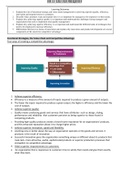
Functional Strategies, the Value Chain and Competitive Advantage
Four ways of creating a competitive advantage:
1. Achieve superior efficiency:
• Efficiency is a measure of the amount of inputs required to produce a given amount of outputs.
• The fewer the inputs required to produce a given output, the higher is efficiency and the lower the
cost of outputs.
2. Achieve superior quality:
o Quality means producing goods and services that have attributes- such as design, styling,
performance and reliability- that customers perceive as being superior to those found in
competing products.
o Providing high-quality products creates a brand-name reputation for an organizations’ products,
and this enhanced reputation allows it to charge higher prices.
3. Achieve superior innovation, speed and flexibility:
• Anything new or better about the way an organization operates or the goods and services it
produces is the result of innovation.
• Successful innovation gives the organization something unique or different about its products that
rivals lack- more attractive, useful, sophisticated products or superior production processes that
strengthen its competitive advantage.
4. Attain superior responsiveness to customers:
• An organization that is responsive to customers tries to satisfy their needs and give them exactly
what they want.


