

CCT CCI CERTIFIED
CARDIOGRAPHIC TECHNICIAN EXAM
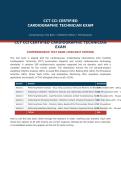
Comprehensive Test Bank • 2026/2027 Edition • 500 Questions
CCT CCI CERTIFIED CARDIOGRAPHIC TECHNICIAN
EXAM
COMPREHENSIVE TEST BANK (2026/2027 EDITION)
This test bank is aligned with the Cardiovascular Credentialing International (CCI) Certified
Cardiographic Technician (CCT) examination blueprint and current cardiovascular technology
standards. It contains 500 multiple-choice questions organized into six domains, each with a
complete rationale for the correct answer. The distribution mirrors the CCI job-task-analysis
weighting: Rhythm Analysis (40%), 12-Lead ECG Analysis (22%), Resting ECG (14%), Pre-Procedural
Activities (10%), Stress Tests (10%), and Ambulatory Monitoring (4%). Questions emphasize
application and analysis (≈75%) alongside direct recall (≈25%).
Section Domain Questions
Section 1 Performing Rhythm Analysis – Sinus, Atrial, Junctional, Ventricular Rhythms, AV Blocks,
200Pacemakers (40% – 200 qu
Section 2 Analyzing 12-Lead ECG – Waveforms, Intervals, Axis, Hypertrophy, Bundle Branch Blocks,
110 MI Localization (22% – 11
Section 3 Performing Resting ECG – Lead Placement, Calibration, Artifact Troubleshooting, Patient
70 Education (14% – 70 ques
Section 4 Conducting Pre-Procedural Activities – Patient ID, Consent, Universal Precautions, Patient
50 Prep, Safety (10% – 50 qu
Section 5 Performing Stress Tests – Protocols, Safety, Baseline ECG, Pharmacologic Stress (10%
50– 50 questions)
Section 6 Performing Ambulatory Monitoring – Holter, Event, Telemetry, Equipment Setup, Patient
20 Education (4% – 20 questi
TOTAL 500
How to use this test bank: Work through the domains in order, marking your answers. Each item
shows four options (A–D) with exactly one correct response, followed by the answer and a rationale.
A consolidated answer key appears at the end for quick scoring.
,CCT CCI — Certified Cardiographic Technician Comprehensive Test Bank (2026/2027)
Section 1: Performing Rhythm Analysis – Sinus, Atrial, Junctional, Ventricular
Rhythms, AV Blocks, Pacemakers (40% – 200 questions)
Q1: A normal sinus rhythm has a rate of:
A. 20-40 beats per minute
B. 40-60 beats per minute
C. 60-100 beats per minute [CORRECT]
D. 100-180 beats per minute
Correct Answer: C
Rationale: Normal sinus rhythm is 60-100 bpm, set by the SA node. Slower rates suggest bradycardia; faster
rates suggest tachycardia.
Q2: In normal sinus rhythm, the P wave appears:
A. upright before every QRS complex [CORRECT]
B. inverted after every QRS complex
C. absent entirely
D. sawtooth shaped
Correct Answer: A
Rationale: A sinus P wave is upright in lead II and precedes each QRS. Inverted or absent P waves indicate a
different origin or rhythm.
Q3: The normal PR interval is:
A. 0.04-0.10 second
B. 0.12-0.20 second [CORRECT]
C. 0.24-0.40 second
D. 0.44-0.60 second
Correct Answer: B
Rationale: The normal PR interval is 0.12-0.20 second. Longer values indicate AV conduction delay (first-degree
block).
Q4: The normal QRS complex duration is:
A. less than 0.12 second [CORRECT]
B. 0.12-0.20 second
C. 0.20-0.30 second
D. greater than 0.30 second
Correct Answer: A
Rationale: A normal QRS is less than 0.12 second. A wider QRS indicates a conduction delay or ventricular
origin.
Q5: The primary pacemaker of the heart is the:
A. AV node
B. sinoatrial (SA) node [CORRECT]
C. bundle of His
D. Purkinje fibers
Correct Answer: B
Rationale: The SA node normally sets the pace at 60-100 bpm because it depolarizes fastest.
Page 2 of 89
,CCT CCI — Certified Cardiographic Technician Comprehensive Test Bank (2026/2027)
Q6: The intrinsic firing rate of the SA node is:
A. 20-40 bpm
B. 40-60 bpm
C. 60-100 bpm [CORRECT]
D. 100-150 bpm
Correct Answer: C
Rationale: The SA node fires at 60-100 bpm. The AV node fires at 40-60, and the ventricles at 20-40.
Q7: The intrinsic firing rate of the AV node is:
A. 20-40 bpm
B. 40-60 bpm [CORRECT]
C. 60-100 bpm
D. 100-150 bpm
Correct Answer: B
Rationale: The AV junction fires at 40-60 bpm and becomes the pacemaker if the SA node fails.
Q8: The intrinsic firing rate of the ventricles (Purkinje system) is:
A. 20-40 bpm [CORRECT]
B. 40-60 bpm
C. 60-100 bpm
D. 80-120 bpm
Correct Answer: A
Rationale: The Purkinje fibers fire at 20-40 bpm and serve as the last-resort ventricular pacemaker.
Q9: Sinus bradycardia is defined as a sinus rate:
A. below 60 bpm [CORRECT]
B. 60-100 bpm
C. 100-150 bpm
D. above 150 bpm
Correct Answer: A
Rationale: Sinus bradycardia is a sinus rhythm below 60 bpm, common in athletes and during sleep.
Q10: Sinus tachycardia is a sinus rhythm with a rate:
A. below 60 bpm
B. 60-100 bpm
C. above 100 bpm [CORRECT]
D. above 250 bpm
Correct Answer: C
Rationale: Sinus tachycardia is a sinus rhythm above 100 bpm, usually from exercise, fever, anxiety, or
hypovolemia.
Q11: A rhythm that speeds with inspiration and slows with expiration is:
A. atrial fibrillation
B. sinus arrhythmia [CORRECT]
C. third-degree block
D. ventricular tachycardia
Correct Answer: B
Rationale: Sinus arrhythmia varies with respiration and has a normal P-QRS-T sequence; it is usually benign.
Page 3 of 89
, CCT CCI — Certified Cardiographic Technician Comprehensive Test Bank (2026/2027)
Q12: The normal sequence of electrical conduction is:
A. SA node, AV node, bundle of His, bundle branches, Purkinje fibers [CORRECT]
B. AV node, SA node, Purkinje, bundle of His
C. Purkinje, bundle branches, SA node, AV node
D. SA node, Purkinje, AV node, bundle of His
Correct Answer: A
Rationale: The impulse travels SA node to AV node, then bundle of His, bundle branches, and Purkinje fibers.
Q13: Using the 6-second method, a rhythm with 8 QRS complexes in a 6-second strip has a rate of:
A. 48 bpm
B. 80 bpm [CORRECT]
C. 120 bpm
D. 160 bpm
Correct Answer: B
Rationale: The 6-second method multiplies the number of complexes in 6 seconds by 10: 8 x 10 = 80 bpm.
Q14: Using the 1500 method, the rate of a regular rhythm with 25 small squares between R waves is:
A. 25 bpm
B. 50 bpm
C. 60 bpm [CORRECT]
D. 150 bpm
Correct Answer: C
Rationale: 1500 divided by the number of small squares (25) equals 60 bpm.
Q15: Using the large-box method, a regular rhythm with 3 large boxes between R waves has a rate of:
A. 50 bpm
B. 100 bpm [CORRECT]
C. 150 bpm
D. 300 bpm
Correct Answer: B
Rationale: 300 divided by 3 large boxes equals 100 bpm.
Q16: One small square on ECG paper represents:
A. 0.04 second [CORRECT]
B. 0.10 second
C. 0.20 second
D. 1.00 second
Correct Answer: A
Rationale: At standard 25 mm/s, one small square equals 0.04 second and one large square equals 0.20
second.
Q17: Atrial flutter typically has an atrial rate of:
A. 60-100 bpm
B. 150-250 bpm
C. 250-350 bpm [CORRECT]
D. 400-600 bpm
Correct Answer: C
Rationale: Atrial flutter produces a sawtooth pattern at 250-350 atrial beats per minute, with a variable
ventricular response.
Page 4 of 89
CARDIOGRAPHIC TECHNICIAN EXAM
Comprehensive Test Bank • 2026/2027 Edition • 500 Questions
CCT CCI CERTIFIED CARDIOGRAPHIC TECHNICIAN
EXAM
COMPREHENSIVE TEST BANK (2026/2027 EDITION)
This test bank is aligned with the Cardiovascular Credentialing International (CCI) Certified
Cardiographic Technician (CCT) examination blueprint and current cardiovascular technology
standards. It contains 500 multiple-choice questions organized into six domains, each with a
complete rationale for the correct answer. The distribution mirrors the CCI job-task-analysis
weighting: Rhythm Analysis (40%), 12-Lead ECG Analysis (22%), Resting ECG (14%), Pre-Procedural
Activities (10%), Stress Tests (10%), and Ambulatory Monitoring (4%). Questions emphasize
application and analysis (≈75%) alongside direct recall (≈25%).
Section Domain Questions
Section 1 Performing Rhythm Analysis – Sinus, Atrial, Junctional, Ventricular Rhythms, AV Blocks,
200Pacemakers (40% – 200 qu
Section 2 Analyzing 12-Lead ECG – Waveforms, Intervals, Axis, Hypertrophy, Bundle Branch Blocks,
110 MI Localization (22% – 11
Section 3 Performing Resting ECG – Lead Placement, Calibration, Artifact Troubleshooting, Patient
70 Education (14% – 70 ques
Section 4 Conducting Pre-Procedural Activities – Patient ID, Consent, Universal Precautions, Patient
50 Prep, Safety (10% – 50 qu
Section 5 Performing Stress Tests – Protocols, Safety, Baseline ECG, Pharmacologic Stress (10%
50– 50 questions)
Section 6 Performing Ambulatory Monitoring – Holter, Event, Telemetry, Equipment Setup, Patient
20 Education (4% – 20 questi
TOTAL 500
How to use this test bank: Work through the domains in order, marking your answers. Each item
shows four options (A–D) with exactly one correct response, followed by the answer and a rationale.
A consolidated answer key appears at the end for quick scoring.
,CCT CCI — Certified Cardiographic Technician Comprehensive Test Bank (2026/2027)
Section 1: Performing Rhythm Analysis – Sinus, Atrial, Junctional, Ventricular
Rhythms, AV Blocks, Pacemakers (40% – 200 questions)
Q1: A normal sinus rhythm has a rate of:
A. 20-40 beats per minute
B. 40-60 beats per minute
C. 60-100 beats per minute [CORRECT]
D. 100-180 beats per minute
Correct Answer: C
Rationale: Normal sinus rhythm is 60-100 bpm, set by the SA node. Slower rates suggest bradycardia; faster
rates suggest tachycardia.
Q2: In normal sinus rhythm, the P wave appears:
A. upright before every QRS complex [CORRECT]
B. inverted after every QRS complex
C. absent entirely
D. sawtooth shaped
Correct Answer: A
Rationale: A sinus P wave is upright in lead II and precedes each QRS. Inverted or absent P waves indicate a
different origin or rhythm.
Q3: The normal PR interval is:
A. 0.04-0.10 second
B. 0.12-0.20 second [CORRECT]
C. 0.24-0.40 second
D. 0.44-0.60 second
Correct Answer: B
Rationale: The normal PR interval is 0.12-0.20 second. Longer values indicate AV conduction delay (first-degree
block).
Q4: The normal QRS complex duration is:
A. less than 0.12 second [CORRECT]
B. 0.12-0.20 second
C. 0.20-0.30 second
D. greater than 0.30 second
Correct Answer: A
Rationale: A normal QRS is less than 0.12 second. A wider QRS indicates a conduction delay or ventricular
origin.
Q5: The primary pacemaker of the heart is the:
A. AV node
B. sinoatrial (SA) node [CORRECT]
C. bundle of His
D. Purkinje fibers
Correct Answer: B
Rationale: The SA node normally sets the pace at 60-100 bpm because it depolarizes fastest.
Page 2 of 89
,CCT CCI — Certified Cardiographic Technician Comprehensive Test Bank (2026/2027)
Q6: The intrinsic firing rate of the SA node is:
A. 20-40 bpm
B. 40-60 bpm
C. 60-100 bpm [CORRECT]
D. 100-150 bpm
Correct Answer: C
Rationale: The SA node fires at 60-100 bpm. The AV node fires at 40-60, and the ventricles at 20-40.
Q7: The intrinsic firing rate of the AV node is:
A. 20-40 bpm
B. 40-60 bpm [CORRECT]
C. 60-100 bpm
D. 100-150 bpm
Correct Answer: B
Rationale: The AV junction fires at 40-60 bpm and becomes the pacemaker if the SA node fails.
Q8: The intrinsic firing rate of the ventricles (Purkinje system) is:
A. 20-40 bpm [CORRECT]
B. 40-60 bpm
C. 60-100 bpm
D. 80-120 bpm
Correct Answer: A
Rationale: The Purkinje fibers fire at 20-40 bpm and serve as the last-resort ventricular pacemaker.
Q9: Sinus bradycardia is defined as a sinus rate:
A. below 60 bpm [CORRECT]
B. 60-100 bpm
C. 100-150 bpm
D. above 150 bpm
Correct Answer: A
Rationale: Sinus bradycardia is a sinus rhythm below 60 bpm, common in athletes and during sleep.
Q10: Sinus tachycardia is a sinus rhythm with a rate:
A. below 60 bpm
B. 60-100 bpm
C. above 100 bpm [CORRECT]
D. above 250 bpm
Correct Answer: C
Rationale: Sinus tachycardia is a sinus rhythm above 100 bpm, usually from exercise, fever, anxiety, or
hypovolemia.
Q11: A rhythm that speeds with inspiration and slows with expiration is:
A. atrial fibrillation
B. sinus arrhythmia [CORRECT]
C. third-degree block
D. ventricular tachycardia
Correct Answer: B
Rationale: Sinus arrhythmia varies with respiration and has a normal P-QRS-T sequence; it is usually benign.
Page 3 of 89
, CCT CCI — Certified Cardiographic Technician Comprehensive Test Bank (2026/2027)
Q12: The normal sequence of electrical conduction is:
A. SA node, AV node, bundle of His, bundle branches, Purkinje fibers [CORRECT]
B. AV node, SA node, Purkinje, bundle of His
C. Purkinje, bundle branches, SA node, AV node
D. SA node, Purkinje, AV node, bundle of His
Correct Answer: A
Rationale: The impulse travels SA node to AV node, then bundle of His, bundle branches, and Purkinje fibers.
Q13: Using the 6-second method, a rhythm with 8 QRS complexes in a 6-second strip has a rate of:
A. 48 bpm
B. 80 bpm [CORRECT]
C. 120 bpm
D. 160 bpm
Correct Answer: B
Rationale: The 6-second method multiplies the number of complexes in 6 seconds by 10: 8 x 10 = 80 bpm.
Q14: Using the 1500 method, the rate of a regular rhythm with 25 small squares between R waves is:
A. 25 bpm
B. 50 bpm
C. 60 bpm [CORRECT]
D. 150 bpm
Correct Answer: C
Rationale: 1500 divided by the number of small squares (25) equals 60 bpm.
Q15: Using the large-box method, a regular rhythm with 3 large boxes between R waves has a rate of:
A. 50 bpm
B. 100 bpm [CORRECT]
C. 150 bpm
D. 300 bpm
Correct Answer: B
Rationale: 300 divided by 3 large boxes equals 100 bpm.
Q16: One small square on ECG paper represents:
A. 0.04 second [CORRECT]
B. 0.10 second
C. 0.20 second
D. 1.00 second
Correct Answer: A
Rationale: At standard 25 mm/s, one small square equals 0.04 second and one large square equals 0.20
second.
Q17: Atrial flutter typically has an atrial rate of:
A. 60-100 bpm
B. 150-250 bpm
C. 250-350 bpm [CORRECT]
D. 400-600 bpm
Correct Answer: C
Rationale: Atrial flutter produces a sawtooth pattern at 250-350 atrial beats per minute, with a variable
ventricular response.
Page 4 of 89


