
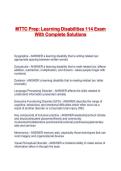
MTTC Prep: Learning Disabilities 114 Exam
With Complete Solutions
Dysgraphia - ANSWER a learning disability that is writing related (ex:
appropriate spacing between written words)
Dyscalculia - ANSWER a learning disability that is math related (ex: affects
addition, subtraction, multiplication, and division - takes people longer with
numbers)
Dyslexia - ANSWER a learning disability that is reading related (ex: letter
reversals)
Language Processing Disorder - ANSWER affects the skills needed to
understand information presented verbally
Executive Functioning Disorder (EFD) - ANSWER describe the range of
cognitive, behavioral, and emotional difficulties which often occur as a
result of another disorder or a traumatic brain injury (TBI).
Key compounds of inclusive practice - ANSWER leadership/school climate
and structure/student placement/family and community
involvement/collaborative practices/instructional practices/supplementary
aids and services
Mnemonics - ANSWER memory aids, especially those techniques that use
vivid imagery and organizational devices
Visual Perceptual Disorder - ANSWER a hindered ability to make sense of
information taken in through the eyes
, Scaffolding - ANSWER breaking up the learning into chunks and providing
a tool or structure, with each chunk
Expressive Language Disorder - ANSWER life long condition that impacts
the ability to use language
Substituting Sounds - ANSWER fench/fence, wings/rings. s/z, d/g
One-Word Utterances - ANSWER "up", "get", "more" (Expressive
Language Disorder)
Working Memory - ANSWER the part of short-term memory that is
concerned with immediate conscious perceptual and linguistic processing
(ex: holding a persons address in mind while listening to instructions about
how to get there)
Self-Motivation - ANSWER ability to begin or to follow through with a task
without the assistance of others
Self-Monitoring - ANSWER trait to help monitor and regulate self-
presentations, emotions, behaviors in response to social environment and
situations
Processing Speed - ANSWER a measure of the time required to respond to
and/or process information in ones environment
Manipulatives in the classroom - ANSWER objects (ex: blocks) that a
student is instructed to use in a way that teaches or reinforces a lesson
Pictorial Representation - ANSWER picture/drawing/painting/etc.
Long-Term Memory - ANSWER unlimited storage information to be
maintained for long periods, even for life
Short-Term Memory - ANSWER information that people can remember for
a short period of time immediately after receiving it
Expressive Vocabulary - ANSWER (output of language) words that a
person can express or produce (ex: speaking, gesturing, writing, facial
expressions, and vocalizations)
With Complete Solutions
Dysgraphia - ANSWER a learning disability that is writing related (ex:
appropriate spacing between written words)
Dyscalculia - ANSWER a learning disability that is math related (ex: affects
addition, subtraction, multiplication, and division - takes people longer with
numbers)
Dyslexia - ANSWER a learning disability that is reading related (ex: letter
reversals)
Language Processing Disorder - ANSWER affects the skills needed to
understand information presented verbally
Executive Functioning Disorder (EFD) - ANSWER describe the range of
cognitive, behavioral, and emotional difficulties which often occur as a
result of another disorder or a traumatic brain injury (TBI).
Key compounds of inclusive practice - ANSWER leadership/school climate
and structure/student placement/family and community
involvement/collaborative practices/instructional practices/supplementary
aids and services
Mnemonics - ANSWER memory aids, especially those techniques that use
vivid imagery and organizational devices
Visual Perceptual Disorder - ANSWER a hindered ability to make sense of
information taken in through the eyes
, Scaffolding - ANSWER breaking up the learning into chunks and providing
a tool or structure, with each chunk
Expressive Language Disorder - ANSWER life long condition that impacts
the ability to use language
Substituting Sounds - ANSWER fench/fence, wings/rings. s/z, d/g
One-Word Utterances - ANSWER "up", "get", "more" (Expressive
Language Disorder)
Working Memory - ANSWER the part of short-term memory that is
concerned with immediate conscious perceptual and linguistic processing
(ex: holding a persons address in mind while listening to instructions about
how to get there)
Self-Motivation - ANSWER ability to begin or to follow through with a task
without the assistance of others
Self-Monitoring - ANSWER trait to help monitor and regulate self-
presentations, emotions, behaviors in response to social environment and
situations
Processing Speed - ANSWER a measure of the time required to respond to
and/or process information in ones environment
Manipulatives in the classroom - ANSWER objects (ex: blocks) that a
student is instructed to use in a way that teaches or reinforces a lesson
Pictorial Representation - ANSWER picture/drawing/painting/etc.
Long-Term Memory - ANSWER unlimited storage information to be
maintained for long periods, even for life
Short-Term Memory - ANSWER information that people can remember for
a short period of time immediately after receiving it
Expressive Vocabulary - ANSWER (output of language) words that a
person can express or produce (ex: speaking, gesturing, writing, facial
expressions, and vocalizations)


