
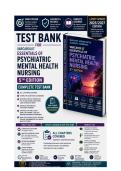
,Varcarolis' Essentials of Psychiatric Mental Health Nursing, 5th Edition – Complete Test Bank
Overview
The 5th Edition (authored by Chyllia D. Fosbre) includes updated content aligned with the DSM-5-TR,
expanded coverage of trauma-informed care, recovery-oriented practice, cultural competence,
and evidence-based psychopharmacology.
Chapter Structure (Per Chapter)
Section Question Type Quantity
Section A Multiple-Choice Questions 35
Section B True/False Questions 25
Section C Case-Based/Application Questions 20
Total 80
Chapter 1: The Science of Psychiatric-Mental Health Nursing
Section A: Multiple-Choice Questions (Questions 1–35)
Question 1
A nursing student asks the instructor, "What is the most important distinction between psychiatric
nursing and other nursing specialties?" The instructor's best response is:
A) "Psychiatric nursing focuses primarily on medication administration."
B) "Psychiatric nursing emphasizes the therapeutic use of self as the core intervention."
C) "Psychiatric nursing is primarily concerned with physical assessment."
D) "Psychiatric nursing is the same as general nursing with a focus on mental health."
Answer: B
Rationale: The therapeutic use of self is the foundation of psychiatric-mental health nursing and
distinguishes it from other specialties. While medication administration (A), physical assessment (C), and
general nursing skills (D) are important, the therapeutic relationship and use of self are central to
psychiatric nursing practice. The 5th edition emphasizes the nurse-client relationship as the therapeutic
tool that facilitates healing and recovery .
,Question 2
A newly licensed nurse is orienting to a psychiatric unit. The nurse asks, "How do I know if I am using
myself therapeutically?" The preceptor's best response is:
A) "You are using yourself therapeutically when you share your personal experiences with the patient."
B) "You are using yourself therapeutically when you establish a professional boundary and maintain
focus on the patient's needs."
C) "You are using yourself therapeutically when you become friends with the patient."
D) "You are using yourself therapeutically when you give advice to the patient."
Answer: B
Rationale: The therapeutic use of self involves establishing a professional, therapeutic relationship
focused on the patient's needs while maintaining appropriate boundaries. Sharing personal experiences
(A) is self-disclosure and should be used sparingly. Becoming friends (C) blurs professional boundaries.
Giving advice (D) is not therapeutic; the goal is to facilitate the patient's own problem-solving. The 5th
edition emphasizes that the therapeutic use of self is intentional and patient-centered .
Question 3
A nurse is caring for a patient who is angry and yelling. The nurse responds in a calm, low tone and says,
"I can see you are very upset. I'm here to listen when you're ready to talk." This is an example of:
A) Emotional regulation of the nurse
B) Countertransference
C) Therapeutic use of self
D) Boundary violation
Answer: C
Rationale: The nurse is demonstrating therapeutic use of self by maintaining composure, validating the
patient's emotions, and offering support. This approach de-escalates anger and models emotional
regulation. Emotional regulation of the nurse (A) is a component but not the best description.
Countertransference (B) is the nurse's emotional reaction to the patient based on personal history.
Boundary violation (D) occurs when professional boundaries are crossed. The 5th edition emphasizes
self-awareness and self-regulation as core therapeutic skills .
Question 4
A nurse is providing education about evidence-based practice (EBP) in psychiatric nursing. Which
statement accurately describes EBP?
A) "EBP is based solely on the nurse's clinical experience."
B) "EBP integrates the best research evidence with clinical expertise and patient preferences."
C) "EBP is the same as following hospital protocols."
D) "EBP relies exclusively on randomized controlled trials."
Answer: B
Rationale: Evidence-based practice integrates the best available research evidence, clinical expertise,
, and patient values and preferences. It is not based solely on experience (A), is not the same as protocols
(C), and does not rely exclusively on RCTs (D). The 5th edition emphasizes EBP as a cornerstone of
psychiatric nursing, ensuring that interventions are effective, current, and patient-centered .
Question 5
A nurse is implementing a new evidence-based intervention for patients with depression. The first step
in the EBP process is:
A) Appraising the evidence for quality
B) Asking a clinical question
C) Implementing the intervention
D) Evaluating outcomes
Answer: B
Rationale: The EBP process begins with asking a clinical question (PICO format). Appraising evidence (A)
is the second step. Implementation (C) and evaluation (D) occur later in the process. The 5th edition
outlines the EBP process as a systematic approach to improving patient outcomes .
Question 6
A nurse is caring for a patient who reports hearing voices. The nurse's priority assessment should be:
A) What the voices are saying and whether they are command hallucinations
B) Whether the patient has insight into the hallucinations
C) Whether the patient is taking prescribed medications
D) Whether the patient has a history of psychosis
Answer: A
Rationale: The priority assessment for a patient with auditory hallucinations is to determine the content,
frequency, and intensity of the voices, especially whether they are command hallucinations instructing
self-harm or harm to others. Safety is the priority. Insight (B), medication adherence (C), and history (D)
are important but secondary to safety assessment. The 5th edition prioritizes safety as the primary
nursing concern .
Question 7
A nurse is conducting a culturally responsive mental health assessment. Which approach best
demonstrates cultural humility?
A) Using a standardized assessment tool for all patients
B) Asking open-ended questions about the patient's cultural beliefs and health practices
C) Avoiding discussion of cultural factors to prevent stereotyping
D) Assuming the patient's cultural background based on their appearance
Answer: B
Rationale: Cultural humility involves self-reflection and asking open-ended questions to understand the
patient's cultural beliefs, values, and practices without making assumptions. Standardized tools (A) may
Overview
The 5th Edition (authored by Chyllia D. Fosbre) includes updated content aligned with the DSM-5-TR,
expanded coverage of trauma-informed care, recovery-oriented practice, cultural competence,
and evidence-based psychopharmacology.
Chapter Structure (Per Chapter)
Section Question Type Quantity
Section A Multiple-Choice Questions 35
Section B True/False Questions 25
Section C Case-Based/Application Questions 20
Total 80
Chapter 1: The Science of Psychiatric-Mental Health Nursing
Section A: Multiple-Choice Questions (Questions 1–35)
Question 1
A nursing student asks the instructor, "What is the most important distinction between psychiatric
nursing and other nursing specialties?" The instructor's best response is:
A) "Psychiatric nursing focuses primarily on medication administration."
B) "Psychiatric nursing emphasizes the therapeutic use of self as the core intervention."
C) "Psychiatric nursing is primarily concerned with physical assessment."
D) "Psychiatric nursing is the same as general nursing with a focus on mental health."
Answer: B
Rationale: The therapeutic use of self is the foundation of psychiatric-mental health nursing and
distinguishes it from other specialties. While medication administration (A), physical assessment (C), and
general nursing skills (D) are important, the therapeutic relationship and use of self are central to
psychiatric nursing practice. The 5th edition emphasizes the nurse-client relationship as the therapeutic
tool that facilitates healing and recovery .
,Question 2
A newly licensed nurse is orienting to a psychiatric unit. The nurse asks, "How do I know if I am using
myself therapeutically?" The preceptor's best response is:
A) "You are using yourself therapeutically when you share your personal experiences with the patient."
B) "You are using yourself therapeutically when you establish a professional boundary and maintain
focus on the patient's needs."
C) "You are using yourself therapeutically when you become friends with the patient."
D) "You are using yourself therapeutically when you give advice to the patient."
Answer: B
Rationale: The therapeutic use of self involves establishing a professional, therapeutic relationship
focused on the patient's needs while maintaining appropriate boundaries. Sharing personal experiences
(A) is self-disclosure and should be used sparingly. Becoming friends (C) blurs professional boundaries.
Giving advice (D) is not therapeutic; the goal is to facilitate the patient's own problem-solving. The 5th
edition emphasizes that the therapeutic use of self is intentional and patient-centered .
Question 3
A nurse is caring for a patient who is angry and yelling. The nurse responds in a calm, low tone and says,
"I can see you are very upset. I'm here to listen when you're ready to talk." This is an example of:
A) Emotional regulation of the nurse
B) Countertransference
C) Therapeutic use of self
D) Boundary violation
Answer: C
Rationale: The nurse is demonstrating therapeutic use of self by maintaining composure, validating the
patient's emotions, and offering support. This approach de-escalates anger and models emotional
regulation. Emotional regulation of the nurse (A) is a component but not the best description.
Countertransference (B) is the nurse's emotional reaction to the patient based on personal history.
Boundary violation (D) occurs when professional boundaries are crossed. The 5th edition emphasizes
self-awareness and self-regulation as core therapeutic skills .
Question 4
A nurse is providing education about evidence-based practice (EBP) in psychiatric nursing. Which
statement accurately describes EBP?
A) "EBP is based solely on the nurse's clinical experience."
B) "EBP integrates the best research evidence with clinical expertise and patient preferences."
C) "EBP is the same as following hospital protocols."
D) "EBP relies exclusively on randomized controlled trials."
Answer: B
Rationale: Evidence-based practice integrates the best available research evidence, clinical expertise,
, and patient values and preferences. It is not based solely on experience (A), is not the same as protocols
(C), and does not rely exclusively on RCTs (D). The 5th edition emphasizes EBP as a cornerstone of
psychiatric nursing, ensuring that interventions are effective, current, and patient-centered .
Question 5
A nurse is implementing a new evidence-based intervention for patients with depression. The first step
in the EBP process is:
A) Appraising the evidence for quality
B) Asking a clinical question
C) Implementing the intervention
D) Evaluating outcomes
Answer: B
Rationale: The EBP process begins with asking a clinical question (PICO format). Appraising evidence (A)
is the second step. Implementation (C) and evaluation (D) occur later in the process. The 5th edition
outlines the EBP process as a systematic approach to improving patient outcomes .
Question 6
A nurse is caring for a patient who reports hearing voices. The nurse's priority assessment should be:
A) What the voices are saying and whether they are command hallucinations
B) Whether the patient has insight into the hallucinations
C) Whether the patient is taking prescribed medications
D) Whether the patient has a history of psychosis
Answer: A
Rationale: The priority assessment for a patient with auditory hallucinations is to determine the content,
frequency, and intensity of the voices, especially whether they are command hallucinations instructing
self-harm or harm to others. Safety is the priority. Insight (B), medication adherence (C), and history (D)
are important but secondary to safety assessment. The 5th edition prioritizes safety as the primary
nursing concern .
Question 7
A nurse is conducting a culturally responsive mental health assessment. Which approach best
demonstrates cultural humility?
A) Using a standardized assessment tool for all patients
B) Asking open-ended questions about the patient's cultural beliefs and health practices
C) Avoiding discussion of cultural factors to prevent stereotyping
D) Assuming the patient's cultural background based on their appearance
Answer: B
Rationale: Cultural humility involves self-reflection and asking open-ended questions to understand the
patient's cultural beliefs, values, and practices without making assumptions. Standardized tools (A) may


