

EDEXCEL AS LEVEL MATHEMATICS PAPER 1: PURE
MATHEMATICS COMPLETE COMPREHENSIVE
ACTUAL FINAL PRACTICE EXAM PREP WITH REAL
WELL ELABORATED AND MOST TESTED
EVALUATION 100 PRACTICE QUESTIONS AND 100%
CORRECT VERIFIED ANSWERS FULLY SOLVED
(BASED ON OFFICIAL IDOI OUTLINE) WITH
ACCURATE RELIABLE RATIONALES PLUS
APPROVED ANSWER KEY (100% COMPLETE
SOLUTIONS) LATEST UPDATED VERSION 2026-2027
Q&A 93% SCORE AND ABOVE INSTANT DOWNLOAD
PDF
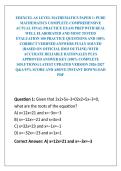
Question 1: Given that 2x2+5x−3=02x2+5x−3=0,
what are the roots of the equation?
A) x=12x=21 and x=−3x=−3
B) x=−12x=−21 and x=3x=3
C) x=32x=23 and x=−1x=−1
D) x=−32x=−23 and x=1x=1
Correct Answer: A) x=12x=21 and x=−3x=−3
,Rationale:
Factorizing: 2x2+5x−3=(2x−1)(x+3)=02x2+5x−3=(2x
−1)(x+3)=0. Therefore x=12x=21 or x=−3x=−3.
Always verify by substituting back into the original
equation.
Question 2: What is the discriminant of the
quadratic equation 3x2−6x+2=03x2−6x+2=0?
A) 12
B) 60
C) -12
D) 36
Correct Answer: A) 12
Rationale:
Discriminant =b2−4ac=(−6)2−4(3)(2)=36−24=12=b2
−4ac=(−6)2−4(3)(2)=36−24=12. Since the
discriminant is positive and not a perfect square,
there are two distinct irrational roots.
,Question 3: Which of the following is the inverse
function of f(x)=2x+3f(x)=2x+3?
A) f−1(x)=x−32f−1(x)=2x−3
B) f−1(x)=x+32f−1(x)=2x+3
C) f−1(x)=2x−3f−1(x)=2x−3
D) f−1(x)=x2−3f−1(x)=2x−3
Correct Answer: A) f−1(x)=x−32f−1(x)=2x−3
Rationale: To find the inverse,
replace f(x)f(x) with yy: y=2x+3y=2x+3.
Swap xx and yy: x=2y+3x=2y+3. Solve
for yy: y=x−32y=2x−3.
Therefore, f−1(x)=x−32f−1(x)=2x−3.
Question 4: A circle has
equation x2+y2−6x+4y−12=0x2+y2−6x+4y−12=0.
What is the radius of the circle?
A) 3
B) 5
, C) 7
D) 9
Correct Answer: B) 5
Rationale: Complete the
square: (x−3)2+(y+2)2=12+9+4=25(x−3)2+(y+2)2=12
+9+4=25. The equation is in the
form (x−a)2+(y−b)2=r2(x−a)2+(y−b)2=r2.
Therefore, r2=25r2=25, so r=5r=5.
Question 5: Which of the following is a valid proof
by contradiction for the statement "There is no
smallest positive rational number"?
A) Assume there is a smallest positive rational, then
show that half of it is a smaller positive rational.
B) Assume there is no smallest positive rational,
then show this leads to a contradiction.
C) Directly show that 0 is the smallest positive
rational.
MATHEMATICS COMPLETE COMPREHENSIVE
ACTUAL FINAL PRACTICE EXAM PREP WITH REAL
WELL ELABORATED AND MOST TESTED
EVALUATION 100 PRACTICE QUESTIONS AND 100%
CORRECT VERIFIED ANSWERS FULLY SOLVED
(BASED ON OFFICIAL IDOI OUTLINE) WITH
ACCURATE RELIABLE RATIONALES PLUS
APPROVED ANSWER KEY (100% COMPLETE
SOLUTIONS) LATEST UPDATED VERSION 2026-2027
Q&A 93% SCORE AND ABOVE INSTANT DOWNLOAD
Question 1: Given that 2x2+5x−3=02x2+5x−3=0,
what are the roots of the equation?
A) x=12x=21 and x=−3x=−3
B) x=−12x=−21 and x=3x=3
C) x=32x=23 and x=−1x=−1
D) x=−32x=−23 and x=1x=1
Correct Answer: A) x=12x=21 and x=−3x=−3
,Rationale:
Factorizing: 2x2+5x−3=(2x−1)(x+3)=02x2+5x−3=(2x
−1)(x+3)=0. Therefore x=12x=21 or x=−3x=−3.
Always verify by substituting back into the original
equation.
Question 2: What is the discriminant of the
quadratic equation 3x2−6x+2=03x2−6x+2=0?
A) 12
B) 60
C) -12
D) 36
Correct Answer: A) 12
Rationale:
Discriminant =b2−4ac=(−6)2−4(3)(2)=36−24=12=b2
−4ac=(−6)2−4(3)(2)=36−24=12. Since the
discriminant is positive and not a perfect square,
there are two distinct irrational roots.
,Question 3: Which of the following is the inverse
function of f(x)=2x+3f(x)=2x+3?
A) f−1(x)=x−32f−1(x)=2x−3
B) f−1(x)=x+32f−1(x)=2x+3
C) f−1(x)=2x−3f−1(x)=2x−3
D) f−1(x)=x2−3f−1(x)=2x−3
Correct Answer: A) f−1(x)=x−32f−1(x)=2x−3
Rationale: To find the inverse,
replace f(x)f(x) with yy: y=2x+3y=2x+3.
Swap xx and yy: x=2y+3x=2y+3. Solve
for yy: y=x−32y=2x−3.
Therefore, f−1(x)=x−32f−1(x)=2x−3.
Question 4: A circle has
equation x2+y2−6x+4y−12=0x2+y2−6x+4y−12=0.
What is the radius of the circle?
A) 3
B) 5
, C) 7
D) 9
Correct Answer: B) 5
Rationale: Complete the
square: (x−3)2+(y+2)2=12+9+4=25(x−3)2+(y+2)2=12
+9+4=25. The equation is in the
form (x−a)2+(y−b)2=r2(x−a)2+(y−b)2=r2.
Therefore, r2=25r2=25, so r=5r=5.
Question 5: Which of the following is a valid proof
by contradiction for the statement "There is no
smallest positive rational number"?
A) Assume there is a smallest positive rational, then
show that half of it is a smaller positive rational.
B) Assume there is no smallest positive rational,
then show this leads to a contradiction.
C) Directly show that 0 is the smallest positive
rational.


