

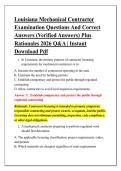
Louisiana Mechanical Contractor
Examination Questions And Correct
Answers (Verified Answers) Plus
Rationales 2026 Q&A | Instant
Download Pdf
1. In Louisiana, the primary purpose of contractor licensing
requirements for mechanical contractors is to:
A. Increase the number of contractors operating in the state
B. Eliminate the need for building permits
C. Establish competency and protect the public through regulated
contracting
D. Allow contractors to avoid local inspection requirements
Answer: C. Establish competency and protect the public through
regulated contracting
Rationale: Contractor licensing is intended to promote competent,
responsible contracting and protect owners, occupants, and the public.
Licensing does not eliminate permitting, inspection, code compliance,
or other legal obligations.
2. A mechanical contractor preparing to perform regulated work
should first determine:
A. The applicable licensing classification, project requirements, codes,
and permits
B. Which materials are cheapest regardless of code requirements
,C. Whether inspections can be skipped
D. Whether the owner will accept unlicensed subcontractors
Answer: A. The applicable licensing classification, project
requirements, codes, and permits
Rationale: Proper planning begins with identifying the scope of work
and determining the licensing, permitting, code, inspection, and
contractual requirements that apply. Ignoring these requirements can
result in violations, delays, corrective work, or penalties.
3. Which document most directly communicates the technical
requirements for mechanical work on a construction project?
A. Payroll register
B. Project specifications and drawings
C. Employee handbook
D. Insurance advertisement
Answer: B. Project specifications and drawings
Rationale: Mechanical drawings and specifications communicate
system layouts, equipment requirements, materials, performance
criteria, installation details, and other project requirements. A
contractor must review these documents together with applicable codes
and manufacturer instructions.
4. When interpreting mechanical plans, a contractor should generally
begin by reviewing:
A. Only the equipment manufacturer's warranty
B. Only the architectural elevations
C. The project's financial records
D. The drawings, schedules, specifications, legends, and applicable
details as a coordinated set
,Answer: D. The drawings, schedules, specifications, legends, and
applicable details as a coordinated set
Rationale: Mechanical work frequently depends on information
distributed across several documents. Coordinating plans, schedules,
details, specifications, architectural information, and structural
requirements helps identify conflicts before installation begins.
5. Which measurement is commonly used to express the cooling
capacity of air-conditioning equipment?
A. BTU per hour
B. Ohms per foot
C. Gallons per minute
D. Pounds per square inch
Answer: A. BTU per hour
Rationale: Air-conditioning capacity is commonly expressed in British
thermal units per hour (Btu/h). A nominal cooling ton is traditionally
associated with approximately 12,000 Btu/h of cooling capacity.
6. A ton of refrigeration is approximately equivalent to:
A. 1,000 Btu/h
B. 6,000 Btu/h
C. 12,000 Btu/h
D. 36,000 Btu/h
Answer: C. 12,000 Btu/h
Rationale: One refrigeration ton is conventionally equal to 12,000
Btu/h. This relationship is frequently used when estimating air-
conditioning capacity and comparing equipment ratings.
, 7. The primary function of a thermostat in a typical comfort-cooling
system is to:
A. Compress refrigerant
B. Sense space conditions and control system operation
C. Filter combustion gases
D. Increase refrigerant pressure mechanically
Answer: B. Sense space conditions and control system operation
Rationale: A thermostat monitors a condition such as room
temperature and sends a control signal to operate heating, cooling, or
fan equipment according to the selected setpoint and control sequence.
8. Which component of a vapor-compression refrigeration system
removes heat from the conditioned space?
A. Condenser
B. Receiver
C. Compressor
D. Evaporator
Answer: D. Evaporator
Rationale: The evaporator absorbs heat from the space, air, water, or
other medium being cooled as refrigerant evaporates. The condenser
subsequently rejects that absorbed heat to another medium, commonly
outdoor air.
9. The principal function of a refrigeration compressor is to:
A. Raise the pressure and temperature of refrigerant vapor
B. Remove moisture from the building structure
C. Reduce condenser airflow
D. Store liquid refrigerant permanently
Examination Questions And Correct
Answers (Verified Answers) Plus
Rationales 2026 Q&A | Instant
Download Pdf
1. In Louisiana, the primary purpose of contractor licensing
requirements for mechanical contractors is to:
A. Increase the number of contractors operating in the state
B. Eliminate the need for building permits
C. Establish competency and protect the public through regulated
contracting
D. Allow contractors to avoid local inspection requirements
Answer: C. Establish competency and protect the public through
regulated contracting
Rationale: Contractor licensing is intended to promote competent,
responsible contracting and protect owners, occupants, and the public.
Licensing does not eliminate permitting, inspection, code compliance,
or other legal obligations.
2. A mechanical contractor preparing to perform regulated work
should first determine:
A. The applicable licensing classification, project requirements, codes,
and permits
B. Which materials are cheapest regardless of code requirements
,C. Whether inspections can be skipped
D. Whether the owner will accept unlicensed subcontractors
Answer: A. The applicable licensing classification, project
requirements, codes, and permits
Rationale: Proper planning begins with identifying the scope of work
and determining the licensing, permitting, code, inspection, and
contractual requirements that apply. Ignoring these requirements can
result in violations, delays, corrective work, or penalties.
3. Which document most directly communicates the technical
requirements for mechanical work on a construction project?
A. Payroll register
B. Project specifications and drawings
C. Employee handbook
D. Insurance advertisement
Answer: B. Project specifications and drawings
Rationale: Mechanical drawings and specifications communicate
system layouts, equipment requirements, materials, performance
criteria, installation details, and other project requirements. A
contractor must review these documents together with applicable codes
and manufacturer instructions.
4. When interpreting mechanical plans, a contractor should generally
begin by reviewing:
A. Only the equipment manufacturer's warranty
B. Only the architectural elevations
C. The project's financial records
D. The drawings, schedules, specifications, legends, and applicable
details as a coordinated set
,Answer: D. The drawings, schedules, specifications, legends, and
applicable details as a coordinated set
Rationale: Mechanical work frequently depends on information
distributed across several documents. Coordinating plans, schedules,
details, specifications, architectural information, and structural
requirements helps identify conflicts before installation begins.
5. Which measurement is commonly used to express the cooling
capacity of air-conditioning equipment?
A. BTU per hour
B. Ohms per foot
C. Gallons per minute
D. Pounds per square inch
Answer: A. BTU per hour
Rationale: Air-conditioning capacity is commonly expressed in British
thermal units per hour (Btu/h). A nominal cooling ton is traditionally
associated with approximately 12,000 Btu/h of cooling capacity.
6. A ton of refrigeration is approximately equivalent to:
A. 1,000 Btu/h
B. 6,000 Btu/h
C. 12,000 Btu/h
D. 36,000 Btu/h
Answer: C. 12,000 Btu/h
Rationale: One refrigeration ton is conventionally equal to 12,000
Btu/h. This relationship is frequently used when estimating air-
conditioning capacity and comparing equipment ratings.
, 7. The primary function of a thermostat in a typical comfort-cooling
system is to:
A. Compress refrigerant
B. Sense space conditions and control system operation
C. Filter combustion gases
D. Increase refrigerant pressure mechanically
Answer: B. Sense space conditions and control system operation
Rationale: A thermostat monitors a condition such as room
temperature and sends a control signal to operate heating, cooling, or
fan equipment according to the selected setpoint and control sequence.
8. Which component of a vapor-compression refrigeration system
removes heat from the conditioned space?
A. Condenser
B. Receiver
C. Compressor
D. Evaporator
Answer: D. Evaporator
Rationale: The evaporator absorbs heat from the space, air, water, or
other medium being cooled as refrigerant evaporates. The condenser
subsequently rejects that absorbed heat to another medium, commonly
outdoor air.
9. The principal function of a refrigeration compressor is to:
A. Raise the pressure and temperature of refrigerant vapor
B. Remove moisture from the building structure
C. Reduce condenser airflow
D. Store liquid refrigerant permanently


