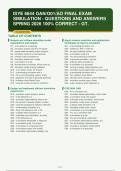
ISYE 6644 OAN/O01/AO FINAL EXAM
SIMULATION - QUESTIONS AND ANSWERS
SPRING 2026 100% CORRECT - GT.
150 QUESTIONS
TABLE OF CONTENTS
Analyze and critique simulation model Apply variance reduction and optimization
assumptions and outputs techniques to improve simulation
Q1 - a simulation of a queueing Q31 - a terminating simulation of a
Q2 - simulation analyst uses the chi-square Q32 - building an AR(1) model for
Q3 - steady-state simulation output analysis, ... Q33 - an input modeling context, you
Q4 - simulation model of a manufacturing Q34 - a simulation study of a
Q5 - a Monte Carlo simulation for Q35 - You are analyzing a simulation
Q6 - simulation model has a single Q36 - a queueing simulation, you are
Q7 - a simulation of a call Q37 - a Monte Carlo simulation to
Q8 - discrete-event simulation, which event-sc... Q38 - a simulation of a stochastic
Q9 - simulation model is being validated Q39 - running a steady-state simulation, you
Q10 - a simulation model, the analyst Q40 - simulation-based optimization, you are using
Q11 - a terminating simulation with a Q41 - a terminating simulation with a
Q12 - For a non-terminating system, which Q42 - For a Markov chain Monte
Q13 - goodness-of-fit test is generally preferred Q43 - discrete-event simulation, which method is
Q14 - a Markov chain Monte Carlo Q44 - simulation analyst uses a linear
Q15 - using the inverse-transform method to Q45 - output analysis, which approach is
Design and implement efficient simulation ISYE 6644 OAN
experiments Q46 - For a simulation of a
Q16 - simulation output analysis, what is Q47 - simulation-based optimization, which meth...
Q17 - of the following is a Q48 - a simulation study, the analyst
Q18 - simulation metamodeling, what is the Q49 - a discrete-event simulation, which event
Q19 - the context of pseudo-random number Q50 - simulation model uses a Poisson
Q20 - using the acceptance-rejection method to Q51 - a steady-state simulation of a
Q21 - a terminating simulation of a Q52 - simulation model uses a linear
Q22 - Given the sequence 0.42, 0.73, Q53 - a simulation of a manufacturing
Q23 - a steady-state simulation of a Q54 - You run a simulation with
Q24 - a discrete-event simulation, an entity Q55 - a simulation of a call
Q25 - of the following is a Q56 - You are simulating a stochastic
Q26 - a simulation metamodel, a response Q57 - a simulation optimization problem, you
Q27 - a simulation study, the analyst Q58 - You are building a discrete-event
Q28 - a simulation of a manufacturing Q59 - Consider a simulation model where
Q29 - a simulation project, the analyst Q60 - a simulation of a queueing
Q30 - a simulation optimization problem, the
Page 1
,AO Final Exam Simulation Applied Simulation and Stochastic Modeling
Q61 - a steady-state M/M/1 queue, the Q106 - Consider a simulation where the
Q62 - simulation analyst uses a linear Q107 - simulation output analysis uses the
Q63 - a discrete-event simulation of a Q108 - a simulation of a call
Q64 - simulation model of a hospital Q109 - of the following is a
Q65 - a simulation study, we have Q110 - a simulation optimization problem, the
Q66 - variance reduction technique is most Q111 - a terminating simulation of a
Q67 - a Markov chain Monte Carlo Q112 - a Markov chain Monte Carlo
Q68 - a simulation of a call Q113 - a simulation of a queueing
Q69 - a discrete-event simulation, which of Q114 - simulation analyst uses the chi-square
Q70 - simulation model uses an AR(1) Q115 - a simulation experiment, the analyst
Q71 - a terminating simulation of a Q116 - a simulation of a stochastic
Q72 - simulation model uses a multiplicative Q117 - a steady-state simulation, the method
Q73 - a discrete-event simulation of a Q118 - a simulation of a call
Q74 - fitting a Johnson distribution to Q119 - a simulation optimization problem, the
Q75 - a simulation of an inventory Q120 - a simulation of a supply
Questions and Answers spring 2026 100% Advanced Simulation and Stochastic
Correct Modeling
Q76 - a simulation experiment comparing two Q121 - a simulation study of a
Q77 - simulation output analysis, what is Q122 - of the following is a
Q78 - the context of random variate Q123 - input modeling, when fitting a
Q79 - a simulation study, the analyst Q124 - For a Markov chain with
Q80 - a Markov chain Monte Carlo Q125 - steady-state simulation output analysis, ...
Q81 - a terminating simulation with a Q126 - of the following is a
Q82 - For an M/M/1 queue with Q127 - simulation metamodeling, which of the
Q83 - a simulation experiment, you collect Q128 - a Markov chain Monte Carlo
Q84 - simulation uses a linear congruential Q129 - of the following is the
Q85 - a simulation of a production Q130 - a simulation of a production
Q86 - variance reduction technique is most Q131 - a terminating simulation of a
Q87 - a simulation, you need to Q132 - For a Markov chain with
Q88 - discrete-event simulation, which event-sc... Q133 - a discrete-event simulation of a
Q89 - statistical test is most appropriate Q134 - fitting a normal distribution to
Q90 - a simulation optimization problem, you Q135 - a simulation optimization problem with
Foundations of Simulation and Stochastic Simulation and Stochastic Modeling Review
Modeling Q136 - technique is most appropriate for
Q91 - a simulation of a queueing Q137 - a two-stage stochastic program with
Q92 - For a simulation output analysis, Q138 - steady-state simulation output analysis, ...
Q93 - a stochastic activity network, you Q139 - a simulation metamodel, which approach
Q94 - of the following is the Q140 - a simulation model of a
Q95 - a simulation of an M/M/1 Q141 - a regenerative simulation of an
Q96 - a simulation of a call Q142 - a stochastic activity network, the
Q97 - variance reduction technique is most Q143 - a simulation study of a
Q98 - a simulation study, you need Q144 - a discrete-event simulation of a
Q99 - a simulation of a supply Q145 - a simulation of a production
Q100 - a simulation of a manufacturing Q146 - a Monte Carlo simulation for
Q101 - simulation analyst uses antithetic variates Q147 - a simulation of a queueing
Q102 - a simulation, interarrival times are Q148 - a discrete-event simulation, you are
Q103 - For a terminating simulation, which Q149 - a simulation of a stochastic
Q104 - simulation model uses a linear Q150 - a simulation experiment, you are
Q105 - building a simulation model of
Page 2
,Q1 ANALYZE AND CRITIQUE SIMULATION MODEL ASSUMPTIONS AND OUTPUTS
In a simulation of a queueing system, the random number stream for service times
is found to be correlated with the stream for interarrival times, leading to biased
results. Which technique would best mitigate this issue while preserving the
ability to compare alternative system configurations?
A. Use a single common random number stream for both interarrival and service times to ensure
consistency.
B. Use antithetic variates for interarrival times and common random numbers for service times.
C. Assign distinct, independent random number streams to interarrival and service times, and
use common random numbers across configurations. CORRECT
D. Increase the number of replications and use the same seed for all runs.
RATIONALE: Assigning independent streams eliminates unwanted correlation, while common
random numbers across configurations reduce variance when comparing alternatives. Antithetic
variates are for within-run variance reduction, not for ensuring independence between different
processes. Using the same seed for all runs would still induce correlation.
Q2 ANALYZE AND CRITIQUE SIMULATION MODEL ASSUMPTIONS AND OUTPUTS
A simulation analyst uses the chi-square goodness-of-fit test to evaluate whether
observed data follow an exponential distribution. The test statistic is 12.3 with 5
degrees of freedom at a 5% significance level. What is the correct interpretation?
A. Reject the null hypothesis; the data do not follow an exponential distribution. CORRECT
B. Fail to reject the null hypothesis; the data are consistent with an exponential distribution.
C. The test is inconclusive because the sample size is not provided.
D. Reject the null hypothesis because the p-value is less than 0.05.
RATIONALE: The critical value for chi-square with 5 df at =0.05 is 11.07. Since 12.3 > 11.07, we
reject the null hypothesis that the data follow the exponential distribution. The p-value is less than
0.05, so option D is true but incomplete; option A is the correct statistical conclusion.
Page 3
, Q3 ANALYZE AND CRITIQUE SIMULATION MODEL ASSUMPTIONS AND OUTPUTS
In steady-state simulation output analysis, which method is most appropriate for
constructing a confidence interval when the initial transient bias is significant and
the simulation run is long?
A. Independent replications with a fixed run length and a warm-up period.
B. Batch means with a large number of batches and no deletion of initial data.
C. Replication-deletion with a warm-up period estimated by Welch's method. CORRECT
D. Regenerative method, provided regeneration points are easily identified.
RATIONALE: Replication-deletion with a warm-up period (e.g., using Welch's method) is
designed to handle initial transient bias, providing unbiased estimates. Batch means without
deletion can be biased. Independent replications without deletion also suffer from bias. The
regenerative method is powerful but requires clear regeneration points, which may not exist for
all systems.
Q4 ANALYZE AND CRITIQUE SIMULATION MODEL ASSUMPTIONS AND OUTPUTS
A simulation model of a manufacturing line uses a triangular distribution for
processing times with parameters (2, 5, 9). The analyst wants to reduce variance in
the estimate of mean throughput. Which variance reduction technique is most
directly applicable given the distribution's known inverse CDF?
A. Common random numbers
B. Antithetic variates CORRECT
C. Control variates
D. Importance sampling
RATIONALE: Antithetic variates use the inverse CDF to generate pairs of negatively correlated
samples (e.g., using U and 1-U), which is straightforward for a triangular distribution with
closed-form inverse CDF. Common random numbers are for comparing alternatives, not reducing
variance in a single estimate. Control variates require a correlated variable with known mean.
Importance sampling is for rare-event simulation.
Page 4
SIMULATION - QUESTIONS AND ANSWERS
SPRING 2026 100% CORRECT - GT.
150 QUESTIONS
TABLE OF CONTENTS
Analyze and critique simulation model Apply variance reduction and optimization
assumptions and outputs techniques to improve simulation
Q1 - a simulation of a queueing Q31 - a terminating simulation of a
Q2 - simulation analyst uses the chi-square Q32 - building an AR(1) model for
Q3 - steady-state simulation output analysis, ... Q33 - an input modeling context, you
Q4 - simulation model of a manufacturing Q34 - a simulation study of a
Q5 - a Monte Carlo simulation for Q35 - You are analyzing a simulation
Q6 - simulation model has a single Q36 - a queueing simulation, you are
Q7 - a simulation of a call Q37 - a Monte Carlo simulation to
Q8 - discrete-event simulation, which event-sc... Q38 - a simulation of a stochastic
Q9 - simulation model is being validated Q39 - running a steady-state simulation, you
Q10 - a simulation model, the analyst Q40 - simulation-based optimization, you are using
Q11 - a terminating simulation with a Q41 - a terminating simulation with a
Q12 - For a non-terminating system, which Q42 - For a Markov chain Monte
Q13 - goodness-of-fit test is generally preferred Q43 - discrete-event simulation, which method is
Q14 - a Markov chain Monte Carlo Q44 - simulation analyst uses a linear
Q15 - using the inverse-transform method to Q45 - output analysis, which approach is
Design and implement efficient simulation ISYE 6644 OAN
experiments Q46 - For a simulation of a
Q16 - simulation output analysis, what is Q47 - simulation-based optimization, which meth...
Q17 - of the following is a Q48 - a simulation study, the analyst
Q18 - simulation metamodeling, what is the Q49 - a discrete-event simulation, which event
Q19 - the context of pseudo-random number Q50 - simulation model uses a Poisson
Q20 - using the acceptance-rejection method to Q51 - a steady-state simulation of a
Q21 - a terminating simulation of a Q52 - simulation model uses a linear
Q22 - Given the sequence 0.42, 0.73, Q53 - a simulation of a manufacturing
Q23 - a steady-state simulation of a Q54 - You run a simulation with
Q24 - a discrete-event simulation, an entity Q55 - a simulation of a call
Q25 - of the following is a Q56 - You are simulating a stochastic
Q26 - a simulation metamodel, a response Q57 - a simulation optimization problem, you
Q27 - a simulation study, the analyst Q58 - You are building a discrete-event
Q28 - a simulation of a manufacturing Q59 - Consider a simulation model where
Q29 - a simulation project, the analyst Q60 - a simulation of a queueing
Q30 - a simulation optimization problem, the
Page 1
,AO Final Exam Simulation Applied Simulation and Stochastic Modeling
Q61 - a steady-state M/M/1 queue, the Q106 - Consider a simulation where the
Q62 - simulation analyst uses a linear Q107 - simulation output analysis uses the
Q63 - a discrete-event simulation of a Q108 - a simulation of a call
Q64 - simulation model of a hospital Q109 - of the following is a
Q65 - a simulation study, we have Q110 - a simulation optimization problem, the
Q66 - variance reduction technique is most Q111 - a terminating simulation of a
Q67 - a Markov chain Monte Carlo Q112 - a Markov chain Monte Carlo
Q68 - a simulation of a call Q113 - a simulation of a queueing
Q69 - a discrete-event simulation, which of Q114 - simulation analyst uses the chi-square
Q70 - simulation model uses an AR(1) Q115 - a simulation experiment, the analyst
Q71 - a terminating simulation of a Q116 - a simulation of a stochastic
Q72 - simulation model uses a multiplicative Q117 - a steady-state simulation, the method
Q73 - a discrete-event simulation of a Q118 - a simulation of a call
Q74 - fitting a Johnson distribution to Q119 - a simulation optimization problem, the
Q75 - a simulation of an inventory Q120 - a simulation of a supply
Questions and Answers spring 2026 100% Advanced Simulation and Stochastic
Correct Modeling
Q76 - a simulation experiment comparing two Q121 - a simulation study of a
Q77 - simulation output analysis, what is Q122 - of the following is a
Q78 - the context of random variate Q123 - input modeling, when fitting a
Q79 - a simulation study, the analyst Q124 - For a Markov chain with
Q80 - a Markov chain Monte Carlo Q125 - steady-state simulation output analysis, ...
Q81 - a terminating simulation with a Q126 - of the following is a
Q82 - For an M/M/1 queue with Q127 - simulation metamodeling, which of the
Q83 - a simulation experiment, you collect Q128 - a Markov chain Monte Carlo
Q84 - simulation uses a linear congruential Q129 - of the following is the
Q85 - a simulation of a production Q130 - a simulation of a production
Q86 - variance reduction technique is most Q131 - a terminating simulation of a
Q87 - a simulation, you need to Q132 - For a Markov chain with
Q88 - discrete-event simulation, which event-sc... Q133 - a discrete-event simulation of a
Q89 - statistical test is most appropriate Q134 - fitting a normal distribution to
Q90 - a simulation optimization problem, you Q135 - a simulation optimization problem with
Foundations of Simulation and Stochastic Simulation and Stochastic Modeling Review
Modeling Q136 - technique is most appropriate for
Q91 - a simulation of a queueing Q137 - a two-stage stochastic program with
Q92 - For a simulation output analysis, Q138 - steady-state simulation output analysis, ...
Q93 - a stochastic activity network, you Q139 - a simulation metamodel, which approach
Q94 - of the following is the Q140 - a simulation model of a
Q95 - a simulation of an M/M/1 Q141 - a regenerative simulation of an
Q96 - a simulation of a call Q142 - a stochastic activity network, the
Q97 - variance reduction technique is most Q143 - a simulation study of a
Q98 - a simulation study, you need Q144 - a discrete-event simulation of a
Q99 - a simulation of a supply Q145 - a simulation of a production
Q100 - a simulation of a manufacturing Q146 - a Monte Carlo simulation for
Q101 - simulation analyst uses antithetic variates Q147 - a simulation of a queueing
Q102 - a simulation, interarrival times are Q148 - a discrete-event simulation, you are
Q103 - For a terminating simulation, which Q149 - a simulation of a stochastic
Q104 - simulation model uses a linear Q150 - a simulation experiment, you are
Q105 - building a simulation model of
Page 2
,Q1 ANALYZE AND CRITIQUE SIMULATION MODEL ASSUMPTIONS AND OUTPUTS
In a simulation of a queueing system, the random number stream for service times
is found to be correlated with the stream for interarrival times, leading to biased
results. Which technique would best mitigate this issue while preserving the
ability to compare alternative system configurations?
A. Use a single common random number stream for both interarrival and service times to ensure
consistency.
B. Use antithetic variates for interarrival times and common random numbers for service times.
C. Assign distinct, independent random number streams to interarrival and service times, and
use common random numbers across configurations. CORRECT
D. Increase the number of replications and use the same seed for all runs.
RATIONALE: Assigning independent streams eliminates unwanted correlation, while common
random numbers across configurations reduce variance when comparing alternatives. Antithetic
variates are for within-run variance reduction, not for ensuring independence between different
processes. Using the same seed for all runs would still induce correlation.
Q2 ANALYZE AND CRITIQUE SIMULATION MODEL ASSUMPTIONS AND OUTPUTS
A simulation analyst uses the chi-square goodness-of-fit test to evaluate whether
observed data follow an exponential distribution. The test statistic is 12.3 with 5
degrees of freedom at a 5% significance level. What is the correct interpretation?
A. Reject the null hypothesis; the data do not follow an exponential distribution. CORRECT
B. Fail to reject the null hypothesis; the data are consistent with an exponential distribution.
C. The test is inconclusive because the sample size is not provided.
D. Reject the null hypothesis because the p-value is less than 0.05.
RATIONALE: The critical value for chi-square with 5 df at =0.05 is 11.07. Since 12.3 > 11.07, we
reject the null hypothesis that the data follow the exponential distribution. The p-value is less than
0.05, so option D is true but incomplete; option A is the correct statistical conclusion.
Page 3
, Q3 ANALYZE AND CRITIQUE SIMULATION MODEL ASSUMPTIONS AND OUTPUTS
In steady-state simulation output analysis, which method is most appropriate for
constructing a confidence interval when the initial transient bias is significant and
the simulation run is long?
A. Independent replications with a fixed run length and a warm-up period.
B. Batch means with a large number of batches and no deletion of initial data.
C. Replication-deletion with a warm-up period estimated by Welch's method. CORRECT
D. Regenerative method, provided regeneration points are easily identified.
RATIONALE: Replication-deletion with a warm-up period (e.g., using Welch's method) is
designed to handle initial transient bias, providing unbiased estimates. Batch means without
deletion can be biased. Independent replications without deletion also suffer from bias. The
regenerative method is powerful but requires clear regeneration points, which may not exist for
all systems.
Q4 ANALYZE AND CRITIQUE SIMULATION MODEL ASSUMPTIONS AND OUTPUTS
A simulation model of a manufacturing line uses a triangular distribution for
processing times with parameters (2, 5, 9). The analyst wants to reduce variance in
the estimate of mean throughput. Which variance reduction technique is most
directly applicable given the distribution's known inverse CDF?
A. Common random numbers
B. Antithetic variates CORRECT
C. Control variates
D. Importance sampling
RATIONALE: Antithetic variates use the inverse CDF to generate pairs of negatively correlated
samples (e.g., using U and 1-U), which is straightforward for a triangular distribution with
closed-form inverse CDF. Common random numbers are for comparing alternatives, not reducing
variance in a single estimate. Control variates require a correlated variable with known mean.
Importance sampling is for rare-event simulation.
Page 4