

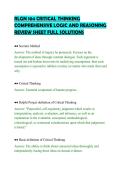
RLGN 104 CRITICAL THINKING
COMPREHENSIVE LOGIC AND REASONING
REVIEW SHEET FULL SOLUTIONS
●● Socratic Method
Answer: The method of inquiry he pioneered. Focuses on the
development of ideas through constant dialogue. Each argument is
teased out and broken down into its underlying assumptions, then each
assumption is exposed to ruthless scrutiny no matter who made them and
why.
●● Critical Thinking
Answer: Essential component of human progress.
●● Delphi Project definition of Critical Thinking
Answer: "Purposeful, self-regulatory judgment which results in
interpretation, analysis, evaluation, and inference, as well as an
explanation fo the evidential, conceptual, methodological,
criteriological, or contextual considerations upon which that judgement
is based."
●● Basic definition of Critical Thinking
Answer: The ability to think about connected ideas thoroughly and
independently, basing those ideas on factual evidence.
,●● How is Critical thinking done?
Answer: By gathering and categorizing evidence data relevant to their
problem to gain relevant knowledge. Connect an issue's disparate parts
into one workable framework. Then, divide the data into definitions and
categories. Make connections necessary to understand and define the
problem.
●● The process of critical thinking involves...
Answer: Perception, Assumptions, Emotions, Language, Arguments,
Fallacies, Logic, Problem Solving
●● Perception
Answer: Perceive the situation. How we filter objective reality through
our subjective value systems.
●● Assumptions
Answer: Unexamined beliefs taken for granted. Our plans and actions
are, usually unknowingly, built on assumptions.
●● Emotions
Answer: Integral part of the critical thinking process.
●● Language
,Answer: Words we use are the nuts and bolts of critical thinking. We can
turn our thoughts from vague concepts into firm ones by applying
precise language to the problem.
●● Arguments
Answer: Well-reasoned list of assumptions and premises.
●● Fallacies
Answer: Consistent human tendencies towards uncritical thinking.
●● Logic
Answer: Structured thinking, designed to evaluate information
accurately.
●● Problem solving
Answer: Finding a better way of approaching a problem or achieving a
goal means little unless you take steps to apply it practically.
●● Paul-Elder Framework
Answer: Remains the most advanced and widely recognized blueprint
for the critical thought and process.
3 sections: reasoning, intellectual standards, and intellectual traits.
, ●● Intellectual traits
Answer: Intellectual humility, courage, empathy, autonomy, integrity,
perserverance, confidence in reason, and fair-mindedness.
●● Intellectual standards
Answer: Clarity, accuracy, precision, relevance, depth, breadth, logic,
significance, and fairness.
●● Reasoning
Answer: Act of thinking an issue through, logically and clearly, while
drawing well-founded inferences and conclusions on the matter.
●● Paul-Elder framework (continued and elements)
Answer: Framework suggests we pay attention to specific thought
elements. By focusing on these elements, we can dig deeper and reach
reasonable and practical conclusions.
●● Purpose
Answer: All reasoning strives for something clear and specific.
●● Point of view
Answer: We derive many of our thought patterns from our culture,
biases, and self-interested viewpoints. Important part is to be aware of
our biases.
COMPREHENSIVE LOGIC AND REASONING
REVIEW SHEET FULL SOLUTIONS
●● Socratic Method
Answer: The method of inquiry he pioneered. Focuses on the
development of ideas through constant dialogue. Each argument is
teased out and broken down into its underlying assumptions, then each
assumption is exposed to ruthless scrutiny no matter who made them and
why.
●● Critical Thinking
Answer: Essential component of human progress.
●● Delphi Project definition of Critical Thinking
Answer: "Purposeful, self-regulatory judgment which results in
interpretation, analysis, evaluation, and inference, as well as an
explanation fo the evidential, conceptual, methodological,
criteriological, or contextual considerations upon which that judgement
is based."
●● Basic definition of Critical Thinking
Answer: The ability to think about connected ideas thoroughly and
independently, basing those ideas on factual evidence.
,●● How is Critical thinking done?
Answer: By gathering and categorizing evidence data relevant to their
problem to gain relevant knowledge. Connect an issue's disparate parts
into one workable framework. Then, divide the data into definitions and
categories. Make connections necessary to understand and define the
problem.
●● The process of critical thinking involves...
Answer: Perception, Assumptions, Emotions, Language, Arguments,
Fallacies, Logic, Problem Solving
●● Perception
Answer: Perceive the situation. How we filter objective reality through
our subjective value systems.
●● Assumptions
Answer: Unexamined beliefs taken for granted. Our plans and actions
are, usually unknowingly, built on assumptions.
●● Emotions
Answer: Integral part of the critical thinking process.
●● Language
,Answer: Words we use are the nuts and bolts of critical thinking. We can
turn our thoughts from vague concepts into firm ones by applying
precise language to the problem.
●● Arguments
Answer: Well-reasoned list of assumptions and premises.
●● Fallacies
Answer: Consistent human tendencies towards uncritical thinking.
●● Logic
Answer: Structured thinking, designed to evaluate information
accurately.
●● Problem solving
Answer: Finding a better way of approaching a problem or achieving a
goal means little unless you take steps to apply it practically.
●● Paul-Elder Framework
Answer: Remains the most advanced and widely recognized blueprint
for the critical thought and process.
3 sections: reasoning, intellectual standards, and intellectual traits.
, ●● Intellectual traits
Answer: Intellectual humility, courage, empathy, autonomy, integrity,
perserverance, confidence in reason, and fair-mindedness.
●● Intellectual standards
Answer: Clarity, accuracy, precision, relevance, depth, breadth, logic,
significance, and fairness.
●● Reasoning
Answer: Act of thinking an issue through, logically and clearly, while
drawing well-founded inferences and conclusions on the matter.
●● Paul-Elder framework (continued and elements)
Answer: Framework suggests we pay attention to specific thought
elements. By focusing on these elements, we can dig deeper and reach
reasonable and practical conclusions.
●● Purpose
Answer: All reasoning strives for something clear and specific.
●● Point of view
Answer: We derive many of our thought patterns from our culture,
biases, and self-interested viewpoints. Important part is to be aware of
our biases.


