

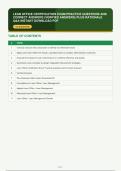
LEAN OFFICE CERTIFICATION EXAM PRACTICE QUESTIONS AND
CORRECT ANSWERS (VERIFIED ANSWERS) PLUS RATIONALE
Q&A INSTANT DOWNLOAD PDF
129 QUESTIONS
TABLE OF CONTENTS
# TOPIC
1 Critically analyze office processes to identify and eliminate waste
2 Apply Lean tools (VSM, 5S, Kaizen, standard work) to complex administrative scenarios
3 Evaluate the impact of Lean interventions on workflow efficiency and quality
4 Synthesize Lean concepts to design integrated improvement strategies
5 Lean Office Certification Exam Practice Questions And Correct Answers
6 Verified Answers
7 Plus Rationale Q&A Instant Download Pdf
8 Foundations of Lean Office / Lean Management
9 Applied Lean Office / Lean Management
10 Advanced Lean Office / Lean Management
11 Lean Office / Lean Management Review
Page 1
,Q1 CRITICALLY ANALYZE OFFICE PROCESSES TO IDENTIFY AND ELIMINATE WASTE
In a high-mix, low-volume order processing office, which value stream mapping
approach best reveals hidden waiting time and rework loops that traditional
process maps miss?
A. Current-state map with cycle time and lead time data CORRECT
B. Spaghetti diagram of employee movement
C. Value-added flow analysis per product family
D. Future-state map with target metrics
RATIONALE: A current-state VSM captures cycle time, lead time, and rework loops, exposing
waiting and non-value-added steps. Spaghetti diagrams show movement, not time. Flow analysis
per family may miss cross-family waits. Future-state maps are for designing, not diagnosing.
Q2 CRITICALLY ANALYZE OFFICE PROCESSES TO IDENTIFY AND ELIMINATE WASTE
A finance team implements 5S but sees minimal long-term improvement. Which
root cause is most likely?
A. They did not sort items by frequency of use
B. They skipped the 'Shine' step
C. They treated 5S as an event, not a habit CORRECT
D. They used red tags for disposal
RATIONALE: 5S requires daily discipline and continuous reinforcement; treating it as a one-time
event leads to backsliding. Sorting and shine are important but not the primary cause. Red
tagging is correct in Sort.
Page 2
,Q3 CRITICALLY ANALYZE OFFICE PROCESSES TO IDENTIFY AND ELIMINATE WASTE
In a claims processing office, which metric best indicates whether the process is
capable of meeting customer demand without overtime?
A. Takt time versus actual cycle time CORRECT
B. First-pass yield
C. Average lead time per claim
D. Number of claims reworked
RATIONALE: Takt time sets the pace of customer demand; comparing it to actual cycle time
reveals whether capacity matches demand. Yield and lead time measure quality and speed, not
capacity balance. Rework is a quality issue.
Q4 CRITICALLY ANALYZE OFFICE PROCESSES TO IDENTIFY AND ELIMINATE WASTE
A manager wants to reduce the time spent searching for electronic documents.
Which Lean tool is most directly applicable?
A. Poka-yoke to prevent misfiling
B. Kanban for document retrieval
C. 5S applied to digital file structures CORRECT
D. Value stream mapping of search processes
RATIONALE: 5S principles (sort, set in order, shine, standardize, sustain) directly address
workspace and digital organization, reducing search time. Poka-yoke prevents errors but not
search. Kanban is for inventory. VSM is broader.
Page 3
, Q5 CRITICALLY ANALYZE OFFICE PROCESSES TO IDENTIFY AND ELIMINATE WASTE
During a Kaizen event, a team proposes automating data entry. Which
countermeasure best aligns with Lean principles?
A. Automate the entire process to reduce headcount
B. First simplify the process, then automate the simplified steps CORRECT
C. Implement automation only for high-volume transactions
D. Postpone automation until defects are eliminated
RATIONALE: Lean emphasizes process improvement before automation; automating a wasteful
process only speeds waste. Simplification first ensures automation adds value. Automating
selectively or delaying may miss opportunities.
Q6 CRITICALLY ANALYZE OFFICE PROCESSES TO IDENTIFY AND ELIMINATE WASTE
In an office setting, which of the following best distinguishes a 'pull' system from a
'push' system?
A. Pull uses a forecast to schedule work; push uses actual demand
B. Pull authorizes work based on downstream consumption; push schedules based on forecast
CORRECT
C. Pull works only in manufacturing; push is for services
D. Pull requires no inventory; push requires inventory
RATIONALE: Pull systems trigger work when the next step needs it (downstream signal), while
push produces according to forecast. Pull can apply to services and may still have some
inventory (WIP).
Page 4
CORRECT ANSWERS (VERIFIED ANSWERS) PLUS RATIONALE
Q&A INSTANT DOWNLOAD PDF
129 QUESTIONS
TABLE OF CONTENTS
# TOPIC
1 Critically analyze office processes to identify and eliminate waste
2 Apply Lean tools (VSM, 5S, Kaizen, standard work) to complex administrative scenarios
3 Evaluate the impact of Lean interventions on workflow efficiency and quality
4 Synthesize Lean concepts to design integrated improvement strategies
5 Lean Office Certification Exam Practice Questions And Correct Answers
6 Verified Answers
7 Plus Rationale Q&A Instant Download Pdf
8 Foundations of Lean Office / Lean Management
9 Applied Lean Office / Lean Management
10 Advanced Lean Office / Lean Management
11 Lean Office / Lean Management Review
Page 1
,Q1 CRITICALLY ANALYZE OFFICE PROCESSES TO IDENTIFY AND ELIMINATE WASTE
In a high-mix, low-volume order processing office, which value stream mapping
approach best reveals hidden waiting time and rework loops that traditional
process maps miss?
A. Current-state map with cycle time and lead time data CORRECT
B. Spaghetti diagram of employee movement
C. Value-added flow analysis per product family
D. Future-state map with target metrics
RATIONALE: A current-state VSM captures cycle time, lead time, and rework loops, exposing
waiting and non-value-added steps. Spaghetti diagrams show movement, not time. Flow analysis
per family may miss cross-family waits. Future-state maps are for designing, not diagnosing.
Q2 CRITICALLY ANALYZE OFFICE PROCESSES TO IDENTIFY AND ELIMINATE WASTE
A finance team implements 5S but sees minimal long-term improvement. Which
root cause is most likely?
A. They did not sort items by frequency of use
B. They skipped the 'Shine' step
C. They treated 5S as an event, not a habit CORRECT
D. They used red tags for disposal
RATIONALE: 5S requires daily discipline and continuous reinforcement; treating it as a one-time
event leads to backsliding. Sorting and shine are important but not the primary cause. Red
tagging is correct in Sort.
Page 2
,Q3 CRITICALLY ANALYZE OFFICE PROCESSES TO IDENTIFY AND ELIMINATE WASTE
In a claims processing office, which metric best indicates whether the process is
capable of meeting customer demand without overtime?
A. Takt time versus actual cycle time CORRECT
B. First-pass yield
C. Average lead time per claim
D. Number of claims reworked
RATIONALE: Takt time sets the pace of customer demand; comparing it to actual cycle time
reveals whether capacity matches demand. Yield and lead time measure quality and speed, not
capacity balance. Rework is a quality issue.
Q4 CRITICALLY ANALYZE OFFICE PROCESSES TO IDENTIFY AND ELIMINATE WASTE
A manager wants to reduce the time spent searching for electronic documents.
Which Lean tool is most directly applicable?
A. Poka-yoke to prevent misfiling
B. Kanban for document retrieval
C. 5S applied to digital file structures CORRECT
D. Value stream mapping of search processes
RATIONALE: 5S principles (sort, set in order, shine, standardize, sustain) directly address
workspace and digital organization, reducing search time. Poka-yoke prevents errors but not
search. Kanban is for inventory. VSM is broader.
Page 3
, Q5 CRITICALLY ANALYZE OFFICE PROCESSES TO IDENTIFY AND ELIMINATE WASTE
During a Kaizen event, a team proposes automating data entry. Which
countermeasure best aligns with Lean principles?
A. Automate the entire process to reduce headcount
B. First simplify the process, then automate the simplified steps CORRECT
C. Implement automation only for high-volume transactions
D. Postpone automation until defects are eliminated
RATIONALE: Lean emphasizes process improvement before automation; automating a wasteful
process only speeds waste. Simplification first ensures automation adds value. Automating
selectively or delaying may miss opportunities.
Q6 CRITICALLY ANALYZE OFFICE PROCESSES TO IDENTIFY AND ELIMINATE WASTE
In an office setting, which of the following best distinguishes a 'pull' system from a
'push' system?
A. Pull uses a forecast to schedule work; push uses actual demand
B. Pull authorizes work based on downstream consumption; push schedules based on forecast
CORRECT
C. Pull works only in manufacturing; push is for services
D. Pull requires no inventory; push requires inventory
RATIONALE: Pull systems trigger work when the next step needs it (downstream signal), while
push produces according to forecast. Pull can apply to services and may still have some
inventory (WIP).
Page 4


