

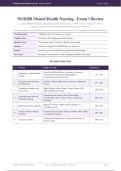
NUR208 Mental Health Nursing - Exam 1 Review 2026/2027 Edition
NUR208 Mental Health Nursing - Exam 1 Review
Latest 2026/2027 Update - Questions and Verified Answers - 100% Correct - Grade A - Fortis
Aligned with 2026-2027 Fortis NUR208 Mental Health Nursing Course Objectives
Total Questions 75 Multiple-Choice (4 options, one correct)
Cognitive Mix 30% Recall / 50% Application / 20% Analysis
Question Style 75% Scenario-based / 25% Direct Recall or Conceptual
Sections 7 sections covering Fortis NUR208 Exam 1 objectives
Format Verified answers with detailed mental health nursing rationales
Key Focus Therapeutic communication, safety, legal/ethical, DSM-5-TR criteria
Section Overview
# Section Topic Coverage Questions
Mental Health/Mental Illness Continuum, Therapeutic
Foundations of Mental Health
1 Communication, Therapeutic Relationship, & Q1 - Q15
Nursing
Transference/Countertransference
Psychiatric Assessment and Psychiatric History, MSE, Risk Assessment, & Diagnostic
2 Q16 - Q25
the DSM-5-TR Criteria
Therapeutic Modalities and Milieu Therapy, Group Therapy, Family Therapy, CBT,
3 Q26 - Q35
Interventions DBT, & Behavioral Therapy
Commitment, Informed Consent, Patient Rights,
Legal and Ethical Issues in
4 Confidentiality, HIPAA, Duty to Warn, & Mandatory Q36 - Q42
Psychiatric Nursing
Reporting
Depressive Disorders, Bipolar I/II, Cyclothymic, &
5 Mood and Affective Disorders Q43 - Q55
Grief/Bereavement
Anxiety and Stress-Related Generalized Anxiety, Panic Disorder, Phobias, OCD, PTSD,
6 Q56 - Q65
Disorders & Adjustment Disorders
Schizophrenia, Schizoaffective, Delusional Disorder, &
7 Psychotic Disorders Q66 - Q75
Psychosis NOS
NUR208 - Mental Health Nursing Exam 1 Comprehensive Review - 75 Questions Page 1
,NUR208 Mental Health Nursing - Exam 1 Review 2026/2027 Edition
Section 1: Foundations of Mental Health Nursing
Mental Health/Mental Illness Continuum, Therapeutic Communication, Therapeutic Relationship, &
Transference/Countertransference (Q1-Q15)
Q1: A nurse is caring for a patient who recently lost their job, has intermittent sleep difficulty, and
feels 'down' but continues to attend social events and perform daily activities. How should the nurse
best understand this patient's current state?
A. The patient is experiencing mental illness and requires psychiatric hospitalization
B. The patient is in denial and requires confrontation about depressive symptoms
C. The patient is functioning on the mental health end of the mental health-mental illness continuum and
would benefit from supportive interventions [CORRECT]
D. The patient meets criteria for major depressive disorder under the DSM-5-TR
Correct Answer: C
Rationale: Mental health and mental illness exist on a continuum rather than as a strict dichotomy; this
patient retains social and occupational functioning, indicating placement toward the mental health end while
still experiencing distress that warrants support. The option describing 'patient is experiencing mental illness'
overpathologizes a subclinical response. The option describing 'patient is in denial and' (confrontation)
violates therapeutic communication principles. The option describing 'patient meets criteria for major'
requires 5+ depressive symptoms for at least 2 weeks, which the stem does not support. The nurse's role is
supportive intervention, not diagnosis.
Q2: Which statement by the nurse best demonstrates the therapeutic communication technique of
RESTATING?
A. 'You're saying that you felt afraid when your husband raised his voice.' [CORRECT]
B. 'Tell me more about what happened when you felt anxious.'
C. 'It sounds like this has been a very difficult time for you.'
D. 'Why do you think you reacted that way?'
Correct Answer: A
Rationale: Restating repeats the main idea of the patient's message using similar words to confirm
understanding and encourage further exploration. The correct option is the only choice that mirrors the
patient's content. 'Tell me more about what happened when you felt anxious' is 'exploring' or a 'broad
opening.' 'It sounds like this has been a very difficult time for you' is 'reflecting' feelings. 'Why do you think
you reacted that way?' is a 'why' question, which is nontherapeutic because it demands justification and can
feel interrogational. Restating builds rapport by demonstrating active listening.
NUR208 - Mental Health Nursing Exam 1 Comprehensive Review - 75 Questions Page 2
, NUR208 Mental Health Nursing - Exam 1 Review 2026/2027 Edition
Q3: A patient newly diagnosed with depression says, 'I just don't think I'm worth anyone's time.'
Which therapeutic response by the nurse is MOST appropriate?
A. 'Of course you're worth people's time. Don't talk like that.'
B. 'You seem to be feeling worthless right now.' [CORRECT]
C. 'Why would you say something like that about yourself?'
D. 'Let's not focus on the negative. Tell me about something good today.'
Correct Answer: B
Rationale: Reflecting feelings (The option describing ''You seem to be feeling') acknowledges the patient's
emotional state without judgment, validating their experience and inviting further exploration. The option
describing ''Of course you're worth people's' is 'false reassurance' and dismisses feelings. The option
describing ''Why would you say something' uses a 'why' question, which can feel blaming. The option
describing ''Let's not focus on the' is 'changing the subject,' a nontherapeutic response that invalidates the
patient. Therapeutic communication prioritizes empathy and acceptance over problem-solving.
Q4: During a shift, a patient tells the nurse, 'I really look forward to our talks. You're the only one
here who really understands me, just like my mom used to.' The nurse recognizes this as a sign of:
A. Transference, in which the patient unconsciously redirects feelings about a significant other onto the
nurse [CORRECT]
B. Countertransference, in which the nurse is emotionally reacting to the patient
C. A therapeutic boundary violation requiring immediate termination of the relationship
D. Manipulation intended to obtain special privileges from the nurse
Correct Answer: A
Rationale: Transference occurs when a patient unconsciously redirects feelings, desires, and expectations
from a past significant relationship (such as with a parent) onto the nurse. The nurse should recognize it
therapeutically, explore it as part of therapy, and maintain professional boundaries. Countertransference
(The option describing 'Countertransference') describes the nurse's emotional reaction to the patient. The
option describing 'therapeutic boundary violation requiring immediate' is incorrect - transference is a normal
therapeutic phenomenon, not a boundary violation in itself. The option describing 'Manipulation intended to
obtain special' jumps to a nontherapeutic assumption.
Q5: A nurse finds herself feeling unusually protective of a young male patient who reminds her of her
own son. She is tempted to spend extra time with him and bring him special treats. The nurse's BEST
action is to:
A. Recognize this as countertransference and discuss these feelings in clinical supervision [CORRECT]
B. Bring the treats and spend extra time, as this strengthens the therapeutic relationship
C. Request that another nurse take over the patient's care immediately
D. Confront the patient about the inappropriate dynamic
Correct Answer: A
Rationale: Countertransference occurs when the nurse unconsciously redirects personal feelings (often from
past relationships) onto the patient. The professional response is to recognize it and process it in clinical
supervision so the nurse can continue providing objective care. The option describing 'Bring the treats and
spend' violates professional boundaries and risks favoritism. The option describing 'Request that another
nurse take' is premature - the nurse can manage countertransference through supervision rather than
abandoning the patient. The option describing 'Confront the patient about the' is inappropriate; the patient did
not create this dynamic. Self-awareness and supervision are core to therapeutic use of self.
NUR208 - Mental Health Nursing Exam 1 Comprehensive Review - 75 Questions Page 3
NUR208 Mental Health Nursing - Exam 1 Review
Latest 2026/2027 Update - Questions and Verified Answers - 100% Correct - Grade A - Fortis
Aligned with 2026-2027 Fortis NUR208 Mental Health Nursing Course Objectives
Total Questions 75 Multiple-Choice (4 options, one correct)
Cognitive Mix 30% Recall / 50% Application / 20% Analysis
Question Style 75% Scenario-based / 25% Direct Recall or Conceptual
Sections 7 sections covering Fortis NUR208 Exam 1 objectives
Format Verified answers with detailed mental health nursing rationales
Key Focus Therapeutic communication, safety, legal/ethical, DSM-5-TR criteria
Section Overview
# Section Topic Coverage Questions
Mental Health/Mental Illness Continuum, Therapeutic
Foundations of Mental Health
1 Communication, Therapeutic Relationship, & Q1 - Q15
Nursing
Transference/Countertransference
Psychiatric Assessment and Psychiatric History, MSE, Risk Assessment, & Diagnostic
2 Q16 - Q25
the DSM-5-TR Criteria
Therapeutic Modalities and Milieu Therapy, Group Therapy, Family Therapy, CBT,
3 Q26 - Q35
Interventions DBT, & Behavioral Therapy
Commitment, Informed Consent, Patient Rights,
Legal and Ethical Issues in
4 Confidentiality, HIPAA, Duty to Warn, & Mandatory Q36 - Q42
Psychiatric Nursing
Reporting
Depressive Disorders, Bipolar I/II, Cyclothymic, &
5 Mood and Affective Disorders Q43 - Q55
Grief/Bereavement
Anxiety and Stress-Related Generalized Anxiety, Panic Disorder, Phobias, OCD, PTSD,
6 Q56 - Q65
Disorders & Adjustment Disorders
Schizophrenia, Schizoaffective, Delusional Disorder, &
7 Psychotic Disorders Q66 - Q75
Psychosis NOS
NUR208 - Mental Health Nursing Exam 1 Comprehensive Review - 75 Questions Page 1
,NUR208 Mental Health Nursing - Exam 1 Review 2026/2027 Edition
Section 1: Foundations of Mental Health Nursing
Mental Health/Mental Illness Continuum, Therapeutic Communication, Therapeutic Relationship, &
Transference/Countertransference (Q1-Q15)
Q1: A nurse is caring for a patient who recently lost their job, has intermittent sleep difficulty, and
feels 'down' but continues to attend social events and perform daily activities. How should the nurse
best understand this patient's current state?
A. The patient is experiencing mental illness and requires psychiatric hospitalization
B. The patient is in denial and requires confrontation about depressive symptoms
C. The patient is functioning on the mental health end of the mental health-mental illness continuum and
would benefit from supportive interventions [CORRECT]
D. The patient meets criteria for major depressive disorder under the DSM-5-TR
Correct Answer: C
Rationale: Mental health and mental illness exist on a continuum rather than as a strict dichotomy; this
patient retains social and occupational functioning, indicating placement toward the mental health end while
still experiencing distress that warrants support. The option describing 'patient is experiencing mental illness'
overpathologizes a subclinical response. The option describing 'patient is in denial and' (confrontation)
violates therapeutic communication principles. The option describing 'patient meets criteria for major'
requires 5+ depressive symptoms for at least 2 weeks, which the stem does not support. The nurse's role is
supportive intervention, not diagnosis.
Q2: Which statement by the nurse best demonstrates the therapeutic communication technique of
RESTATING?
A. 'You're saying that you felt afraid when your husband raised his voice.' [CORRECT]
B. 'Tell me more about what happened when you felt anxious.'
C. 'It sounds like this has been a very difficult time for you.'
D. 'Why do you think you reacted that way?'
Correct Answer: A
Rationale: Restating repeats the main idea of the patient's message using similar words to confirm
understanding and encourage further exploration. The correct option is the only choice that mirrors the
patient's content. 'Tell me more about what happened when you felt anxious' is 'exploring' or a 'broad
opening.' 'It sounds like this has been a very difficult time for you' is 'reflecting' feelings. 'Why do you think
you reacted that way?' is a 'why' question, which is nontherapeutic because it demands justification and can
feel interrogational. Restating builds rapport by demonstrating active listening.
NUR208 - Mental Health Nursing Exam 1 Comprehensive Review - 75 Questions Page 2
, NUR208 Mental Health Nursing - Exam 1 Review 2026/2027 Edition
Q3: A patient newly diagnosed with depression says, 'I just don't think I'm worth anyone's time.'
Which therapeutic response by the nurse is MOST appropriate?
A. 'Of course you're worth people's time. Don't talk like that.'
B. 'You seem to be feeling worthless right now.' [CORRECT]
C. 'Why would you say something like that about yourself?'
D. 'Let's not focus on the negative. Tell me about something good today.'
Correct Answer: B
Rationale: Reflecting feelings (The option describing ''You seem to be feeling') acknowledges the patient's
emotional state without judgment, validating their experience and inviting further exploration. The option
describing ''Of course you're worth people's' is 'false reassurance' and dismisses feelings. The option
describing ''Why would you say something' uses a 'why' question, which can feel blaming. The option
describing ''Let's not focus on the' is 'changing the subject,' a nontherapeutic response that invalidates the
patient. Therapeutic communication prioritizes empathy and acceptance over problem-solving.
Q4: During a shift, a patient tells the nurse, 'I really look forward to our talks. You're the only one
here who really understands me, just like my mom used to.' The nurse recognizes this as a sign of:
A. Transference, in which the patient unconsciously redirects feelings about a significant other onto the
nurse [CORRECT]
B. Countertransference, in which the nurse is emotionally reacting to the patient
C. A therapeutic boundary violation requiring immediate termination of the relationship
D. Manipulation intended to obtain special privileges from the nurse
Correct Answer: A
Rationale: Transference occurs when a patient unconsciously redirects feelings, desires, and expectations
from a past significant relationship (such as with a parent) onto the nurse. The nurse should recognize it
therapeutically, explore it as part of therapy, and maintain professional boundaries. Countertransference
(The option describing 'Countertransference') describes the nurse's emotional reaction to the patient. The
option describing 'therapeutic boundary violation requiring immediate' is incorrect - transference is a normal
therapeutic phenomenon, not a boundary violation in itself. The option describing 'Manipulation intended to
obtain special' jumps to a nontherapeutic assumption.
Q5: A nurse finds herself feeling unusually protective of a young male patient who reminds her of her
own son. She is tempted to spend extra time with him and bring him special treats. The nurse's BEST
action is to:
A. Recognize this as countertransference and discuss these feelings in clinical supervision [CORRECT]
B. Bring the treats and spend extra time, as this strengthens the therapeutic relationship
C. Request that another nurse take over the patient's care immediately
D. Confront the patient about the inappropriate dynamic
Correct Answer: A
Rationale: Countertransference occurs when the nurse unconsciously redirects personal feelings (often from
past relationships) onto the patient. The professional response is to recognize it and process it in clinical
supervision so the nurse can continue providing objective care. The option describing 'Bring the treats and
spend' violates professional boundaries and risks favoritism. The option describing 'Request that another
nurse take' is premature - the nurse can manage countertransference through supervision rather than
abandoning the patient. The option describing 'Confront the patient about the' is inappropriate; the patient did
not create this dynamic. Self-awareness and supervision are core to therapeutic use of self.
NUR208 - Mental Health Nursing Exam 1 Comprehensive Review - 75 Questions Page 3


