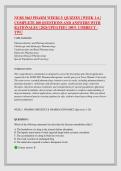
NURS 5663 PHARM WEEKLY QUIZZES | WEEK 1-6 |
COMPLETE 100 QUESTIONS AND ANSWERS WITH
RATIONALES | 2026 UPDATED | 100% CORRECT -
TWU
CORE DOMAINS
Pharmacokinetics and Pharmacodynamics
Cholinergic and Adrenergic Pharmacology
Cardiovascular and Renal Pharmacology
Endocrine Pharmacology
Infectious Disease Pharmacology
Special Populations and Toxicology
INTRODUCTION
This comprehensive examination is designed to assess the knowledge and clinical application
required for the NURS 5663 Pharmacotherapeutics weekly quizzes at Texas Woman's University.
The exam covers essential pharmacology content across six weeks, including pharmacokinetics,
pharmacodynamics, cholinergic and adrenergic agents, cardiovascular drugs, endocrine
therapies, infectious disease treatments, and considerations for special populations. Questions
are presented in multiple-choice format with detailed rationales to reinforce understanding of
drug mechanisms, clinical applications, adverse effects, and patient education. This assessment
prepares advanced practice nursing students for safe, evidence-based prescribing across diverse
patient populations.
WEEK 1: PHARMACOKINETICS & PHARMACODYNAMICS (Questions 1-20)
QUESTION 1
Which of the following statements best describes the first-pass metabolism effect?
A. The breakdown of a drug in the stomach before absorption
B. The hepatic inactivation of orally ingested drugs before systemic circulation
C. The accumulation of a drug in body fat over time
D. The renal excretion of unchanged drug
E. The initial dose required to achieve therapeutic levels
Correct answer: B
, RATIONALE: First-pass metabolism (or first-pass effect) occurs when an orally ingested
drug is absorbed from the GI tract and travels via the portal circulation directly to the liver,
where it may be significantly metabolized before reaching the systemic circulation. This reduces
bioavailability and may require higher oral doses compared to IV doses of the same drug. Routes
that bypass the liver (sublingual, rectal, IV, transdermal) avoid first-pass metabolism.
QUESTION 2
A patient has a creatinine clearance of 30 mL/min (normal is 80-120 mL/min). What change
should be made to drug dosing?
A. Increase all drug doses
B. Decrease doses and extend dosing intervals for renally cleared drugs
C. Administer all drugs intravenously
D. No adjustment is necessary
E. Double all doses to compensate for reduced kidney function
Correct answer: B
RATIONALE: Reduced creatinine clearance indicates impaired renal function and reduced
ability to excrete drugs. Drugs that are primarily renally eliminated require dose reduction and/or
increased dosing intervals to prevent toxic accumulation. Failure to adjust doses in renal
impairment can lead to supratherapeutic levels and serious adverse effects.
QUESTION 3
Which characteristic of a drug would result in the longest duration of action?
A. Short half-life and high lipid solubility
B. Long half-life and high protein binding
C. Short half-life and high water solubility
D. Rapid metabolism by the liver
E. Complete renal excretion within 2 hours
Correct answer: B
RATIONALE: A drug with a long half-life remains in the body for an extended period,
resulting in a longer duration of action. High protein binding creates a reservoir effect—as free
drug is eliminated, bound drug is released from protein-binding sites, prolonging the drug's
effects. Conversely, drugs with short half-lives require frequent dosing.
QUESTION 4
,When prescribing drugs with a narrow therapeutic index, what intervention does the provider
take to decrease risk to the patient?
A. Monitor the patient's plasma drug levels at regular intervals
B. Order the medication to be administered by the intravenous route
C. Teach the patient that optimal outcomes will require adherence
D. Schedule drug administration intervals that exceed the drug's half-life
Correct answer: A
RATIONALE: A drug with a narrow therapeutic range is more difficult to administer safely
because the difference between the minimum effective concentration and the toxic concentration
is small. Patients taking these medications must have their plasma drug levels monitored closely
to ensure they are getting an effective dose that is not toxic.
QUESTION 5
When prescribing lovastatin, what will a provider advise to decrease the risk of developing
muscle toxicity?
A. Avoid exercise for 2 hours after administration
B. Take the medication with an NSAID
C. Substitute grapefruit juice with orange juice
D. Monitor AST and ALT
Correct answer: C
RATIONALE: Grapefruit juice inhibits the metabolism of certain drugs including statins like
lovastatin, decreasing intestinal metabolism and resulting in increased drug levels. This increases
the risk for adverse effects such as muscle toxicity. Substituting with orange juice avoids this
interaction.
QUESTION 6
Which term describes the ability of a drug to bind to a receptor and produce a maximal response?
A. Affinity
B. Potency
C. Efficacy
D. Bioavailability
E. Clearance
Correct answer: C
, RATIONALE: Efficacy is the maximum therapeutic effect a drug can produce, regardless of
dose. A drug with high efficacy produces a greater maximal response than one with low efficacy.
This is distinct from potency, which refers to the amount of drug needed to produce a given
effect.
QUESTION 7
Which of the following factors increases the volume of distribution (Vd) of a drug?
A. High water solubility
B. High plasma protein binding
C. High lipid solubility
D. Low molecular weight only
E. Rapid renal clearance
Correct answer: C
RATIONALE: High lipid solubility allows a drug to cross cell membranes and distribute
into tissues, resulting in a larger volume of distribution. Highly water-soluble drugs tend to
remain in the vascular compartment, resulting in a smaller Vd. Vd is a theoretical volume that
describes how extensively a drug distributes into body tissues.
QUESTION 8
A drug has a half-life of 4 hours. Approximately how long will it take for the drug to reach
steady-state concentration?
A. 8 hours
B. 12 hours
C. 16 hours
D. 20 hours
E. 24 hours
Correct answer: D
RATIONALE: Steady-state is reached after approximately 4-5 half-lives. With a half-life of
4 hours, steady-state would be achieved in approximately 16-20 hours (4 half-lives = 16 hours; 5
half-lives = 20 hours). This is the time required for drug accumulation and elimination to
balance.
QUESTION 9
Bioavailability is defined as:
COMPLETE 100 QUESTIONS AND ANSWERS WITH
RATIONALES | 2026 UPDATED | 100% CORRECT -
TWU
CORE DOMAINS
Pharmacokinetics and Pharmacodynamics
Cholinergic and Adrenergic Pharmacology
Cardiovascular and Renal Pharmacology
Endocrine Pharmacology
Infectious Disease Pharmacology
Special Populations and Toxicology
INTRODUCTION
This comprehensive examination is designed to assess the knowledge and clinical application
required for the NURS 5663 Pharmacotherapeutics weekly quizzes at Texas Woman's University.
The exam covers essential pharmacology content across six weeks, including pharmacokinetics,
pharmacodynamics, cholinergic and adrenergic agents, cardiovascular drugs, endocrine
therapies, infectious disease treatments, and considerations for special populations. Questions
are presented in multiple-choice format with detailed rationales to reinforce understanding of
drug mechanisms, clinical applications, adverse effects, and patient education. This assessment
prepares advanced practice nursing students for safe, evidence-based prescribing across diverse
patient populations.
WEEK 1: PHARMACOKINETICS & PHARMACODYNAMICS (Questions 1-20)
QUESTION 1
Which of the following statements best describes the first-pass metabolism effect?
A. The breakdown of a drug in the stomach before absorption
B. The hepatic inactivation of orally ingested drugs before systemic circulation
C. The accumulation of a drug in body fat over time
D. The renal excretion of unchanged drug
E. The initial dose required to achieve therapeutic levels
Correct answer: B
, RATIONALE: First-pass metabolism (or first-pass effect) occurs when an orally ingested
drug is absorbed from the GI tract and travels via the portal circulation directly to the liver,
where it may be significantly metabolized before reaching the systemic circulation. This reduces
bioavailability and may require higher oral doses compared to IV doses of the same drug. Routes
that bypass the liver (sublingual, rectal, IV, transdermal) avoid first-pass metabolism.
QUESTION 2
A patient has a creatinine clearance of 30 mL/min (normal is 80-120 mL/min). What change
should be made to drug dosing?
A. Increase all drug doses
B. Decrease doses and extend dosing intervals for renally cleared drugs
C. Administer all drugs intravenously
D. No adjustment is necessary
E. Double all doses to compensate for reduced kidney function
Correct answer: B
RATIONALE: Reduced creatinine clearance indicates impaired renal function and reduced
ability to excrete drugs. Drugs that are primarily renally eliminated require dose reduction and/or
increased dosing intervals to prevent toxic accumulation. Failure to adjust doses in renal
impairment can lead to supratherapeutic levels and serious adverse effects.
QUESTION 3
Which characteristic of a drug would result in the longest duration of action?
A. Short half-life and high lipid solubility
B. Long half-life and high protein binding
C. Short half-life and high water solubility
D. Rapid metabolism by the liver
E. Complete renal excretion within 2 hours
Correct answer: B
RATIONALE: A drug with a long half-life remains in the body for an extended period,
resulting in a longer duration of action. High protein binding creates a reservoir effect—as free
drug is eliminated, bound drug is released from protein-binding sites, prolonging the drug's
effects. Conversely, drugs with short half-lives require frequent dosing.
QUESTION 4
,When prescribing drugs with a narrow therapeutic index, what intervention does the provider
take to decrease risk to the patient?
A. Monitor the patient's plasma drug levels at regular intervals
B. Order the medication to be administered by the intravenous route
C. Teach the patient that optimal outcomes will require adherence
D. Schedule drug administration intervals that exceed the drug's half-life
Correct answer: A
RATIONALE: A drug with a narrow therapeutic range is more difficult to administer safely
because the difference between the minimum effective concentration and the toxic concentration
is small. Patients taking these medications must have their plasma drug levels monitored closely
to ensure they are getting an effective dose that is not toxic.
QUESTION 5
When prescribing lovastatin, what will a provider advise to decrease the risk of developing
muscle toxicity?
A. Avoid exercise for 2 hours after administration
B. Take the medication with an NSAID
C. Substitute grapefruit juice with orange juice
D. Monitor AST and ALT
Correct answer: C
RATIONALE: Grapefruit juice inhibits the metabolism of certain drugs including statins like
lovastatin, decreasing intestinal metabolism and resulting in increased drug levels. This increases
the risk for adverse effects such as muscle toxicity. Substituting with orange juice avoids this
interaction.
QUESTION 6
Which term describes the ability of a drug to bind to a receptor and produce a maximal response?
A. Affinity
B. Potency
C. Efficacy
D. Bioavailability
E. Clearance
Correct answer: C
, RATIONALE: Efficacy is the maximum therapeutic effect a drug can produce, regardless of
dose. A drug with high efficacy produces a greater maximal response than one with low efficacy.
This is distinct from potency, which refers to the amount of drug needed to produce a given
effect.
QUESTION 7
Which of the following factors increases the volume of distribution (Vd) of a drug?
A. High water solubility
B. High plasma protein binding
C. High lipid solubility
D. Low molecular weight only
E. Rapid renal clearance
Correct answer: C
RATIONALE: High lipid solubility allows a drug to cross cell membranes and distribute
into tissues, resulting in a larger volume of distribution. Highly water-soluble drugs tend to
remain in the vascular compartment, resulting in a smaller Vd. Vd is a theoretical volume that
describes how extensively a drug distributes into body tissues.
QUESTION 8
A drug has a half-life of 4 hours. Approximately how long will it take for the drug to reach
steady-state concentration?
A. 8 hours
B. 12 hours
C. 16 hours
D. 20 hours
E. 24 hours
Correct answer: D
RATIONALE: Steady-state is reached after approximately 4-5 half-lives. With a half-life of
4 hours, steady-state would be achieved in approximately 16-20 hours (4 half-lives = 16 hours; 5
half-lives = 20 hours). This is the time required for drug accumulation and elimination to
balance.
QUESTION 9
Bioavailability is defined as: