
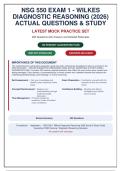
NSG 550 EXAM 1 - WILKES
DIAGNOSTIC REASONING (2026)
ACTUAL QUESTIONS & STUDY
LATEST MOCK PRACTICE SET
200 Questions with Answers and Detailed Rationales
100 PERCENT GUARANTEED PASS
INSTANT DOWNLOAD ANSWERS INCLUDED
IMPORTANCE OF THIS DOCUMENT
This comprehensive examination preparation guide has been meticulously developed to help you succeed in the
NSG 550 EXAM 1 - WILKES DIAGNOSTIC REASONING (2026) ACTUAL QUESTIONS & STUDY GUIDE |
GUARANTEE PASS. It contains 200 carefully selected questions that reflect the most current exam content and
testing strategies. Each question is accompanied by a correct answer and a detailed rationale that explains the
underlying pathophysiology, pharmacology, or clinical reasoning.
Self-Assessment – Test your knowledge and Exam Preparation – Familiarize yourself with the
identify areas requiring further question format and content
study areas
Concept Reinforcement – Deepen your Confidence Building – Develop test-taking
understanding through strategies and reduce
evidence-based exam anxiety
rationales
Time Management – Practice answering
questions under simulated
exam conditions
Review Summary 200 Questions
Foundations - Application - NSG 550 1 Wilkes Diagnostic Reasoning 2026 Actual & Study Guide
Guarantee PASS Nursing / Diagnostic Reasoning Graduate
All answers with rationales
,Table of Contents
Content Area Questions Key Topics
Diagnostic 1-50 Reasoning, Appropriate, Presents, Acute, Clinician
Acute 51-100 Diagnostic, Presents, Suspected, Positive, Disease
Appropriate 101-150 Acute, Finding, Presents, Diagnostic, Suspected
Presents 151-200 Diagnostic, Appropriate, Acute, Suspected, Combination
TOTAL 200 All questions include answers and detailed rationales
,Section A - Diagnostic
Q1.
A patient presents with acute chest pain and ST-segment elevation on ECG. Which
diagnostic test should be performed with the highest priority to guide immediate
management?
A. Cardiac troponin I B. Coronary angiography
C. CT coronary angiography D. Exercise stress test
Correct: B - Coronary angiography
Rationale:In ST-elevation myocardial infarction (STEMI), immediate coronary angiography
with percutaneous coronary intervention is indicated to restore blood flow. Troponin confirms
myocardial injury but does not guide immediate reperfusion. CT angiography and stress
testing are not appropriate in acute STEMI.
Q2.
A patient with suspected deep vein thrombosis has a low pre-test probability on Wells
score. Which diagnostic strategy is most appropriate to rule out DVT?
A. Start anticoagulation empirically and B. D-dimer testing, and if negative, DVT is
order ultrasound excluded
C. Venography as the initial test D. MRI of the lower extremity
Correct: B - D-dimer testing, and if negative, DVT is excluded
Rationale:In patients with low pre-test probability, a negative D-dimer (using a highly
sensitive assay) effectively rules out DVT without further imaging. Empirical anticoagulation is
not indicated without confirmation. Venography is invasive and rarely used. MRI is not
first-line.
Q3.
A patient presents with acute onset of severe headache and neck stiffness. Kernig's sign
is positive. Which diagnostic test is most appropriate to confirm the diagnosis?
A. CT of the head without contrast B. Lumbar puncture for CSF analysis
C. MRI of the brain with contrast D. EEG
Correct: B - Lumbar puncture for CSF analysis
Page 3
, Section A - Diagnostic
Rationale: The presentation suggests meningitis. Lumbar puncture with CSF analysis is
required to confirm the diagnosis and identify the pathogen. CT head may be done before LP
if there is concern for increased intracranial pressure, but LP is the definitive test. MRI and
EEG are not diagnostic for meningitis.
Q4.
A patient with type 2 diabetes has an HbA1c of 8.5% despite metformin and lifestyle
changes. According to current guidelines, which class of medication is generally
preferred as the next add-on therapy, especially in the presence of atherosclerotic
cardiovascular disease?
A. Sulfonylurea B. DPP-4 inhibitor
C. GLP-1 receptor agonist D. Thiazolidinedione
Correct: C - GLP-1 receptor agonist
Rationale:Current ADA/EASD guidelines recommend GLP-1 receptor agonists (or SGLT2
inhibitors) as preferred add-on therapy in patients with ASCVD or high cardiovascular risk due
to cardioprotective benefits. Sulfonylureas and DPP-4 inhibitors have neutral or less favorable
effects. Thiazolidinediones may worsen heart failure.
Q5.
A patient with chronic kidney disease stage 3 has a serum potassium of 5.8 mEq/L and
ECG shows peaked T waves. Which intervention should be administered first?
A. Sodium polystyrene sulfonate B. IV calcium gluconate
(Kayexalate)
C. IV insulin with glucose D. Hemodialysis
Correct: B - IV calcium gluconate
Rationale:In hyperkalemia with ECG changes, IV calcium gluconate is given first to stabilize
the cardiac membrane and prevent arrhythmias. Insulin with glucose shifts potassium
intracellularly but takes longer. Kayexalate removes potassium slowly. Dialysis is definitive but
not immediately available and not the first step.
Q6.
A patient presents with acute onset of severe epigastric pain radiating to the back,
nausea, and elevated serum lipase. Which initial imaging study is most appropriate to
assess for complications?
A. Abdominal ultrasound B. CT abdomen with IV contrast
C. MRI abdomen D. Plain abdominal radiograph
Page 4
DIAGNOSTIC REASONING (2026)
ACTUAL QUESTIONS & STUDY
LATEST MOCK PRACTICE SET
200 Questions with Answers and Detailed Rationales
100 PERCENT GUARANTEED PASS
INSTANT DOWNLOAD ANSWERS INCLUDED
IMPORTANCE OF THIS DOCUMENT
This comprehensive examination preparation guide has been meticulously developed to help you succeed in the
NSG 550 EXAM 1 - WILKES DIAGNOSTIC REASONING (2026) ACTUAL QUESTIONS & STUDY GUIDE |
GUARANTEE PASS. It contains 200 carefully selected questions that reflect the most current exam content and
testing strategies. Each question is accompanied by a correct answer and a detailed rationale that explains the
underlying pathophysiology, pharmacology, or clinical reasoning.
Self-Assessment – Test your knowledge and Exam Preparation – Familiarize yourself with the
identify areas requiring further question format and content
study areas
Concept Reinforcement – Deepen your Confidence Building – Develop test-taking
understanding through strategies and reduce
evidence-based exam anxiety
rationales
Time Management – Practice answering
questions under simulated
exam conditions
Review Summary 200 Questions
Foundations - Application - NSG 550 1 Wilkes Diagnostic Reasoning 2026 Actual & Study Guide
Guarantee PASS Nursing / Diagnostic Reasoning Graduate
All answers with rationales
,Table of Contents
Content Area Questions Key Topics
Diagnostic 1-50 Reasoning, Appropriate, Presents, Acute, Clinician
Acute 51-100 Diagnostic, Presents, Suspected, Positive, Disease
Appropriate 101-150 Acute, Finding, Presents, Diagnostic, Suspected
Presents 151-200 Diagnostic, Appropriate, Acute, Suspected, Combination
TOTAL 200 All questions include answers and detailed rationales
,Section A - Diagnostic
Q1.
A patient presents with acute chest pain and ST-segment elevation on ECG. Which
diagnostic test should be performed with the highest priority to guide immediate
management?
A. Cardiac troponin I B. Coronary angiography
C. CT coronary angiography D. Exercise stress test
Correct: B - Coronary angiography
Rationale:In ST-elevation myocardial infarction (STEMI), immediate coronary angiography
with percutaneous coronary intervention is indicated to restore blood flow. Troponin confirms
myocardial injury but does not guide immediate reperfusion. CT angiography and stress
testing are not appropriate in acute STEMI.
Q2.
A patient with suspected deep vein thrombosis has a low pre-test probability on Wells
score. Which diagnostic strategy is most appropriate to rule out DVT?
A. Start anticoagulation empirically and B. D-dimer testing, and if negative, DVT is
order ultrasound excluded
C. Venography as the initial test D. MRI of the lower extremity
Correct: B - D-dimer testing, and if negative, DVT is excluded
Rationale:In patients with low pre-test probability, a negative D-dimer (using a highly
sensitive assay) effectively rules out DVT without further imaging. Empirical anticoagulation is
not indicated without confirmation. Venography is invasive and rarely used. MRI is not
first-line.
Q3.
A patient presents with acute onset of severe headache and neck stiffness. Kernig's sign
is positive. Which diagnostic test is most appropriate to confirm the diagnosis?
A. CT of the head without contrast B. Lumbar puncture for CSF analysis
C. MRI of the brain with contrast D. EEG
Correct: B - Lumbar puncture for CSF analysis
Page 3
, Section A - Diagnostic
Rationale: The presentation suggests meningitis. Lumbar puncture with CSF analysis is
required to confirm the diagnosis and identify the pathogen. CT head may be done before LP
if there is concern for increased intracranial pressure, but LP is the definitive test. MRI and
EEG are not diagnostic for meningitis.
Q4.
A patient with type 2 diabetes has an HbA1c of 8.5% despite metformin and lifestyle
changes. According to current guidelines, which class of medication is generally
preferred as the next add-on therapy, especially in the presence of atherosclerotic
cardiovascular disease?
A. Sulfonylurea B. DPP-4 inhibitor
C. GLP-1 receptor agonist D. Thiazolidinedione
Correct: C - GLP-1 receptor agonist
Rationale:Current ADA/EASD guidelines recommend GLP-1 receptor agonists (or SGLT2
inhibitors) as preferred add-on therapy in patients with ASCVD or high cardiovascular risk due
to cardioprotective benefits. Sulfonylureas and DPP-4 inhibitors have neutral or less favorable
effects. Thiazolidinediones may worsen heart failure.
Q5.
A patient with chronic kidney disease stage 3 has a serum potassium of 5.8 mEq/L and
ECG shows peaked T waves. Which intervention should be administered first?
A. Sodium polystyrene sulfonate B. IV calcium gluconate
(Kayexalate)
C. IV insulin with glucose D. Hemodialysis
Correct: B - IV calcium gluconate
Rationale:In hyperkalemia with ECG changes, IV calcium gluconate is given first to stabilize
the cardiac membrane and prevent arrhythmias. Insulin with glucose shifts potassium
intracellularly but takes longer. Kayexalate removes potassium slowly. Dialysis is definitive but
not immediately available and not the first step.
Q6.
A patient presents with acute onset of severe epigastric pain radiating to the back,
nausea, and elevated serum lipase. Which initial imaging study is most appropriate to
assess for complications?
A. Abdominal ultrasound B. CT abdomen with IV contrast
C. MRI abdomen D. Plain abdominal radiograph
Page 4


