

IMPLANT OCCLUSION AND BIOMECHANICS CERTIFICATION EXAM
PRACTICE QUESTIONS AND CORRECT ANSWERS (VERIFIED ANSWERS)
PLUS RATIONALE Q&A INSTANT DOWNLOAD PDF
120 QUESTIONS
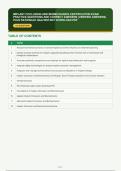
TABLE OF CONTENTS
# TOPIC
1 Analyze biomechanical forces on dental implants and their influence on treatment planning
2 Design occlusal schemes for implant-supported prostheses that minimize risk of mechanical and
biological complications
3 Evaluate prosthetic components and materials for optimal load distribution and longevity
4 Integrate digital technologies for precise implant occlusion management
5 Diagnose and manage biomechanical and occlusal complications in implant therapy
6 Implant Occlusion and Biomechanics Certification Exam Practice Questions And Correct Answers
7 Verified Answers
8 Plus Rationale Q&A Instant Download Pdf
9 Foundations of Implant Occlusion and Biomechanics
10 Applied Implant Occlusion and Biomechanics
11 Advanced Implant Occlusion and Biomechanics
12 Implant Occlusion and Biomechanics Review
Page 1
,Q1 ANALYZE BIOMECHANICAL FORCES ON DENTAL IMPLANTS AND THEIR INFLUENCE ON
TREATMENT PLANNING
In a patient with a single implant-supported crown in the mandibular first molar
position, which occlusal contact scheme best minimizes bending moments on the
implant-abutment complex during lateral excursions?
A. Group function with contacts on the implant crown and adjacent natural teeth
B. Mutually protected occlusion with canine guidance and no contacts on the implant crown in
excursive movements CORRECT
C. Balanced occlusion with contacts on the implant crown on both working and non-working
sides
D. Lateral guidance on the implant crown only to avoid overloading natural teeth
RATIONALE: Canine guidance (mutually protected occlusion) eliminates lateral forces on the
implant crown during excursions, reducing bending moments. Group function on an implant
increases lateral load, and balanced occlusion involves non-working contacts that are
detrimental. Implant-only guidance concentrates stress on the implant, risking mechanical failure.
Q2 ANALYZE BIOMECHANICAL FORCES ON DENTAL IMPLANTS AND THEIR INFLUENCE ON
TREATMENT PLANNING
Which combination of implant diameter and crown height space most adversely
affects the mechanical stability of a cement-retained implant crown under a 300 N
occlusal load?
A. 3.5 mm diameter, 8 mm crown height
B. 4.0 mm diameter, 10 mm crown height
C. 4.5 mm diameter, 12 mm crown height
D. 5.0 mm diameter, 15 mm crown height CORRECT
RATIONALE: A larger crown height space increases the moment arm, amplifying bending
moments. While a larger diameter implant improves resistance, the excessive crown height (15
mm) in option D creates a high crown-to-implant ratio that can lead to screw loosening or
component fracture. The combination of 5.0 mm diameter with 15 mm height is the worst
because the height advantage does not compensate for the increased leverage.
Page 2
,Q3 ANALYZE BIOMECHANICAL FORCES ON DENTAL IMPLANTS AND THEIR INFLUENCE ON
TREATMENT PLANNING
When comparing a 3-unit implant-supported fixed dental prosthesis (FDP) with a
tooth-implant-supported FDP, which biomechanical principle explains the higher
risk of complications in the latter?
A. Differential mobility between tooth and implant creates stress concentration at the connection
CORRECT
B. Tooth-supported FDPs have higher occlusal forces due to periodontal ligament feedback
C. Implants are more rigid, leading to increased forces on the natural tooth abutment
D. The prosthetic screw joint is weaker than the cement joint in tooth-implant FDPs
RATIONALE: The periodontal ligament gives natural teeth physiological mobility (approximately
50-100 µm), while implants have minimal mobility (10-50 µm). This differential movement under
load generates stress at the rigid connection, leading to loosening, fracture, or bone loss. The
other options are not primary biomechanical reasons.
Q4 ANALYZE BIOMECHANICAL FORCES ON DENTAL IMPLANTS AND THEIR INFLUENCE ON
TREATMENT PLANNING
Which prosthetic material for an implant-supported crown exhibits the highest
elastic modulus and thus transmits the most occlusal force to the implant-bone
interface?
A. Porcelain-fused-to-metal (PFM)
B. Lithium disilicate
C. Zirconia CORRECT
D. Polyetheretherketone (PEEK)
RATIONALE: Zirconia has an elastic modulus of ~210 GPa, higher than lithium disilicate (~95
GPa) and PFM (metal alloy ~200 GPa but ceramic veneer lower). PEEK is very low (~4 GPa). A
stiffer material transmits more load directly to the implant, increasing stress at the bone interface.
However, stiffness also affects stress distribution; zirconia's high modulus can lead to higher
peak stresses.
Page 3
, Q5 ANALYZE BIOMECHANICAL FORCES ON DENTAL IMPLANTS AND THEIR INFLUENCE ON
TREATMENT PLANNING
Which biomechanical factor is most critical in preventing peri-implant bone loss
around a single implant in the anterior maxilla?
A. Achieving a passive fit of the prosthesis
B. Placing the implant platform at the level of the bone crest
C. Using a platform-switched abutment
D. Directing occlusal forces along the implant long axis CORRECT
RATIONALE: Axial loading creates uniform stress distribution, reducing microdamage and bone
remodeling. Off-axis forces increase bending moments, leading to crestal bone loss. While
passive fit and platform switching are important, they do not directly control the direction of
occlusal forces. Platform level is a surgical consideration, not a biomechanical loading factor.
Q6 ANALYZE BIOMECHANICAL FORCES ON DENTAL IMPLANTS AND THEIR INFLUENCE ON
TREATMENT PLANNING
In a patient with bruxism and an implant-supported full-arch fixed prosthesis,
which occlusal scheme is recommended to minimize the risk of mechanical
complications?
A. Canine-guided occlusion with anterior guidance
B. Group function with multiple contacts on the prosthesis
C. Balanced occlusion with bilateral simultaneous contacts in all excursions CORRECT
D. Mutually protected occlusion with posterior disclusion
RATIONALE: For full-arch implant prostheses, balanced occlusion is often recommended to
distribute forces over the widest area, especially in patients with bruxism, as it reduces stress on
individual implants. Canine guidance may overload anterior implants, and group function may
concentrate stress on a few implants. Mutually protected occlusion is for natural dentition;
full-arch implants require more distributed contacts.
Page 4
PRACTICE QUESTIONS AND CORRECT ANSWERS (VERIFIED ANSWERS)
PLUS RATIONALE Q&A INSTANT DOWNLOAD PDF
120 QUESTIONS
TABLE OF CONTENTS
# TOPIC
1 Analyze biomechanical forces on dental implants and their influence on treatment planning
2 Design occlusal schemes for implant-supported prostheses that minimize risk of mechanical and
biological complications
3 Evaluate prosthetic components and materials for optimal load distribution and longevity
4 Integrate digital technologies for precise implant occlusion management
5 Diagnose and manage biomechanical and occlusal complications in implant therapy
6 Implant Occlusion and Biomechanics Certification Exam Practice Questions And Correct Answers
7 Verified Answers
8 Plus Rationale Q&A Instant Download Pdf
9 Foundations of Implant Occlusion and Biomechanics
10 Applied Implant Occlusion and Biomechanics
11 Advanced Implant Occlusion and Biomechanics
12 Implant Occlusion and Biomechanics Review
Page 1
,Q1 ANALYZE BIOMECHANICAL FORCES ON DENTAL IMPLANTS AND THEIR INFLUENCE ON
TREATMENT PLANNING
In a patient with a single implant-supported crown in the mandibular first molar
position, which occlusal contact scheme best minimizes bending moments on the
implant-abutment complex during lateral excursions?
A. Group function with contacts on the implant crown and adjacent natural teeth
B. Mutually protected occlusion with canine guidance and no contacts on the implant crown in
excursive movements CORRECT
C. Balanced occlusion with contacts on the implant crown on both working and non-working
sides
D. Lateral guidance on the implant crown only to avoid overloading natural teeth
RATIONALE: Canine guidance (mutually protected occlusion) eliminates lateral forces on the
implant crown during excursions, reducing bending moments. Group function on an implant
increases lateral load, and balanced occlusion involves non-working contacts that are
detrimental. Implant-only guidance concentrates stress on the implant, risking mechanical failure.
Q2 ANALYZE BIOMECHANICAL FORCES ON DENTAL IMPLANTS AND THEIR INFLUENCE ON
TREATMENT PLANNING
Which combination of implant diameter and crown height space most adversely
affects the mechanical stability of a cement-retained implant crown under a 300 N
occlusal load?
A. 3.5 mm diameter, 8 mm crown height
B. 4.0 mm diameter, 10 mm crown height
C. 4.5 mm diameter, 12 mm crown height
D. 5.0 mm diameter, 15 mm crown height CORRECT
RATIONALE: A larger crown height space increases the moment arm, amplifying bending
moments. While a larger diameter implant improves resistance, the excessive crown height (15
mm) in option D creates a high crown-to-implant ratio that can lead to screw loosening or
component fracture. The combination of 5.0 mm diameter with 15 mm height is the worst
because the height advantage does not compensate for the increased leverage.
Page 2
,Q3 ANALYZE BIOMECHANICAL FORCES ON DENTAL IMPLANTS AND THEIR INFLUENCE ON
TREATMENT PLANNING
When comparing a 3-unit implant-supported fixed dental prosthesis (FDP) with a
tooth-implant-supported FDP, which biomechanical principle explains the higher
risk of complications in the latter?
A. Differential mobility between tooth and implant creates stress concentration at the connection
CORRECT
B. Tooth-supported FDPs have higher occlusal forces due to periodontal ligament feedback
C. Implants are more rigid, leading to increased forces on the natural tooth abutment
D. The prosthetic screw joint is weaker than the cement joint in tooth-implant FDPs
RATIONALE: The periodontal ligament gives natural teeth physiological mobility (approximately
50-100 µm), while implants have minimal mobility (10-50 µm). This differential movement under
load generates stress at the rigid connection, leading to loosening, fracture, or bone loss. The
other options are not primary biomechanical reasons.
Q4 ANALYZE BIOMECHANICAL FORCES ON DENTAL IMPLANTS AND THEIR INFLUENCE ON
TREATMENT PLANNING
Which prosthetic material for an implant-supported crown exhibits the highest
elastic modulus and thus transmits the most occlusal force to the implant-bone
interface?
A. Porcelain-fused-to-metal (PFM)
B. Lithium disilicate
C. Zirconia CORRECT
D. Polyetheretherketone (PEEK)
RATIONALE: Zirconia has an elastic modulus of ~210 GPa, higher than lithium disilicate (~95
GPa) and PFM (metal alloy ~200 GPa but ceramic veneer lower). PEEK is very low (~4 GPa). A
stiffer material transmits more load directly to the implant, increasing stress at the bone interface.
However, stiffness also affects stress distribution; zirconia's high modulus can lead to higher
peak stresses.
Page 3
, Q5 ANALYZE BIOMECHANICAL FORCES ON DENTAL IMPLANTS AND THEIR INFLUENCE ON
TREATMENT PLANNING
Which biomechanical factor is most critical in preventing peri-implant bone loss
around a single implant in the anterior maxilla?
A. Achieving a passive fit of the prosthesis
B. Placing the implant platform at the level of the bone crest
C. Using a platform-switched abutment
D. Directing occlusal forces along the implant long axis CORRECT
RATIONALE: Axial loading creates uniform stress distribution, reducing microdamage and bone
remodeling. Off-axis forces increase bending moments, leading to crestal bone loss. While
passive fit and platform switching are important, they do not directly control the direction of
occlusal forces. Platform level is a surgical consideration, not a biomechanical loading factor.
Q6 ANALYZE BIOMECHANICAL FORCES ON DENTAL IMPLANTS AND THEIR INFLUENCE ON
TREATMENT PLANNING
In a patient with bruxism and an implant-supported full-arch fixed prosthesis,
which occlusal scheme is recommended to minimize the risk of mechanical
complications?
A. Canine-guided occlusion with anterior guidance
B. Group function with multiple contacts on the prosthesis
C. Balanced occlusion with bilateral simultaneous contacts in all excursions CORRECT
D. Mutually protected occlusion with posterior disclusion
RATIONALE: For full-arch implant prostheses, balanced occlusion is often recommended to
distribute forces over the widest area, especially in patients with bruxism, as it reduces stress on
individual implants. Canine guidance may overload anterior implants, and group function may
concentrate stress on a few implants. Mutually protected occlusion is for natural dentition;
full-arch implants require more distributed contacts.
Page 4


