1
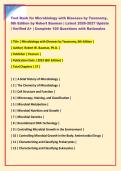
Test Bank for Microbiology with Diseases by Taxonomy,
6th Edition by Robert Bauman | Latest 2026-2027 Update
| Verified A+ | Complete 100 Questions with Rationales
| Title | Microbiology with Diseases by Taxonomy, 6th Edition |
| Author| Robert W. Bauman, Ph.D. |
| Publisher | Pearson |
| Publication Date | 2019 (6th Edition) |
| Total Chapters | 27 |
| 1 | A Brief History of Microbiology |
| 2 | The Chemistry of Microbiology |
| 3 | Cell Structure and Function |
| 4 | Microscopy, Staining, and Classification |
| 5 | Microbial Metabolism |
| 6 | Microbial Nutrition and Growth |
| 7 | Microbial Genetics |
| 8 | Recombinant DNA Technology |
| 9 | Controlling Microbial Growth in the Environment |
| 10 | Controlling Microbial Growth in the Body: Antimicrobial Drugs |
| 11 | Characterizing and Classifying Prokaryotes |
| 12 | Characterizing and Classifying Eukaryotes |
,2
| 13 | Characterizing and Classifying Viruses, Viroids, and Prions |
| 14 | Infection, Infectious Diseases, and Epidemiology |
| 15 | Innate Immunity |
| 16 | Specific Defense: Adaptive Immunity |
| 17 | Immunization and Immune Testing |
| 18 | Hypersensitivities, Autoimmune Diseases, and Immune Deficiencies |
| 19 | Pathogenic Gram-Positive Bacteria |
| 20 | Pathogenic Gram-Negative Cocci and Bacilli |
| 21 | Rickettsias, Chlamydias, Spirochetes, and Vibrios |
| 22 | Pathogenic Fungi |
| 23 | Parasitic Protozoa, Helminths, and Arthropod Vectors |
| 24 | Pathogenic DNA Viruses |
| 25 | Pathogenic RNA Viruses |
| 26 | Applied and Industrial Microbiology |
| 27 | Microbial Ecology and Microbiomes |
CHAPTER 1: A BRIEF HISTORY OF MICROBIOLOGY
,3
1. Antoni van Leeuwenhoek was the first person in history to:
A) Use a magnifying glass
B) Develop a taxonomic system
C) View microorganisms and record these observations
D) Disprove spontaneous generation
E) Propose the germ theory of disease
Correct Answer: C
Rationale: Antoni van Leeuwenhoek (1632-1723) was a Dutch cloth
merchant who made over 500 simple microscopes and was the first to
observe and record microorganisms, which he called "animalcules." Robert
Hooke used a magnifying glass and compound microscope but did not focus
on microorganisms. Carolus Linnaeus developed the taxonomic system.
Francesco Redi disproved spontaneous generation for larger organisms.
Louis Pasteur and Robert Koch contributed to the germ theory of disease.
2. The theory that living organisms can arise from nonliving matter is called:
A) Biogenesis
B) Spontaneous generation
, 4
C) Germ theory
D) Cell theory
E) Evolution
Correct Answer: B
Rationale: Spontaneous generation (also called abiogenesis) was the belief
that living organisms could arise from nonliving matter. This theory was
challenged by Francesco Redi's experiments with maggots and meat, and
later definitively disproved by Louis Pasteur's swan-neck flask experiments.
Biogenesis is the principle that living organisms arise only from preexisting
living organisms.
3. Which scientist is credited with definitively disproving the theory of
spontaneous generation?
A) Francesco Redi
B) John Needham
C) Lazzaro Spallanzani
D) Louis Pasteur
E) Robert Koch
Correct Answer: D
Test Bank for Microbiology with Diseases by Taxonomy,
6th Edition by Robert Bauman | Latest 2026-2027 Update
| Verified A+ | Complete 100 Questions with Rationales
| Title | Microbiology with Diseases by Taxonomy, 6th Edition |
| Author| Robert W. Bauman, Ph.D. |
| Publisher | Pearson |
| Publication Date | 2019 (6th Edition) |
| Total Chapters | 27 |
| 1 | A Brief History of Microbiology |
| 2 | The Chemistry of Microbiology |
| 3 | Cell Structure and Function |
| 4 | Microscopy, Staining, and Classification |
| 5 | Microbial Metabolism |
| 6 | Microbial Nutrition and Growth |
| 7 | Microbial Genetics |
| 8 | Recombinant DNA Technology |
| 9 | Controlling Microbial Growth in the Environment |
| 10 | Controlling Microbial Growth in the Body: Antimicrobial Drugs |
| 11 | Characterizing and Classifying Prokaryotes |
| 12 | Characterizing and Classifying Eukaryotes |
,2
| 13 | Characterizing and Classifying Viruses, Viroids, and Prions |
| 14 | Infection, Infectious Diseases, and Epidemiology |
| 15 | Innate Immunity |
| 16 | Specific Defense: Adaptive Immunity |
| 17 | Immunization and Immune Testing |
| 18 | Hypersensitivities, Autoimmune Diseases, and Immune Deficiencies |
| 19 | Pathogenic Gram-Positive Bacteria |
| 20 | Pathogenic Gram-Negative Cocci and Bacilli |
| 21 | Rickettsias, Chlamydias, Spirochetes, and Vibrios |
| 22 | Pathogenic Fungi |
| 23 | Parasitic Protozoa, Helminths, and Arthropod Vectors |
| 24 | Pathogenic DNA Viruses |
| 25 | Pathogenic RNA Viruses |
| 26 | Applied and Industrial Microbiology |
| 27 | Microbial Ecology and Microbiomes |
CHAPTER 1: A BRIEF HISTORY OF MICROBIOLOGY
,3
1. Antoni van Leeuwenhoek was the first person in history to:
A) Use a magnifying glass
B) Develop a taxonomic system
C) View microorganisms and record these observations
D) Disprove spontaneous generation
E) Propose the germ theory of disease
Correct Answer: C
Rationale: Antoni van Leeuwenhoek (1632-1723) was a Dutch cloth
merchant who made over 500 simple microscopes and was the first to
observe and record microorganisms, which he called "animalcules." Robert
Hooke used a magnifying glass and compound microscope but did not focus
on microorganisms. Carolus Linnaeus developed the taxonomic system.
Francesco Redi disproved spontaneous generation for larger organisms.
Louis Pasteur and Robert Koch contributed to the germ theory of disease.
2. The theory that living organisms can arise from nonliving matter is called:
A) Biogenesis
B) Spontaneous generation
, 4
C) Germ theory
D) Cell theory
E) Evolution
Correct Answer: B
Rationale: Spontaneous generation (also called abiogenesis) was the belief
that living organisms could arise from nonliving matter. This theory was
challenged by Francesco Redi's experiments with maggots and meat, and
later definitively disproved by Louis Pasteur's swan-neck flask experiments.
Biogenesis is the principle that living organisms arise only from preexisting
living organisms.
3. Which scientist is credited with definitively disproving the theory of
spontaneous generation?
A) Francesco Redi
B) John Needham
C) Lazzaro Spallanzani
D) Louis Pasteur
E) Robert Koch
Correct Answer: D