
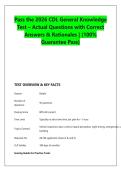
Pass the 2026 CDL General Knowledge
Test – Actual Questions with Correct
Answers & Rationales | (100%
Guarantee Pass)
TEST OVERVIEW & KEY FACTS
Feature Details
Number of
50 questions
Questions
Passing Score 80% (40 correct)
Time Limit Typically no strict time limit, but plan for ~1 hour
Vehicle inspection, basic control, hazard perception, night driving, emergencies, ca
Topics Covered
handling
Required For All CDL applicants (Class A, B, and C)
CLP Validity 180 days (6 months)
Scoring Guide for Practice Tests:
, 13-14 correct (93-100%) : Ready for the exam
11-12 correct (79-86%) : Almost there; review missed questions
9-10 correct (64-71%) : Need more study time
Below 9 (under 64%) : Read the full CDL manual
SECTION 1: VEHICLE INSPECTION & SAFETY
Q1. What is the most important reason to inspect your truck or bus before driving?
A. To avoid fines from law enforcement
B. To ensure the vehicle is safe to operate and prevent breakdowns
C. To save fuel costs
D. To comply with company policy
Answer: B
Rationale: The primary reason for pre-trip inspections is safety. Inspecting your vehicle
before driving helps identify potential mechanical issues that could cause accidents or
breakdowns.
Q2. During a pre-trip inspection of the engine compartment, which of these is NOT
typically checked?
A. Battery fluid level
B. Oil level
C. Coolant level
D. Amount of fuel in the vehicle
Answer: D
Rationale: The amount of fuel is typically checked using the fuel gauge, not as part of a
pre-trip inspection. Battery fluid level, oil, and coolant are important checks that can
prevent fires and breakdowns.
,Q3. What should you check wheel bearing seals for during a vehicle inspection?
A. Proper color coding
B. Leaks
C. Tire pressure
D. Rust
Answer: B
Rationale: Leaking wheel bearing seals allow grease to escape, which can cause
bearings to overheat, seize, or catch fire. Check for visible grease on the inside of the
wheel and tire.
Q4. Which of the following problems, if found during a pre-trip inspection, should be
fixed before the vehicle is driven?
A. Slight oil stain on the engine block
B. Steering wheel play of more than 10 degrees
C. Low windshield washer fluid
D. Minor scratches on the paint
Answer: B
Rationale: Steering wheel play of more than 10 degrees (about 2 inches on a 20-inch
steering wheel) indicates a serious steering system problem that must be fixed before
driving. Excessive play reduces steering control and is a safety hazard.
Q5. Rust around wheel nuts on a commercial vehicle may mean:
A. The wheels or rims have had welding repairs
B. The nuts are loose
C. The weather is wet
D. The nuts are too tight
Answer: B
, Rationale: Rust around wheel nuts can indicate that the nuts are loose. Loose wheel
nuts can cause wheels to detach from the vehicle while driving.
Q6. Which of these items is NOT checked for a standard pre-trip inspection?
A. Brake adjustment
B. Tire condition
C. Windshield wipers
D. Amount of fuel in the vehicle
Answer: D
Rationale: The amount of fuel is not a standard pre-trip inspection item. Brake
adjustment, tire condition, and windshield wipers are all critical safety items that must
be checked.
Q7. During the vehicle inspection, checking of ________ will NOT prevent a fire?
A. Electrical systems
B. Exhaust systems
C. Fuel systems
D. Battery fluid level
Answer: D
Rationale: While battery fluid level is important for battery function, checking it will not
directly prevent a fire. Electrical, exhaust, and fuel systems are the primary fire
prevention checks.
SECTION 2: BASIC VEHICLE CONTROL
Q8. If you are traveling at 55 mph in a 30-foot vehicle, how many seconds of following
distance should you have?


