
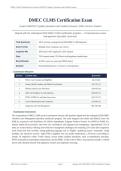
DMEC CLMS Certification Exam (Latest 2026/2027 Update) | Questions and Verified Answers
DMEC CLMS Certification Exam
(Latest 2026/2027 Update) Questions and Verified Answers | 100% Correct | Grade A
Aligned with the redesigned 2026 DMEC CLMS certification program — Comprehensive Leave
Management Specialist curriculum.
Total Questions 100 (7 sections covering the full 2026 DMEC CLMS blueprint)
Exam Format Multiple choice (4 options, one correct)
Cognitive Mix 30% Recall | 50% Application | 20% Analysis
Style 75% Scenario-based | 25% Direct recall/regulatory identification
Recertification 20 CEUs every two years (per DMEC policy)
Duration Recommended practice: 2.5 hours (1.5 min/question)
Examination Blueprint
Section Content Area Questions
1 FMLA Core Concepts and Eligibility Q1-20 (20)
2 Serious Health Condition and Medical Certification Q21-35 (15)
3 Military Family Leave Provisions Q36-45 (10)
4 ADA and Workplace Accommodations Q46-60 (15)
5 PWFA, PUMP Act, and State Leave Laws Q61-75 (15)
6 Leave Administration and Compliance Q76-90 (15)
7 Integration and Case Management Q91-100 (10)
Examination Instructions
This comprehensive DMEC CLMS practice examination contains 100 questions aligned with the redesigned 2026 DMEC
Certified Leave Management Specialist certification program. The exam integrates the Family and Medical Leave Act
(FMLA), Americans with Disabilities Act (ADA) Amendments, Pregnant Workers Fairness Act (PWFA), PUMP Act,
military family leave provisions, state leave law coordination, and integrated case management. Approximately 75% of
items are scenario-based, reflecting real-world leave management challenges; the remaining 25% assess direct regulatory
recall. Read each stem carefully, noting qualifying language such as 'eligible,' 'qualifying reason,' 'reasonable,' 'undue
hardship,' and 'interactive process.' Apply FMLA eligibility tests (12 months employment, 1,250 hours in preceding 12
months, 50 employees within 75-mile radius), serious health condition definitions, ADA accommodation principles,
PWFA reasonable accommodation requirements, and the DMEC CLMS Code of Ethics. Each question includes a verified
answer and a detailed rationale with regulatory citations and compliance reasoning.
100% Correct | Grade A Page 1 Aligned with 2026 DMEC CLMS Certification Program
,DMEC CLMS Certification Exam (Latest 2026/2027 Update) | Questions and Verified Answers
Section 1: FMLA Core Concepts and Eligibility (Q1-20)
Eligibility Requirements, Qualifying Reasons, Employee Rights, Employer Obligations, and Intermittent Leave.
Q1: An employee requests FMLA leave. The leave administrator reviews the file and notes the employee was hired
11 months ago, has worked 1,400 hours, and works at a site with 60 employees within 75 miles. What is the correct
eligibility determination?
A. Eligible, because the employee meets the hours-worked and 50-employee tests.
B. Not eligible, because the employee has not met the 12-month employment requirement. [CORRECT]
C. Eligible, because the 12-month requirement can be waived if hours exceed 1,250.
D. Not eligible, because the employee must work at the exact site with 50 employees.
Correct Answer: B
Rationale:
FMLA eligibility requires all three tests: (1) 12 months of employment with the employer (does not need to be
consecutive), (2) at least 1,250 hours worked in the 12 months immediately preceding the leave, and (3) works
at a worksite where the employer employs 50 or more employees within a 75-mile radius. Here the employee
meets the hours and worksite tests but not the 12-month service requirement, so they are not yet eligible. The
12-month requirement cannot be waived, and the 75-mile rule is measured from the employee's worksite, not
requiring the employee to physically work at the 50-employee site.
Q2: An employee worked for the employer from 2018 to 2021, left, and returned in 2024. As of the leave request
date in 2026, the employee has 16 cumulative months of employment but only 9 consecutive months since rehire,
with 1,500 hours in the preceding 12 months. Is the employee FMLA-eligible?
A. No, because the break in service resets the 12-month clock.
B. Yes, because prior service can be counted toward the 12-month total when the break in service is less
than 5 years (with exceptions). [CORRECT]
C. No, because rehired employees must complete a new 12-month period before eligibility.
D. Yes, but only if the prior service was at the same worksite.
Correct Answer: B
Rationale:
Under 29 CFR 825.110(b)(1), an employee must be employed for at least 12 months, and prior service counts if
the break in service is less than 7 years (with exceptions for National Guard service, written agreement, or other
compliant circumstances). The break here (2021-2024) is under the 7-year limit, so cumulative service counts;
the employee has 16 months total and meets the 1,250-hour requirement. The 12-month requirement is satisfied
through combined service. Worksite consistency is not required for the service test.
Q3: Which of the following is NOT a qualifying reason for FMLA leave under the federal FMLA?
A. Birth of a son or daughter and to care for the newborn within one year of birth.
B. Placement with the employee of a child for adoption or foster care within one year of placement.
C. Care of an elderly parent who requires assistance with instrumental activities of daily living but has
no serious health condition. [CORRECT]
100% Correct | Grade A Page 2 Aligned with 2026 DMEC CLMS Certification Program
,DMEC CLMS Certification Exam (Latest 2026/2027 Update) | Questions and Verified Answers
D. The employee's own serious health condition that makes the employee unable to perform the essential
functions of the job.
Correct Answer: C
Rationale:
FMLA qualifying reasons under 29 U.S.C. 2612(a)(1) include: (A) birth/care of newborn within one year; (B)
placement/adoption/foster care within one year; (C) care of spouse, son, daughter, or parent with a serious
health condition; (D) employee's own serious health condition; (E) qualifying exigency for covered military
member; and (F) military caregiver leave. Care of an elderly parent who does not have a serious health
condition is not a qualifying reason, regardless of how much assistance they need. The parent must have a
serious health condition as defined by FMLA regulations.
Q4: An eligible employee's spouse gives birth to a child. Both parents work for the same covered employer. How is
the 12-week FMLA entitlement applied?
A. Each parent is entitled to a full 12 weeks for bonding and for caring for the spouse/child.
B. The 12 weeks for bonding and for care of a spouse with a serious health condition is shared between
the spouses (combined limit of 12 weeks for those reasons). [CORRECT]
C. Only the mother is entitled to FMLA leave; the father is not eligible for bonding leave.
D. Each parent is entitled to 26 weeks because childbirth triggers military caregiver limits.
Correct Answer: B
Rationale:
Under 29 CFR 825.120(h) and 825.200, when spouses are employed by the same covered employer, the
combined 12-week entitlement is shared for: (1) birth of a son or daughter or care of the newborn; (2) placement
for adoption/foster care; and (3) care of a parent with a serious health condition. However, each spouse is
separately entitled to 12 weeks for their own serious health condition or for the serious health condition of a
child. The 26-week military caregiver limit is unrelated to ordinary childbirth.
Q5: An employee is eligible for FMLA leave and has used 6 weeks for their own serious health condition. Six
months later, the employee's parent develops a serious health condition. How much FMLA leave remains available in
the current 12-month period?
A. 12 weeks, because each qualifying reason has its own 12-week allotment.
B. 6 weeks, because the 12-week entitlement is a combined total per 12-month period regardless of reason
(with military caregiver as an exception). [CORRECT]
C. 0 weeks, because the employee already used FMLA in the same year.
D. 26 weeks, because caregiving triggers the military caregiver limit.
Correct Answer: B
Rationale:
Under FMLA, an eligible employee is entitled to 12 workweeks of leave in a defined 12-month period for
qualifying reasons (other than military caregiver leave, which provides up to 26 weeks). The 12-week total is
combined across all qualifying reasons within the same 12-month period. The 6 weeks already used leaves 6
weeks remaining for the parent's care. The 26-workweek limit applies only to military caregiver leave in a
single 12-month period.
100% Correct | Grade A Page 3 Aligned with 2026 DMEC CLMS Certification Program
, DMEC CLMS Certification Exam (Latest 2026/2027 Update) | Questions and Verified Answers
Q6: Which method for determining the 12-month FMLA period is most advantageous to the employee (provides the
longest possible continuous leave)?
A. Calendar year (January 1 - December 31).
B. Fixed 12-month period (e.g., fiscal year or anniversary date).
C. 12-month period measured forward from the first date FMLA leave begins. [CORRECT]
D. Rolling 12-month period measured backward from the date of any FMLA leave usage.
Correct Answer: C
Rationale:
Per 29 CFR 825.200(b), employers may choose from four methods. The 'rolling forward' method (measured
forward from the date of first FMLA leave use) can allow an employee to potentially take up to 24 weeks of
continuous leave spanning the end of one 12-month period and the beginning of the next, when the leave
straddles the period boundary. The 'rolling backward' method is the most restrictive for employees. Employers
must apply the chosen method consistently and uniformly to all employees, and must give 60 days' notice
before changing methods.
Q7: An employee with migraine headaches requests intermittent FMLA leave. The leave administrator is concerned
about unpredictable absences disrupting operations. Which statement best describes the employer's obligations?
A. The employer may deny intermittent leave for migraines because it is not a qualifying condition.
B. The employer must allow intermittent leave for the employee's own serious health condition
(migraines) when medically necessary, and may transfer the employee to an alternative position with
equivalent pay and benefits only if the intermittent leave is foreseeable based on planned treatment.
[CORRECT]
C. The employer may require the employee to use all 12 weeks consecutively before returning to work.
D. The employer may grant intermittent leave only if the employee provides a fixed schedule 30 days in
advance.
Correct Answer: B
Rationale:
Under 29 CFR 825.202, intermittent leave or a reduced leave schedule is available when medically necessary
for the employee's own serious health condition (including chronic conditions like migraines), a family
member's serious health condition, or for qualifying exigencies. Intermittent leave for bonding or for
foreseeable treatment may allow transfer to an alternative position only when the leave is foreseeable based on
planned treatment (not for chronic conditions). The employer cannot require consecutive use or a fixed schedule
for unpredictable conditions. Transfer to an equivalent position with equivalent pay/benefits is the limited
remedy when the leave is foreseeable/planned.
Q8: An employee gives 30 days' notice of foreseeable FMLA leave for scheduled surgery. Two weeks before the
scheduled leave, the employee fails to provide a complete medical certification despite the 15-day deadline. What
should the employer do?
A. Deny the FMLA leave automatically and discipline the employee.
B. Provide written notice that the certification is incomplete or insufficient, allow the employee at least 7
calendar days to cure the deficiency, and meet with the employee to discuss; only deny if the deficiency is
not cured. [CORRECT]
100% Correct | Grade A Page 4 Aligned with 2026 DMEC CLMS Certification Program
DMEC CLMS Certification Exam
(Latest 2026/2027 Update) Questions and Verified Answers | 100% Correct | Grade A
Aligned with the redesigned 2026 DMEC CLMS certification program — Comprehensive Leave
Management Specialist curriculum.
Total Questions 100 (7 sections covering the full 2026 DMEC CLMS blueprint)
Exam Format Multiple choice (4 options, one correct)
Cognitive Mix 30% Recall | 50% Application | 20% Analysis
Style 75% Scenario-based | 25% Direct recall/regulatory identification
Recertification 20 CEUs every two years (per DMEC policy)
Duration Recommended practice: 2.5 hours (1.5 min/question)
Examination Blueprint
Section Content Area Questions
1 FMLA Core Concepts and Eligibility Q1-20 (20)
2 Serious Health Condition and Medical Certification Q21-35 (15)
3 Military Family Leave Provisions Q36-45 (10)
4 ADA and Workplace Accommodations Q46-60 (15)
5 PWFA, PUMP Act, and State Leave Laws Q61-75 (15)
6 Leave Administration and Compliance Q76-90 (15)
7 Integration and Case Management Q91-100 (10)
Examination Instructions
This comprehensive DMEC CLMS practice examination contains 100 questions aligned with the redesigned 2026 DMEC
Certified Leave Management Specialist certification program. The exam integrates the Family and Medical Leave Act
(FMLA), Americans with Disabilities Act (ADA) Amendments, Pregnant Workers Fairness Act (PWFA), PUMP Act,
military family leave provisions, state leave law coordination, and integrated case management. Approximately 75% of
items are scenario-based, reflecting real-world leave management challenges; the remaining 25% assess direct regulatory
recall. Read each stem carefully, noting qualifying language such as 'eligible,' 'qualifying reason,' 'reasonable,' 'undue
hardship,' and 'interactive process.' Apply FMLA eligibility tests (12 months employment, 1,250 hours in preceding 12
months, 50 employees within 75-mile radius), serious health condition definitions, ADA accommodation principles,
PWFA reasonable accommodation requirements, and the DMEC CLMS Code of Ethics. Each question includes a verified
answer and a detailed rationale with regulatory citations and compliance reasoning.
100% Correct | Grade A Page 1 Aligned with 2026 DMEC CLMS Certification Program
,DMEC CLMS Certification Exam (Latest 2026/2027 Update) | Questions and Verified Answers
Section 1: FMLA Core Concepts and Eligibility (Q1-20)
Eligibility Requirements, Qualifying Reasons, Employee Rights, Employer Obligations, and Intermittent Leave.
Q1: An employee requests FMLA leave. The leave administrator reviews the file and notes the employee was hired
11 months ago, has worked 1,400 hours, and works at a site with 60 employees within 75 miles. What is the correct
eligibility determination?
A. Eligible, because the employee meets the hours-worked and 50-employee tests.
B. Not eligible, because the employee has not met the 12-month employment requirement. [CORRECT]
C. Eligible, because the 12-month requirement can be waived if hours exceed 1,250.
D. Not eligible, because the employee must work at the exact site with 50 employees.
Correct Answer: B
Rationale:
FMLA eligibility requires all three tests: (1) 12 months of employment with the employer (does not need to be
consecutive), (2) at least 1,250 hours worked in the 12 months immediately preceding the leave, and (3) works
at a worksite where the employer employs 50 or more employees within a 75-mile radius. Here the employee
meets the hours and worksite tests but not the 12-month service requirement, so they are not yet eligible. The
12-month requirement cannot be waived, and the 75-mile rule is measured from the employee's worksite, not
requiring the employee to physically work at the 50-employee site.
Q2: An employee worked for the employer from 2018 to 2021, left, and returned in 2024. As of the leave request
date in 2026, the employee has 16 cumulative months of employment but only 9 consecutive months since rehire,
with 1,500 hours in the preceding 12 months. Is the employee FMLA-eligible?
A. No, because the break in service resets the 12-month clock.
B. Yes, because prior service can be counted toward the 12-month total when the break in service is less
than 5 years (with exceptions). [CORRECT]
C. No, because rehired employees must complete a new 12-month period before eligibility.
D. Yes, but only if the prior service was at the same worksite.
Correct Answer: B
Rationale:
Under 29 CFR 825.110(b)(1), an employee must be employed for at least 12 months, and prior service counts if
the break in service is less than 7 years (with exceptions for National Guard service, written agreement, or other
compliant circumstances). The break here (2021-2024) is under the 7-year limit, so cumulative service counts;
the employee has 16 months total and meets the 1,250-hour requirement. The 12-month requirement is satisfied
through combined service. Worksite consistency is not required for the service test.
Q3: Which of the following is NOT a qualifying reason for FMLA leave under the federal FMLA?
A. Birth of a son or daughter and to care for the newborn within one year of birth.
B. Placement with the employee of a child for adoption or foster care within one year of placement.
C. Care of an elderly parent who requires assistance with instrumental activities of daily living but has
no serious health condition. [CORRECT]
100% Correct | Grade A Page 2 Aligned with 2026 DMEC CLMS Certification Program
,DMEC CLMS Certification Exam (Latest 2026/2027 Update) | Questions and Verified Answers
D. The employee's own serious health condition that makes the employee unable to perform the essential
functions of the job.
Correct Answer: C
Rationale:
FMLA qualifying reasons under 29 U.S.C. 2612(a)(1) include: (A) birth/care of newborn within one year; (B)
placement/adoption/foster care within one year; (C) care of spouse, son, daughter, or parent with a serious
health condition; (D) employee's own serious health condition; (E) qualifying exigency for covered military
member; and (F) military caregiver leave. Care of an elderly parent who does not have a serious health
condition is not a qualifying reason, regardless of how much assistance they need. The parent must have a
serious health condition as defined by FMLA regulations.
Q4: An eligible employee's spouse gives birth to a child. Both parents work for the same covered employer. How is
the 12-week FMLA entitlement applied?
A. Each parent is entitled to a full 12 weeks for bonding and for caring for the spouse/child.
B. The 12 weeks for bonding and for care of a spouse with a serious health condition is shared between
the spouses (combined limit of 12 weeks for those reasons). [CORRECT]
C. Only the mother is entitled to FMLA leave; the father is not eligible for bonding leave.
D. Each parent is entitled to 26 weeks because childbirth triggers military caregiver limits.
Correct Answer: B
Rationale:
Under 29 CFR 825.120(h) and 825.200, when spouses are employed by the same covered employer, the
combined 12-week entitlement is shared for: (1) birth of a son or daughter or care of the newborn; (2) placement
for adoption/foster care; and (3) care of a parent with a serious health condition. However, each spouse is
separately entitled to 12 weeks for their own serious health condition or for the serious health condition of a
child. The 26-week military caregiver limit is unrelated to ordinary childbirth.
Q5: An employee is eligible for FMLA leave and has used 6 weeks for their own serious health condition. Six
months later, the employee's parent develops a serious health condition. How much FMLA leave remains available in
the current 12-month period?
A. 12 weeks, because each qualifying reason has its own 12-week allotment.
B. 6 weeks, because the 12-week entitlement is a combined total per 12-month period regardless of reason
(with military caregiver as an exception). [CORRECT]
C. 0 weeks, because the employee already used FMLA in the same year.
D. 26 weeks, because caregiving triggers the military caregiver limit.
Correct Answer: B
Rationale:
Under FMLA, an eligible employee is entitled to 12 workweeks of leave in a defined 12-month period for
qualifying reasons (other than military caregiver leave, which provides up to 26 weeks). The 12-week total is
combined across all qualifying reasons within the same 12-month period. The 6 weeks already used leaves 6
weeks remaining for the parent's care. The 26-workweek limit applies only to military caregiver leave in a
single 12-month period.
100% Correct | Grade A Page 3 Aligned with 2026 DMEC CLMS Certification Program
, DMEC CLMS Certification Exam (Latest 2026/2027 Update) | Questions and Verified Answers
Q6: Which method for determining the 12-month FMLA period is most advantageous to the employee (provides the
longest possible continuous leave)?
A. Calendar year (January 1 - December 31).
B. Fixed 12-month period (e.g., fiscal year or anniversary date).
C. 12-month period measured forward from the first date FMLA leave begins. [CORRECT]
D. Rolling 12-month period measured backward from the date of any FMLA leave usage.
Correct Answer: C
Rationale:
Per 29 CFR 825.200(b), employers may choose from four methods. The 'rolling forward' method (measured
forward from the date of first FMLA leave use) can allow an employee to potentially take up to 24 weeks of
continuous leave spanning the end of one 12-month period and the beginning of the next, when the leave
straddles the period boundary. The 'rolling backward' method is the most restrictive for employees. Employers
must apply the chosen method consistently and uniformly to all employees, and must give 60 days' notice
before changing methods.
Q7: An employee with migraine headaches requests intermittent FMLA leave. The leave administrator is concerned
about unpredictable absences disrupting operations. Which statement best describes the employer's obligations?
A. The employer may deny intermittent leave for migraines because it is not a qualifying condition.
B. The employer must allow intermittent leave for the employee's own serious health condition
(migraines) when medically necessary, and may transfer the employee to an alternative position with
equivalent pay and benefits only if the intermittent leave is foreseeable based on planned treatment.
[CORRECT]
C. The employer may require the employee to use all 12 weeks consecutively before returning to work.
D. The employer may grant intermittent leave only if the employee provides a fixed schedule 30 days in
advance.
Correct Answer: B
Rationale:
Under 29 CFR 825.202, intermittent leave or a reduced leave schedule is available when medically necessary
for the employee's own serious health condition (including chronic conditions like migraines), a family
member's serious health condition, or for qualifying exigencies. Intermittent leave for bonding or for
foreseeable treatment may allow transfer to an alternative position only when the leave is foreseeable based on
planned treatment (not for chronic conditions). The employer cannot require consecutive use or a fixed schedule
for unpredictable conditions. Transfer to an equivalent position with equivalent pay/benefits is the limited
remedy when the leave is foreseeable/planned.
Q8: An employee gives 30 days' notice of foreseeable FMLA leave for scheduled surgery. Two weeks before the
scheduled leave, the employee fails to provide a complete medical certification despite the 15-day deadline. What
should the employer do?
A. Deny the FMLA leave automatically and discipline the employee.
B. Provide written notice that the certification is incomplete or insufficient, allow the employee at least 7
calendar days to cure the deficiency, and meet with the employee to discuss; only deny if the deficiency is
not cured. [CORRECT]
100% Correct | Grade A Page 4 Aligned with 2026 DMEC CLMS Certification Program


