

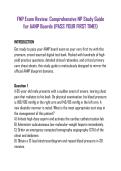
FNP Exam Review: Comprehensive NP Study Guide
for AANP Boards (PASS YOUR FIRST TIME!)
INTRODUCTION
Get ready to pass your AANP board exam on your very first try with this
premium, crowd-sourced digital test bank. Packed with hundreds of high-
yield practice questions, detailed clinical rationales, and critical primary
care cheat sheets, this study guide is meticulously designed to mirror the
official AANP blueprint domains.
Question 1
A 65-year-old male presents with a sudden onset of severe, tearing chest
pain that radiates to his back. On physical examination, his blood pressure
is 180/100 mmHg in the right arm and 140/85 mmHg in the left arm. A
new diastolic murmur is noted. What is the most appropriate next step in
the management of this patient?
A) Initiate high-dose aspirin and activate the cardiac catheterization lab.
B) Administer subcutaneous low-molecular-weight heparin immediately.
C) Order an emergency computed tomography angiography (CTA) of the
chest and abdomen.
D) Obtain a 12-lead electrocardiogram and repeat blood pressure in 30
minutes.
,Answer: C) Order an emergency computed tomography angiography
(CTA) of the chest and abdomen.
Explanation: The clinical presentation is highly suggestive of an
acute aortic dissection, characterized by sudden, tearing chest pain
radiating to the back and a significant pulse or blood pressure
disparity between limbs (>20 mmHg systolic difference). A new
diastolic murmur indicates aortic regurgitation secondary to the
dissection involving the aortic root. CTA of the chest and abdomen is
the gold-standard diagnostic imaging technique for
hemodynamically stable patients suspected of having an aortic
dissection, as it quickly confirms the diagnosis and delineates the
anatomical extent. Delaying for a repeat blood pressure reading or
initiating anticoagulation/antiplatelet therapy (A or B) would be
catastrophic, as it worsens active hemorrhage.
Question 2
A 45-year-old female presents with complaints of fatigue, cold
intolerance, weight gain, and constipation over the past 4 months.
Laboratory findings reveal a Thyroid Stimulating Hormone (TSH) of 14.2
mIU/L and a free T4 of 0.6 ng/dL. Which of the following is the most
appropriate initial maintenance dose of levothyroxine for this patient,
assuming she has no cardiovascular disease?
A) Levothyroxine 25 mcg PO daily
B) Levothyroxine 50 mcg PO daily
,C) Levothyroxine 1.6 mcg/kg/day PO daily
D) Levothyroxine 200 mcg PO daily
Answer: C) Levothyroxine 1.6 mcg/kg/day PO daily
Explanation: The patient has primary hypothyroidism, confirmed by
an elevated TSH and low free T4. For young, healthy adults without
underlying coronary artery disease or severe long-standing
hypothyroidism, the full replacement dose of levothyroxine can be
safely initiated. The standard full replacement dose is approximately
1.6 mcg/kg of ideal body weight per day. Starting at lower doses like
25 mcg or 50 mcg (A and B) is reserved for elderly patients or
those with co-existing cardiac disease ("start low and go slow") to
avoid precipitating myocardial ischemia or arrhythmias. A 200 mcg
dose (D) is inappropriately high and risks causing thyrotoxicosis.
Question 3
A 4-year-old male is brought to the clinic by his mother due to a 5-day
history of high fever up to 103.5°F. On examination, the nurse practitioner
notes bilateral conjunctival injection without exudate, a bright red
"strawberry tongue," dry cracked lips, erythema of the palms and soles,
and a single enlarged cervical lymph node measuring 1.8 cm. Which of the
following is the most critical long-term complication associated with this
condition?
A) Acute post-streptococcal glomerulonephritis
B) Coronary artery aneurysms
, C) Rheumatic heart disease
D) Permanent sensorineural hearing loss
Answer: B) Coronary artery aneurysms
Explanation: This clinical scenario describes Kawasaki disease, an
acute febrile vasculitis of childhood. The diagnostic criteria require
a fever lasting at least 5 days along with at least 4 out of 5 classic
clinical features: bilateral non-exudative conjunctivitis, oral mucosal
changes (strawberry tongue, cracked lips), polymorphous rash,
extremity changes (erythema/edema of hands and feet), and
cervical lymphadenopathy (>1.5 cm, usually unilateral). The most
significant and dangerous complication of untreated Kawasaki
disease is the development of coronary artery aneurysms, which
occurs in up to 25% of untreated children. Treatment with
Intravenous Immunoglobulin (IVIG) and high-dose aspirin within the
first 10 days of fever onset significantly reduces this risk.
Question 4
A 28-year-old female at 32 weeks' gestation presents for a routine
prenatal visit. Her blood pressure is 148/94 mmHg, which is confirmed on
repeat measurement 4 hours later. Her baseline blood pressure early in
pregnancy was 110/70 mmHg. Urinalysis reveals a protein-to-creatinine
ratio of 0.35 mg/mg. She denies headaches, visual disturbances, or right
upper quadrant pain. What is the correct diagnosis for this patient?
A) Gestational Hypertension
B) Chronic Hypertension
for AANP Boards (PASS YOUR FIRST TIME!)
INTRODUCTION
Get ready to pass your AANP board exam on your very first try with this
premium, crowd-sourced digital test bank. Packed with hundreds of high-
yield practice questions, detailed clinical rationales, and critical primary
care cheat sheets, this study guide is meticulously designed to mirror the
official AANP blueprint domains.
Question 1
A 65-year-old male presents with a sudden onset of severe, tearing chest
pain that radiates to his back. On physical examination, his blood pressure
is 180/100 mmHg in the right arm and 140/85 mmHg in the left arm. A
new diastolic murmur is noted. What is the most appropriate next step in
the management of this patient?
A) Initiate high-dose aspirin and activate the cardiac catheterization lab.
B) Administer subcutaneous low-molecular-weight heparin immediately.
C) Order an emergency computed tomography angiography (CTA) of the
chest and abdomen.
D) Obtain a 12-lead electrocardiogram and repeat blood pressure in 30
minutes.
,Answer: C) Order an emergency computed tomography angiography
(CTA) of the chest and abdomen.
Explanation: The clinical presentation is highly suggestive of an
acute aortic dissection, characterized by sudden, tearing chest pain
radiating to the back and a significant pulse or blood pressure
disparity between limbs (>20 mmHg systolic difference). A new
diastolic murmur indicates aortic regurgitation secondary to the
dissection involving the aortic root. CTA of the chest and abdomen is
the gold-standard diagnostic imaging technique for
hemodynamically stable patients suspected of having an aortic
dissection, as it quickly confirms the diagnosis and delineates the
anatomical extent. Delaying for a repeat blood pressure reading or
initiating anticoagulation/antiplatelet therapy (A or B) would be
catastrophic, as it worsens active hemorrhage.
Question 2
A 45-year-old female presents with complaints of fatigue, cold
intolerance, weight gain, and constipation over the past 4 months.
Laboratory findings reveal a Thyroid Stimulating Hormone (TSH) of 14.2
mIU/L and a free T4 of 0.6 ng/dL. Which of the following is the most
appropriate initial maintenance dose of levothyroxine for this patient,
assuming she has no cardiovascular disease?
A) Levothyroxine 25 mcg PO daily
B) Levothyroxine 50 mcg PO daily
,C) Levothyroxine 1.6 mcg/kg/day PO daily
D) Levothyroxine 200 mcg PO daily
Answer: C) Levothyroxine 1.6 mcg/kg/day PO daily
Explanation: The patient has primary hypothyroidism, confirmed by
an elevated TSH and low free T4. For young, healthy adults without
underlying coronary artery disease or severe long-standing
hypothyroidism, the full replacement dose of levothyroxine can be
safely initiated. The standard full replacement dose is approximately
1.6 mcg/kg of ideal body weight per day. Starting at lower doses like
25 mcg or 50 mcg (A and B) is reserved for elderly patients or
those with co-existing cardiac disease ("start low and go slow") to
avoid precipitating myocardial ischemia or arrhythmias. A 200 mcg
dose (D) is inappropriately high and risks causing thyrotoxicosis.
Question 3
A 4-year-old male is brought to the clinic by his mother due to a 5-day
history of high fever up to 103.5°F. On examination, the nurse practitioner
notes bilateral conjunctival injection without exudate, a bright red
"strawberry tongue," dry cracked lips, erythema of the palms and soles,
and a single enlarged cervical lymph node measuring 1.8 cm. Which of the
following is the most critical long-term complication associated with this
condition?
A) Acute post-streptococcal glomerulonephritis
B) Coronary artery aneurysms
, C) Rheumatic heart disease
D) Permanent sensorineural hearing loss
Answer: B) Coronary artery aneurysms
Explanation: This clinical scenario describes Kawasaki disease, an
acute febrile vasculitis of childhood. The diagnostic criteria require
a fever lasting at least 5 days along with at least 4 out of 5 classic
clinical features: bilateral non-exudative conjunctivitis, oral mucosal
changes (strawberry tongue, cracked lips), polymorphous rash,
extremity changes (erythema/edema of hands and feet), and
cervical lymphadenopathy (>1.5 cm, usually unilateral). The most
significant and dangerous complication of untreated Kawasaki
disease is the development of coronary artery aneurysms, which
occurs in up to 25% of untreated children. Treatment with
Intravenous Immunoglobulin (IVIG) and high-dose aspirin within the
first 10 days of fever onset significantly reduces this risk.
Question 4
A 28-year-old female at 32 weeks' gestation presents for a routine
prenatal visit. Her blood pressure is 148/94 mmHg, which is confirmed on
repeat measurement 4 hours later. Her baseline blood pressure early in
pregnancy was 110/70 mmHg. Urinalysis reveals a protein-to-creatinine
ratio of 0.35 mg/mg. She denies headaches, visual disturbances, or right
upper quadrant pain. What is the correct diagnosis for this patient?
A) Gestational Hypertension
B) Chronic Hypertension


