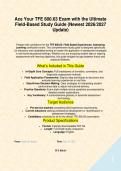
Ace Your TFE 800.63 Exam with the Ultimate
Field-Based Study Guide (Newest 2026/2027
Update)
Prepare with confidence for the TFE 800.63: Field Based Experiences: Assessing
Learning certification exam. This comprehensive study guide is designed specifically
for educators and candidates looking to master the application of assessment strategies
in real-world educational settings. Whether you are analyzing student data or aligning
assessments with learning objectives, this guide bridges the gap between theory and
practical fieldwork.
What’s Included in This Guide
• In-Depth Core Concepts: Full breakdowns of formative, summative, and
diagnostic assessment methods.
• Field Application Frameworks: Step-by-step techniques to document and
evaluate learning experiences in real time.
• Data-Driven Decision Making: Clear strategies for interpreting student
performance data to adjust instructional delivery.
• Practice Questions: Exam-style multiple-choice questions accompanied by
detailed answer explanations.
• Key Vocabulary: A comprehensive glossary of essential assessment
terminology.
Target Audience
• Pre-service teachers completing field experience requirements.
• Current educators seeking professional development or recertification in
assessment strategies.
• Candidates scheduled to sit for the official TFE 800.63 examination.
Product Specifications
• Format: Instantly downloadable PDF file.
• Length: Full-length study companion.
• Language: English.
Name: Study Ace Smart Date: June 18, 2026
TFE 800.63
1
, Field Based Experiences: Assessing Learning
Effective educators understand how to collect, analyze, and use assessment data to plan
instruction that meets student needs. This field-based experience (FBE) course draws on previous
courses such as TCR 405 Questioning Strategies and Feedback, TCR 406 Formal Assessment,
and TTL 409 Using Data to Inform Instruction.
As you spend time observing teachers and students in these five classrooms, watch for both
formative and summative assessment strategies. Pay close attention to the techniques the teacher
uses to gauge understanding and what they do with this information. Does the teacher reteach a
portion of the lesson, pause independent work to clarify a concept, or pull a small group aside to
give extra time for mastery? In your reflection, refer to previous coursework to connect what you
saw in the classroom with how assessment is used to guide instruction.
Reflection Questions:
1. In video 1 where you observed the classrooms of Ms. Christensen and Ms. Dunlap, what
type(s) of formative assessment did you see in the classes observed? How was it
administered and used to impact future instruction?
Ms. Christensen used several forms of formative assessment throughout her reading of small groups. She
listened as students read from a list of words and then transitioned them into reading a book aloud. While
students were reading, she asked simple comprehension questions and conducted a picture walk to
determine whether students understood the story before reading it independently. She was also assessing
vocabulary knowledge and prosody by having students read lines with expression and fluency. In
addition, she used hand signals as a quick check for understanding so she could immediately see which
students were confident and which students needed more support. The information she gathered helped
her decide which students needed additional practice with vocabulary, fluency, or comprehension skills.
Ms. Dunlap also used formative assessment continuously during her math lesson. At the beginning of
class, she asked students, “What are you going to have to pay attention to when you’re graphing today?”
and called on students to explain their thinking. Later, she had students solve a problem on the board and
explain their reasoning to the class. She also created a Quizlet activity that allowed students to practice
and demonstrate their understanding independently. In addition, she worked with small groups so she
could observe student thinking more closely and address misconceptions immediately. Rather than
waiting until the end of the unit to assess students, she used these formative assessments throughout the
lesson to determine what students understood and what concepts needed additional instruction.
2. The classrooms of Ms. Lassiter and Ms. Manske in video 2 are very hands-on
environments. How did each of these teachers employ formative assessments in their
classrooms? Provide specific examples of each.
2
Field-Based Study Guide (Newest 2026/2027
Update)
Prepare with confidence for the TFE 800.63: Field Based Experiences: Assessing
Learning certification exam. This comprehensive study guide is designed specifically
for educators and candidates looking to master the application of assessment strategies
in real-world educational settings. Whether you are analyzing student data or aligning
assessments with learning objectives, this guide bridges the gap between theory and
practical fieldwork.
What’s Included in This Guide
• In-Depth Core Concepts: Full breakdowns of formative, summative, and
diagnostic assessment methods.
• Field Application Frameworks: Step-by-step techniques to document and
evaluate learning experiences in real time.
• Data-Driven Decision Making: Clear strategies for interpreting student
performance data to adjust instructional delivery.
• Practice Questions: Exam-style multiple-choice questions accompanied by
detailed answer explanations.
• Key Vocabulary: A comprehensive glossary of essential assessment
terminology.
Target Audience
• Pre-service teachers completing field experience requirements.
• Current educators seeking professional development or recertification in
assessment strategies.
• Candidates scheduled to sit for the official TFE 800.63 examination.
Product Specifications
• Format: Instantly downloadable PDF file.
• Length: Full-length study companion.
• Language: English.
Name: Study Ace Smart Date: June 18, 2026
TFE 800.63
1
, Field Based Experiences: Assessing Learning
Effective educators understand how to collect, analyze, and use assessment data to plan
instruction that meets student needs. This field-based experience (FBE) course draws on previous
courses such as TCR 405 Questioning Strategies and Feedback, TCR 406 Formal Assessment,
and TTL 409 Using Data to Inform Instruction.
As you spend time observing teachers and students in these five classrooms, watch for both
formative and summative assessment strategies. Pay close attention to the techniques the teacher
uses to gauge understanding and what they do with this information. Does the teacher reteach a
portion of the lesson, pause independent work to clarify a concept, or pull a small group aside to
give extra time for mastery? In your reflection, refer to previous coursework to connect what you
saw in the classroom with how assessment is used to guide instruction.
Reflection Questions:
1. In video 1 where you observed the classrooms of Ms. Christensen and Ms. Dunlap, what
type(s) of formative assessment did you see in the classes observed? How was it
administered and used to impact future instruction?
Ms. Christensen used several forms of formative assessment throughout her reading of small groups. She
listened as students read from a list of words and then transitioned them into reading a book aloud. While
students were reading, she asked simple comprehension questions and conducted a picture walk to
determine whether students understood the story before reading it independently. She was also assessing
vocabulary knowledge and prosody by having students read lines with expression and fluency. In
addition, she used hand signals as a quick check for understanding so she could immediately see which
students were confident and which students needed more support. The information she gathered helped
her decide which students needed additional practice with vocabulary, fluency, or comprehension skills.
Ms. Dunlap also used formative assessment continuously during her math lesson. At the beginning of
class, she asked students, “What are you going to have to pay attention to when you’re graphing today?”
and called on students to explain their thinking. Later, she had students solve a problem on the board and
explain their reasoning to the class. She also created a Quizlet activity that allowed students to practice
and demonstrate their understanding independently. In addition, she worked with small groups so she
could observe student thinking more closely and address misconceptions immediately. Rather than
waiting until the end of the unit to assess students, she used these formative assessments throughout the
lesson to determine what students understood and what concepts needed additional instruction.
2. The classrooms of Ms. Lassiter and Ms. Manske in video 2 are very hands-on
environments. How did each of these teachers employ formative assessments in their
classrooms? Provide specific examples of each.
2