

given in Section 3.2.5, and a 40 cal I mol A val ue for the hydroph obic effect, calculate the di
ti and ga uche butane. Given a n estima ted surfa ce area for anti buta ne of 127 A2, estimate t
. Biochemistry I KEY Spring 2026
the discussion of Section 3.1.5, w hat is the driving force to fo rm some of B when pu re A is f
Recitation 1 (week of 1/26/26)
Group Problems - KEY
llowing com pou nds in orde r of increasing hydrogen bond donating ability towa rd me thyl
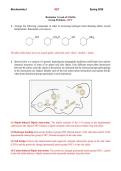
1. Arrange the following compounds in order of increasing hydrogen bond donating ability toward
er. methylamine. Rationalize your answer.
The pKa of the donor serves as a good guide: carboxylic acid > thiol > alcohol > amine
2. Shown below is a cartoon of a protein, depicting the polypeptide backbone (solid black line) and the
5. Shown below is a cartoon of a protein, depicting the polypeptide backbone (solid black line)
chemicalandstructures of some
the chemical of its
structures amino
of some acid
of its sideacid
amino chains. Four Four
side chains. different noncovalent
different noncovalentinteractions
between interactions
the amino acid sidethechains
between aminoin theside
acid protein
chainsare indicated
in the andindicated
protein are the chemical
and the groups
chemicalparticipating
in the interactions are shaded. Identify each of the four noncovalent interactions
groups participating in the interactions are shaded. Identify each of the four noncovalent and explain briefly
what atoms/functional
interactions and groups participate
explain briefly in each interaction.
what atoms/functional groups participate in each interaction.
(1) Dipole-induced Dipole interaction: The dipole moment of the C=O group of the deprotonated
carboxylate side chain (COO-) induces a dipole moment in the non-polar aromatic ring side chain.
(2) Hydrogen bonding between the hydroxyl group (OH; H-bond donor) of the side chain and O- of the
deprotonated carboxylate group (COO-; H-bond acceptor) in the side chain.
(3) Salt bridge between the deprotonated and negatively charged carboxylate group in the side chain
(COO-) and the positively charged protonated amino group (NH3+) in the side chain.
(4) Cation-induced Dipole interaction: The positively charged protonated amino group (NH3+; cation)
in the side chain induces a dipole moment in the non-polar aromatic ring side chain.
,Biochemistry I KEY Spring 2026
This exercise illustrates that the same group can participate in different types of noncovalent interactions.
The polar and negatively charged deprotonated COO- group participates in both a salt bridge and an
induced dipole interaction. Similarly, the polar and positively charged protonated amino group (NH3+) can
participate in both a salt bridge formation and a cation- induced dipole interaction.
3. The first reaction in glycolysis is the phosphorylation of glucose:
Glucose + Pi ⇌ Glucose 6-phosphate + H2O
This is a thermodynamically unfavorable process, with DG°’ = +13.8 kJ/mol.
(a) Calculate the Keq at 37°C for this first step of glycolysis. (R = 8.315 J/mol⋅K)
(b) Hydrolysis of ATP is favorable, with DG°’ = -30.5 kJ/mol. Show how ATP hydrolysis can be used to
favor the formation of glucose-6-phosphate and allow glycolysis to proceed. Include the DG°’ value for
the overall reaction.
(c) Calculate Keq at 37°C for the overall reaction.
(a) Glucose + Pi → Glucose 6-phosphate + H2O
ΔG°’ for the reaction is +13.8 kJ/mol = +13,800 J/mol
R = gas constant = 8.315 J/mol⋅K
T = 37°C + 273 = 310K
DG°’= - RT ln Keq
ln Keq = - (13,800 J/mol) ÷ (8.315 J/mol•K x 310K) = - 5.35
Keq = e-5.35 = 0.0047M-1
(b) Glucose + Pi → Glucose 6-phosphate + H2O ; DG°’= 13.8 kJ/mol
ATP + H2O → ADP + Pi ; DG°’ = - 30.5 kJ/mol
Sum: Glucose + ATP → Glucose 6-phosphate + ADP ; Net DG°’ = -16.7 kJ/mol
Coupling (or varying concentrations) thus can make the reaction favorable
(c) We calculated that the ΔG°’ for the reaction is -16.7 kJ/mol = -16,700 J/mol
R = gas constant = 8.315 J/mol⋅K
T = 37°C + 273 = 310K
Using the calculated DG°’ value, the Keq for the coupled reaction can be calculated as:
DG°’= - RT ln Keq
ln Keq = - (-16700 J/mol) / (8.315 J/mol•K x 310K) = 6.48
Keq = e6.48 = 651.97
Note, that by coupling the original endergonic reaction to a highly exergonic reaction, the value of the Keq
has increased by 138,717 times (0.0047 vs. 651.97). This implies that the equilibrium has been
significantly shifted towards the formation of Glc-6-P.
, Biochemistry I KEY Spring 2026
Also, note that the new equilibrium constant is dimensionless because in the expression for this Keq, (Keq
= [Gl-6-P][ADP] / [Glc][ATP]), there are two concentration-terms each in the numerator and the
denominator, which cancel out each other’s units.
Molarity of H2O is 55.5M and is much larger than any other concentrations present in the cell. Hence it is
almost a constant and ignored in Keq calculations where H2O is a reactant or a product.
4. If the glucose binding site in Hexokinase ((the enzyme that catalyzes the first reaction of
glycolysis, mentioned above) is buried deep in the interior of the enzyme, in a space packed mostly with
amino acid side chains and devoid of water molecules, is the ionic interaction between the enzyme
(hexokinase) and the substrate (glucose) stronger or weaker than what the same interaction would be on
the surface of the enzyme (which is completely exposed to the aqueous solvent)? Explain your answer
briefly and try to be as quantitative as possible (include an equation if necessary).
Answer: The strength, or energy (E), of ionic interactions in a solution depends on the magnitude of the
charges (Q), the distance between the charged groups (r), and the dielectric constant (ε, which is
dimensionless) of the solvent in which the interactions occur, according to the following
! #! #"
E = "pe ∙ $
When comparing the strength of the same ionic bond in water and in the water-excluded (hydrophobic)
environment inside a protein, we know that Q and r are the same; only the dielectric constant (ε) is
different. Water has a large dielectric constant because of the large number of dipoles. A hydrophobic
“solvent” such as the inside of a protein has a much smaller dielectric constant. Given that the strength of
the ionic interaction (E) varies as the inverse of the dielectric constant (ε), the ionic interaction would be
stronger in the protein environment, with the smaller dielectric constant.
5. Consider the reaction in which Glucose-6-P is converted to Fructose-6-P (the second step in glycolysis).
Glucose-6-phosphate ⇌ Fructose-6-Phosphate
You determine the ΔG˚’ for this reaction at a constant pressure of 1 atm, room temperature (298 K), with
[Glucose-6-P] = 1M and [Fructose-6-P] = 1M. You find the ΔG˚’ is +1.7 kJ/mol.
You now alter the concentration so that [Glucose-6-P] = 0.083 mM and [Fructose-6-P] = 0.014 mM.
Perform the following calculations, showing relevant equations.
a) What is the ΔG˚’ for the reaction under these conditions?
b) What is the ΔG for the reaction under these conditions?
c) Will the reaction proceed spontaneously under these conditions?
a) The value for ΔG˚’ is a constant that refers to the free energy change under biochemical standard
conditions (the initial conditions described with product and reactant concentrations at 1 M, 298K,
1atm pressure). Changing the conditions and the concentrations does not alter this constant value.
So ΔG˚’ remains = +1.7 kJ/mol
ti and ga uche butane. Given a n estima ted surfa ce area for anti buta ne of 127 A2, estimate t
. Biochemistry I KEY Spring 2026
the discussion of Section 3.1.5, w hat is the driving force to fo rm some of B when pu re A is f
Recitation 1 (week of 1/26/26)
Group Problems - KEY
llowing com pou nds in orde r of increasing hydrogen bond donating ability towa rd me thyl
1. Arrange the following compounds in order of increasing hydrogen bond donating ability toward
er. methylamine. Rationalize your answer.
The pKa of the donor serves as a good guide: carboxylic acid > thiol > alcohol > amine
2. Shown below is a cartoon of a protein, depicting the polypeptide backbone (solid black line) and the
5. Shown below is a cartoon of a protein, depicting the polypeptide backbone (solid black line)
chemicalandstructures of some
the chemical of its
structures amino
of some acid
of its sideacid
amino chains. Four Four
side chains. different noncovalent
different noncovalentinteractions
between interactions
the amino acid sidethechains
between aminoin theside
acid protein
chainsare indicated
in the andindicated
protein are the chemical
and the groups
chemicalparticipating
in the interactions are shaded. Identify each of the four noncovalent interactions
groups participating in the interactions are shaded. Identify each of the four noncovalent and explain briefly
what atoms/functional
interactions and groups participate
explain briefly in each interaction.
what atoms/functional groups participate in each interaction.
(1) Dipole-induced Dipole interaction: The dipole moment of the C=O group of the deprotonated
carboxylate side chain (COO-) induces a dipole moment in the non-polar aromatic ring side chain.
(2) Hydrogen bonding between the hydroxyl group (OH; H-bond donor) of the side chain and O- of the
deprotonated carboxylate group (COO-; H-bond acceptor) in the side chain.
(3) Salt bridge between the deprotonated and negatively charged carboxylate group in the side chain
(COO-) and the positively charged protonated amino group (NH3+) in the side chain.
(4) Cation-induced Dipole interaction: The positively charged protonated amino group (NH3+; cation)
in the side chain induces a dipole moment in the non-polar aromatic ring side chain.
,Biochemistry I KEY Spring 2026
This exercise illustrates that the same group can participate in different types of noncovalent interactions.
The polar and negatively charged deprotonated COO- group participates in both a salt bridge and an
induced dipole interaction. Similarly, the polar and positively charged protonated amino group (NH3+) can
participate in both a salt bridge formation and a cation- induced dipole interaction.
3. The first reaction in glycolysis is the phosphorylation of glucose:
Glucose + Pi ⇌ Glucose 6-phosphate + H2O
This is a thermodynamically unfavorable process, with DG°’ = +13.8 kJ/mol.
(a) Calculate the Keq at 37°C for this first step of glycolysis. (R = 8.315 J/mol⋅K)
(b) Hydrolysis of ATP is favorable, with DG°’ = -30.5 kJ/mol. Show how ATP hydrolysis can be used to
favor the formation of glucose-6-phosphate and allow glycolysis to proceed. Include the DG°’ value for
the overall reaction.
(c) Calculate Keq at 37°C for the overall reaction.
(a) Glucose + Pi → Glucose 6-phosphate + H2O
ΔG°’ for the reaction is +13.8 kJ/mol = +13,800 J/mol
R = gas constant = 8.315 J/mol⋅K
T = 37°C + 273 = 310K
DG°’= - RT ln Keq
ln Keq = - (13,800 J/mol) ÷ (8.315 J/mol•K x 310K) = - 5.35
Keq = e-5.35 = 0.0047M-1
(b) Glucose + Pi → Glucose 6-phosphate + H2O ; DG°’= 13.8 kJ/mol
ATP + H2O → ADP + Pi ; DG°’ = - 30.5 kJ/mol
Sum: Glucose + ATP → Glucose 6-phosphate + ADP ; Net DG°’ = -16.7 kJ/mol
Coupling (or varying concentrations) thus can make the reaction favorable
(c) We calculated that the ΔG°’ for the reaction is -16.7 kJ/mol = -16,700 J/mol
R = gas constant = 8.315 J/mol⋅K
T = 37°C + 273 = 310K
Using the calculated DG°’ value, the Keq for the coupled reaction can be calculated as:
DG°’= - RT ln Keq
ln Keq = - (-16700 J/mol) / (8.315 J/mol•K x 310K) = 6.48
Keq = e6.48 = 651.97
Note, that by coupling the original endergonic reaction to a highly exergonic reaction, the value of the Keq
has increased by 138,717 times (0.0047 vs. 651.97). This implies that the equilibrium has been
significantly shifted towards the formation of Glc-6-P.
, Biochemistry I KEY Spring 2026
Also, note that the new equilibrium constant is dimensionless because in the expression for this Keq, (Keq
= [Gl-6-P][ADP] / [Glc][ATP]), there are two concentration-terms each in the numerator and the
denominator, which cancel out each other’s units.
Molarity of H2O is 55.5M and is much larger than any other concentrations present in the cell. Hence it is
almost a constant and ignored in Keq calculations where H2O is a reactant or a product.
4. If the glucose binding site in Hexokinase ((the enzyme that catalyzes the first reaction of
glycolysis, mentioned above) is buried deep in the interior of the enzyme, in a space packed mostly with
amino acid side chains and devoid of water molecules, is the ionic interaction between the enzyme
(hexokinase) and the substrate (glucose) stronger or weaker than what the same interaction would be on
the surface of the enzyme (which is completely exposed to the aqueous solvent)? Explain your answer
briefly and try to be as quantitative as possible (include an equation if necessary).
Answer: The strength, or energy (E), of ionic interactions in a solution depends on the magnitude of the
charges (Q), the distance between the charged groups (r), and the dielectric constant (ε, which is
dimensionless) of the solvent in which the interactions occur, according to the following
! #! #"
E = "pe ∙ $
When comparing the strength of the same ionic bond in water and in the water-excluded (hydrophobic)
environment inside a protein, we know that Q and r are the same; only the dielectric constant (ε) is
different. Water has a large dielectric constant because of the large number of dipoles. A hydrophobic
“solvent” such as the inside of a protein has a much smaller dielectric constant. Given that the strength of
the ionic interaction (E) varies as the inverse of the dielectric constant (ε), the ionic interaction would be
stronger in the protein environment, with the smaller dielectric constant.
5. Consider the reaction in which Glucose-6-P is converted to Fructose-6-P (the second step in glycolysis).
Glucose-6-phosphate ⇌ Fructose-6-Phosphate
You determine the ΔG˚’ for this reaction at a constant pressure of 1 atm, room temperature (298 K), with
[Glucose-6-P] = 1M and [Fructose-6-P] = 1M. You find the ΔG˚’ is +1.7 kJ/mol.
You now alter the concentration so that [Glucose-6-P] = 0.083 mM and [Fructose-6-P] = 0.014 mM.
Perform the following calculations, showing relevant equations.
a) What is the ΔG˚’ for the reaction under these conditions?
b) What is the ΔG for the reaction under these conditions?
c) Will the reaction proceed spontaneously under these conditions?
a) The value for ΔG˚’ is a constant that refers to the free energy change under biochemical standard
conditions (the initial conditions described with product and reactant concentrations at 1 M, 298K,
1atm pressure). Changing the conditions and the concentrations does not alter this constant value.
So ΔG˚’ remains = +1.7 kJ/mol


