

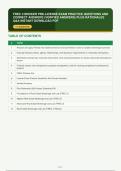
FREC 3 BROKER PRE-LICENSE EXAM PRACTICE QUESTIONS AND
CORRECT ANSWERS (VERIFIED ANSWERS) PLUS RATIONALES
Q&A INSTANT DOWNLOAD PDF
110 QUESTIONS
TABLE OF CONTENTS
# TOPIC
1 Analyze and apply Florida real estate license law and commission rules to complex brokerage scenarios
2 Evaluate fiduciary duties, agency relationships, and disclosure requirements in multi-party transactions
3 Synthesize contract law, financing instruments, and closing procedures to resolve advanced transactional
issues
4 Critically assess risk management, property management, and fair housing compliance in professional
practice
5 FREC 3 Broker Pre
6 License Exam Practice Questions And Correct Answers
7 Verified Answers
8 Plus Rationales Q&A Instant Download Pdf
9 Foundations of Real Estate Brokerage and Law (FREC 3)
10 Applied Real Estate Brokerage and Law (FREC 3)
11 Advanced Real Estate Brokerage and Law (FREC 3)
12 Real Estate Brokerage and Law (FREC 3) Review
Page 1
,Q1 ANALYZE AND APPLY FLORIDA REAL ESTATE LICENSE LAW AND COMMISSION RULES
TO COMPLEX BROKERAGE SCENARIOS
A broker forms a single-member LLC to hold all brokerage commissions. Under
Florida law, which statement accurately describes the legal status of commissions
earned by a sales associate affiliated with the LLC?
A. The LLC, as the employing broker, must be named as the commissioning entity, and the sales
associate cannot receive commissions directly from clients. CORRECT
B. The sales associate may receive commissions directly from the client if the LLC agreement so
provides, as Florida law allows independent contractor fee arrangements.
C. Commissions must be paid to the registered broker in their individual name, and the LLC is
merely an internal accounting tool.
D. The sales associate must hold a broker's license to receive any commission from the LLC, as
only brokers may share fees.
RATIONALE: Florida law requires that all real estate commissions be paid to the employing
broker (the entity licensed as the broker), not directly to the sales associate. The sales
associate's compensation is a matter between the associate and the broker. Therefore, even if
the broker is an LLC, the commission must be paid to the LLC (the broker), and the associate
receives their share from the broker. Option B is incorrect because direct payment to the
associate would violate commission rules. Option C is incorrect because the LLC can be the
licensed broker if it qualifies. Option D is incorrect because sales associates can receive
commissions from their broker without holding a broker's license.
Page 2
,Q2 ANALYZE AND APPLY FLORIDA REAL ESTATE LICENSE LAW AND COMMISSION RULES
TO COMPLEX BROKERAGE SCENARIOS
A property manager in Florida is holding a tenant's security deposit in a
non-interest-bearing account. Under Florida statutes, which condition must be met
for the property manager to avoid paying interest to the tenant?
A. The lease agreement must explicitly waive the tenant's right to interest.
B. The property must be a single-family residential unit and the deposit must be held for less
than two years.
C. The security deposit must be held in a separate trust account and the tenant must be notified
in writing of the account's non-interest-bearing status. CORRECT
D. The property manager must post a surety bond equal to the total deposits held.
RATIONALE: Under Florida law (Chapter 83), a landlord or property manager holding a security
deposit in a non-interest-bearing account is not required to pay interest if the tenant is notified in
writing that the account is non-interest-bearing. This notice must be given at the time the deposit
is collected. Option A is incorrect because a lease waiver is not sufficient; statutory notice is
required. Option B is incorrect because the type of property or duration does not exempt interest.
Option D is incorrect because bonding is not a condition for avoiding interest.
Page 3
, Q3 ANALYZE AND APPLY FLORIDA REAL ESTATE LICENSE LAW AND COMMISSION RULES
TO COMPLEX BROKERAGE SCENARIOS
In a Florida brokerage transaction, a buyer's agent learns that the seller's property
has a latent structural defect that the seller has not disclosed. The defect is not
readily observable. Under Florida agency law, what is the buyer's agent's legal
obligation?
A. The agent must disclose the defect to the buyer, even if the seller refuses, because the agent
owes a fiduciary duty of full disclosure to the buyer. CORRECT
B. The agent must maintain confidentiality and cannot disclose the defect, as it is material
information obtained in confidence from the seller.
C. The agent must withdraw from the transaction without disclosing the defect, to avoid
breaching confidentiality.
D. The agent may disclose the defect only if the buyer asks a direct question about structural
issues.
RATIONALE: A buyer's agent owes fiduciary duties to the buyer, including the duty of full
disclosure. This includes disclosing any material facts known about the property, even if those
facts were learned from the seller. The duty to the buyer supersedes any obligation to maintain
the seller's confidence, as the agent is not the seller's agent. Therefore, the agent must disclose
the defect. Option B is incorrect because confidentiality is owed to the principal (the buyer), not
the seller. Option C is incorrect because withdrawal is not required; disclosure is the proper
action. Option D is incorrect because the duty is proactive, not reactive.
Page 4
CORRECT ANSWERS (VERIFIED ANSWERS) PLUS RATIONALES
Q&A INSTANT DOWNLOAD PDF
110 QUESTIONS
TABLE OF CONTENTS
# TOPIC
1 Analyze and apply Florida real estate license law and commission rules to complex brokerage scenarios
2 Evaluate fiduciary duties, agency relationships, and disclosure requirements in multi-party transactions
3 Synthesize contract law, financing instruments, and closing procedures to resolve advanced transactional
issues
4 Critically assess risk management, property management, and fair housing compliance in professional
practice
5 FREC 3 Broker Pre
6 License Exam Practice Questions And Correct Answers
7 Verified Answers
8 Plus Rationales Q&A Instant Download Pdf
9 Foundations of Real Estate Brokerage and Law (FREC 3)
10 Applied Real Estate Brokerage and Law (FREC 3)
11 Advanced Real Estate Brokerage and Law (FREC 3)
12 Real Estate Brokerage and Law (FREC 3) Review
Page 1
,Q1 ANALYZE AND APPLY FLORIDA REAL ESTATE LICENSE LAW AND COMMISSION RULES
TO COMPLEX BROKERAGE SCENARIOS
A broker forms a single-member LLC to hold all brokerage commissions. Under
Florida law, which statement accurately describes the legal status of commissions
earned by a sales associate affiliated with the LLC?
A. The LLC, as the employing broker, must be named as the commissioning entity, and the sales
associate cannot receive commissions directly from clients. CORRECT
B. The sales associate may receive commissions directly from the client if the LLC agreement so
provides, as Florida law allows independent contractor fee arrangements.
C. Commissions must be paid to the registered broker in their individual name, and the LLC is
merely an internal accounting tool.
D. The sales associate must hold a broker's license to receive any commission from the LLC, as
only brokers may share fees.
RATIONALE: Florida law requires that all real estate commissions be paid to the employing
broker (the entity licensed as the broker), not directly to the sales associate. The sales
associate's compensation is a matter between the associate and the broker. Therefore, even if
the broker is an LLC, the commission must be paid to the LLC (the broker), and the associate
receives their share from the broker. Option B is incorrect because direct payment to the
associate would violate commission rules. Option C is incorrect because the LLC can be the
licensed broker if it qualifies. Option D is incorrect because sales associates can receive
commissions from their broker without holding a broker's license.
Page 2
,Q2 ANALYZE AND APPLY FLORIDA REAL ESTATE LICENSE LAW AND COMMISSION RULES
TO COMPLEX BROKERAGE SCENARIOS
A property manager in Florida is holding a tenant's security deposit in a
non-interest-bearing account. Under Florida statutes, which condition must be met
for the property manager to avoid paying interest to the tenant?
A. The lease agreement must explicitly waive the tenant's right to interest.
B. The property must be a single-family residential unit and the deposit must be held for less
than two years.
C. The security deposit must be held in a separate trust account and the tenant must be notified
in writing of the account's non-interest-bearing status. CORRECT
D. The property manager must post a surety bond equal to the total deposits held.
RATIONALE: Under Florida law (Chapter 83), a landlord or property manager holding a security
deposit in a non-interest-bearing account is not required to pay interest if the tenant is notified in
writing that the account is non-interest-bearing. This notice must be given at the time the deposit
is collected. Option A is incorrect because a lease waiver is not sufficient; statutory notice is
required. Option B is incorrect because the type of property or duration does not exempt interest.
Option D is incorrect because bonding is not a condition for avoiding interest.
Page 3
, Q3 ANALYZE AND APPLY FLORIDA REAL ESTATE LICENSE LAW AND COMMISSION RULES
TO COMPLEX BROKERAGE SCENARIOS
In a Florida brokerage transaction, a buyer's agent learns that the seller's property
has a latent structural defect that the seller has not disclosed. The defect is not
readily observable. Under Florida agency law, what is the buyer's agent's legal
obligation?
A. The agent must disclose the defect to the buyer, even if the seller refuses, because the agent
owes a fiduciary duty of full disclosure to the buyer. CORRECT
B. The agent must maintain confidentiality and cannot disclose the defect, as it is material
information obtained in confidence from the seller.
C. The agent must withdraw from the transaction without disclosing the defect, to avoid
breaching confidentiality.
D. The agent may disclose the defect only if the buyer asks a direct question about structural
issues.
RATIONALE: A buyer's agent owes fiduciary duties to the buyer, including the duty of full
disclosure. This includes disclosing any material facts known about the property, even if those
facts were learned from the seller. The duty to the buyer supersedes any obligation to maintain
the seller's confidence, as the agent is not the seller's agent. Therefore, the agent must disclose
the defect. Option B is incorrect because confidentiality is owed to the principal (the buyer), not
the seller. Option C is incorrect because withdrawal is not required; disclosure is the proper
action. Option D is incorrect because the duty is proactive, not reactive.
Page 4


