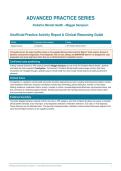
ADVANCED PRACTICE SERIES
Pediatric Mental Health - Maggie Sampson
Unofficial Practice Activity Report & Clinical Reasoning Guide
Patient Confirmed chief complaint Series
Maggie Sampson Constipation APS Pediatric Mental Health 1
This guide mirrors the major workflow shown in the supplied Ramone Garcia Activity Report: Vitals, Inquiry, Review of
Systems, Assessment, Diagnostics, Final Diagnosis, Plan of Care, Billing, and EMPOWER debrief. It is designed for case
preparation and study alignment rather than as an official Sentinel U completion record.
Confirmed case positioning
Publicly indexed Sentinel U APS material identifies Maggie Sampson as one of the five Pediatric Mental Health 1 patients
and labels the chief complaint Constipation. The Sentinel U Pediatric Mental Health product page confirms that these
encounters are managed through a pediatric psych-mental-health lens and include mental-status and safety assessment
elements.
Clinical focus
Constipation in a pediatric mental-health encounter should be approached as both a medical and behavioral problem until the
case establishes otherwise. Important contributors include stool withholding, painful defecation, low fiber or fluid intake,
toileting avoidance, medication effects, anxiety, changes in routine, neurodevelopmental differences, psychosocial stress, and
less commonly an underlying organic disorder. Strong reasoning starts with red-flag screening and a careful history rather
than assuming the symptom is psychiatric.
Evidence boundary
The public Maggie Sampson material confirms her name, APS category, and chief complaint but does not expose a complete
official patient transcript, exact vital signs, exact diagnostic selections, medication selections, ICD code, or final diagnosis.
Those elements are not fabricated here. The document instead provides a detailed, evidence-based framework aligned to the
same Activity Report sections as the supplied example.
Unofficial educational practice companion - not an official Sentinel U Activity Report 1
, Section-by-Section APS Alignment
The supplied example uses a 20-point patient encounter. This guide retains that architecture so preparation follows the same
scoring-section sequence.
Section Example Maggie Sampson preparation target
weighting
Vitals 1 Identify dehydration, growth concerns, fever, abnormal heart rate/BP, or other findings that suggest a
medical problem rather than uncomplicated functional constipation.
Inquiry 1 Clarify stool frequency/consistency, painful stools, withholding, toileting behavior, diet, fluids, medications,
psychosocial stressors, developmental history, and alarm features.
ROS 2 Prioritize GI, constitutional, neurologic, endocrine, urinary, and behavioral symptoms relevant to constipation
and its differential.
Assessment 2 Perform a focused general, abdominal, neurologic and developmental/behavioral assessment; identify
features that warrant escalation.
Diagnostics 5 Distinguish likely functional constipation from organic causes and avoid unnecessary testing when no alarm
features are present.
Final Diagnosis 2 Select only the diagnosis supported by Maggie's actual simulation findings.
Plan of Care 5 Include education, toileting routine, nutrition/hydration support, appropriate first-line therapy, family
involvement, monitoring, referral and follow-up.
Billing 2 Use the ICD-10 code for the diagnosis actually established in the completed encounter.
Current guideline alignment
The 2026 AGA/NASPGHAN pediatric functional-constipation pathway emphasizes early recognition, history and physical
examination, stepwise treatment, timely referral when complexity or poor response warrants it, and multidisciplinary support
when useful. The 2026 ESPGHAN/NASPGHAN guideline likewise stresses individualized management and evidence-based
treatment rather than routine extensive testing.
High-value clinical question
The core question is: Does Maggie's constipation fit a functional/behavioral pattern, or are there alarm features,
medication effects, neurologic/endocrine clues, or other findings that require a different workup?
Unofficial educational practice companion - not an official Sentinel U Activity Report 2
Pediatric Mental Health - Maggie Sampson
Unofficial Practice Activity Report & Clinical Reasoning Guide
Patient Confirmed chief complaint Series
Maggie Sampson Constipation APS Pediatric Mental Health 1
This guide mirrors the major workflow shown in the supplied Ramone Garcia Activity Report: Vitals, Inquiry, Review of
Systems, Assessment, Diagnostics, Final Diagnosis, Plan of Care, Billing, and EMPOWER debrief. It is designed for case
preparation and study alignment rather than as an official Sentinel U completion record.
Confirmed case positioning
Publicly indexed Sentinel U APS material identifies Maggie Sampson as one of the five Pediatric Mental Health 1 patients
and labels the chief complaint Constipation. The Sentinel U Pediatric Mental Health product page confirms that these
encounters are managed through a pediatric psych-mental-health lens and include mental-status and safety assessment
elements.
Clinical focus
Constipation in a pediatric mental-health encounter should be approached as both a medical and behavioral problem until the
case establishes otherwise. Important contributors include stool withholding, painful defecation, low fiber or fluid intake,
toileting avoidance, medication effects, anxiety, changes in routine, neurodevelopmental differences, psychosocial stress, and
less commonly an underlying organic disorder. Strong reasoning starts with red-flag screening and a careful history rather
than assuming the symptom is psychiatric.
Evidence boundary
The public Maggie Sampson material confirms her name, APS category, and chief complaint but does not expose a complete
official patient transcript, exact vital signs, exact diagnostic selections, medication selections, ICD code, or final diagnosis.
Those elements are not fabricated here. The document instead provides a detailed, evidence-based framework aligned to the
same Activity Report sections as the supplied example.
Unofficial educational practice companion - not an official Sentinel U Activity Report 1
, Section-by-Section APS Alignment
The supplied example uses a 20-point patient encounter. This guide retains that architecture so preparation follows the same
scoring-section sequence.
Section Example Maggie Sampson preparation target
weighting
Vitals 1 Identify dehydration, growth concerns, fever, abnormal heart rate/BP, or other findings that suggest a
medical problem rather than uncomplicated functional constipation.
Inquiry 1 Clarify stool frequency/consistency, painful stools, withholding, toileting behavior, diet, fluids, medications,
psychosocial stressors, developmental history, and alarm features.
ROS 2 Prioritize GI, constitutional, neurologic, endocrine, urinary, and behavioral symptoms relevant to constipation
and its differential.
Assessment 2 Perform a focused general, abdominal, neurologic and developmental/behavioral assessment; identify
features that warrant escalation.
Diagnostics 5 Distinguish likely functional constipation from organic causes and avoid unnecessary testing when no alarm
features are present.
Final Diagnosis 2 Select only the diagnosis supported by Maggie's actual simulation findings.
Plan of Care 5 Include education, toileting routine, nutrition/hydration support, appropriate first-line therapy, family
involvement, monitoring, referral and follow-up.
Billing 2 Use the ICD-10 code for the diagnosis actually established in the completed encounter.
Current guideline alignment
The 2026 AGA/NASPGHAN pediatric functional-constipation pathway emphasizes early recognition, history and physical
examination, stepwise treatment, timely referral when complexity or poor response warrants it, and multidisciplinary support
when useful. The 2026 ESPGHAN/NASPGHAN guideline likewise stresses individualized management and evidence-based
treatment rather than routine extensive testing.
High-value clinical question
The core question is: Does Maggie's constipation fit a functional/behavioral pattern, or are there alarm features,
medication effects, neurologic/endocrine clues, or other findings that require a different workup?
Unofficial educational practice companion - not an official Sentinel U Activity Report 2