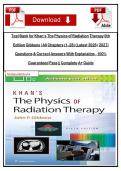
Test Bank for Khan’s The Physics of Radiation Therapy 6th
ly ly ly ly ly ly ly ly ly
ly Edition Gibbons | All Chapters (1–28) (Latest )
ly ly ly ly ly ly ly ly ly
ly Questions & Correct Answers With Explanatins , 100%
ly ly ly ly ly ly ly
ly Guaranteed Pass || Complete A+ Guidely ly ly ly ly
bestguidestuvia
,P A R T I Basic Physics 1
ly ly ly ly ly ly ly
1 Structure of Matter
ly ly ly ly
2 Nuclear Transformations
ly ly ly
3 Production of X-rays
ly ly ly ly
4 Clinical Radiation Generators
ly ly ly ly
5 Interactions of Ionizing Radiation
ly ly ly ly ly
6 Measurement of Ionizing Radiation
ly ly ly ly ly
7 Quality of X-ray Beams
ly ly ly ly ly
8 Measurement of Absorbed Dose
ly ly ly ly ly
P A R T 111 c lassical Radiation t heR aP y
ly ly ly ly ly ly ly ly ly ly ly ly
9 Dose Distribution and Scatter Analysis
ly ly ly ly ly ly
10 A System of Dosimetric Calculations
ly ly ly ly ly ly
11 Treatment Planning I: Isodose Distributions
ly ly ly ly ly ly
12 Treatment Planning II: Patient Data Acquisition, Treatment Verification, and
ly ly ly ly ly ly ly ly ly
Inhomogeneity Corrections ly ly
13 Treatment Planning III: Field Shaping, Skin Dose, and Field Separation
ly ly ly ly ly ly ly ly ly ly ly
14 Electron Beam Therapy
ly ly ly ly
15 Low-Dose-Rate Brachytherapy: Rules of Implantation and Dose Specification
ly ly ly ly ly ly ly ly ly
16 Radiation Protection
ly ly ly
17 Quality Assurance
ly ly ly
18 Total Body Irradiation
ly ly ly ly
P A R T I I I ModeRn Radiation t heR aP y
ly ly ly ly ly ly ly ly ly ly ly ly ly
19 Three-Dimensional Conformal Radiation Therapy
ly ly ly ly ly
20 Intensity-Modulated Radiation Therapy
ly ly ly ly
21 Stereotactic Radiotherapy and Radiosurgery
ly ly ly ly
22 Stereotactic Body Radiation Therapy
ly ly ly ly ly
23 High-Dose-Rate Brachytherapy
ly ly ly
24 Prostate Implants: Technique, Dosimetry, and Treatment Planning
ly ly ly ly ly ly ly ly
25 Intravascular Brachytherapy
ly ly ly
26 Image-Guided Radiation Therapy
ly ly ly ly
27 Proton Beam Therapy
ly ly ly
,28 Knowledge-Based Treatment Planning
ly ly ly ly
, Test Bank for Khan’s The Physics of Radiation Therapy 6th Edition Gibbons |
ly ly ly ly ly ly ly ly ly ly ly ly
Chapter 1: Structure of Matter ly ly ly ly
30 Multiple Choice Questions
ly ly ly
1. Which subatomic particle has a positive charge and is located in the nucleus?
ly ly ly ly ly ly ly ly ly ly ly ly ly
a) Electron
ly
b) Neutron
ly
c) Proton
ly
d) Positron
ly
Answer: c) Proton ly ly
Explanation (4 lines): Protons are positively charged particles found in the atomic
ly ly ly ly ly ly ly ly ly ly ly
nucleus. Their number defines the atomic number (Z) of an element. Electrons are
ly ly ly ly ly ly ly ly ly ly ly ly ly
negative and orbit the nucleus; neutrons are neutral. Positrons are antimatter
ly ly ly ly ly ly ly ly ly ly ly
counterparts of electrons.
ly ly ly
2. The atomic mass number (A) is the sum of:
ly ly ly ly ly ly ly ly ly
a) Protons and electrons
ly ly ly
b) Neutrons and electrons
ly ly ly
c) Protons and neutrons
ly ly ly
d) Protons, neutrons, and electrons
ly ly ly ly
Answer: c) Protons and neutrons
ly ly ly ly
Explanation: Atomic mass number A = number of protons (Z) + number of neutrons (N).
ly ly ly ly ly ly ly ly ly ly ly ly ly ly
Electrons have negligible mass and are not counted in A. This distinguishes isotopes
ly ly ly ly ly ly ly ly ly ly ly ly ly
(same Z, different N). A appears as the superscript in nuclide notation (e.g., ¸µCo).
ly ly ly ly ly ly ly ly ly ly ly ly ly ly
3. Isotopes of an element differ in the number of:
ly ly ly ly ly ly ly ly ly
a) Protons
ly
b) Electrons
ly
ly ly ly ly ly ly ly ly ly
ly Edition Gibbons | All Chapters (1–28) (Latest )
ly ly ly ly ly ly ly ly ly
ly Questions & Correct Answers With Explanatins , 100%
ly ly ly ly ly ly ly
ly Guaranteed Pass || Complete A+ Guidely ly ly ly ly
bestguidestuvia
,P A R T I Basic Physics 1
ly ly ly ly ly ly ly
1 Structure of Matter
ly ly ly ly
2 Nuclear Transformations
ly ly ly
3 Production of X-rays
ly ly ly ly
4 Clinical Radiation Generators
ly ly ly ly
5 Interactions of Ionizing Radiation
ly ly ly ly ly
6 Measurement of Ionizing Radiation
ly ly ly ly ly
7 Quality of X-ray Beams
ly ly ly ly ly
8 Measurement of Absorbed Dose
ly ly ly ly ly
P A R T 111 c lassical Radiation t heR aP y
ly ly ly ly ly ly ly ly ly ly ly ly
9 Dose Distribution and Scatter Analysis
ly ly ly ly ly ly
10 A System of Dosimetric Calculations
ly ly ly ly ly ly
11 Treatment Planning I: Isodose Distributions
ly ly ly ly ly ly
12 Treatment Planning II: Patient Data Acquisition, Treatment Verification, and
ly ly ly ly ly ly ly ly ly
Inhomogeneity Corrections ly ly
13 Treatment Planning III: Field Shaping, Skin Dose, and Field Separation
ly ly ly ly ly ly ly ly ly ly ly
14 Electron Beam Therapy
ly ly ly ly
15 Low-Dose-Rate Brachytherapy: Rules of Implantation and Dose Specification
ly ly ly ly ly ly ly ly ly
16 Radiation Protection
ly ly ly
17 Quality Assurance
ly ly ly
18 Total Body Irradiation
ly ly ly ly
P A R T I I I ModeRn Radiation t heR aP y
ly ly ly ly ly ly ly ly ly ly ly ly ly
19 Three-Dimensional Conformal Radiation Therapy
ly ly ly ly ly
20 Intensity-Modulated Radiation Therapy
ly ly ly ly
21 Stereotactic Radiotherapy and Radiosurgery
ly ly ly ly
22 Stereotactic Body Radiation Therapy
ly ly ly ly ly
23 High-Dose-Rate Brachytherapy
ly ly ly
24 Prostate Implants: Technique, Dosimetry, and Treatment Planning
ly ly ly ly ly ly ly ly
25 Intravascular Brachytherapy
ly ly ly
26 Image-Guided Radiation Therapy
ly ly ly ly
27 Proton Beam Therapy
ly ly ly
,28 Knowledge-Based Treatment Planning
ly ly ly ly
, Test Bank for Khan’s The Physics of Radiation Therapy 6th Edition Gibbons |
ly ly ly ly ly ly ly ly ly ly ly ly
Chapter 1: Structure of Matter ly ly ly ly
30 Multiple Choice Questions
ly ly ly
1. Which subatomic particle has a positive charge and is located in the nucleus?
ly ly ly ly ly ly ly ly ly ly ly ly ly
a) Electron
ly
b) Neutron
ly
c) Proton
ly
d) Positron
ly
Answer: c) Proton ly ly
Explanation (4 lines): Protons are positively charged particles found in the atomic
ly ly ly ly ly ly ly ly ly ly ly
nucleus. Their number defines the atomic number (Z) of an element. Electrons are
ly ly ly ly ly ly ly ly ly ly ly ly ly
negative and orbit the nucleus; neutrons are neutral. Positrons are antimatter
ly ly ly ly ly ly ly ly ly ly ly
counterparts of electrons.
ly ly ly
2. The atomic mass number (A) is the sum of:
ly ly ly ly ly ly ly ly ly
a) Protons and electrons
ly ly ly
b) Neutrons and electrons
ly ly ly
c) Protons and neutrons
ly ly ly
d) Protons, neutrons, and electrons
ly ly ly ly
Answer: c) Protons and neutrons
ly ly ly ly
Explanation: Atomic mass number A = number of protons (Z) + number of neutrons (N).
ly ly ly ly ly ly ly ly ly ly ly ly ly ly
Electrons have negligible mass and are not counted in A. This distinguishes isotopes
ly ly ly ly ly ly ly ly ly ly ly ly ly
(same Z, different N). A appears as the superscript in nuclide notation (e.g., ¸µCo).
ly ly ly ly ly ly ly ly ly ly ly ly ly ly
3. Isotopes of an element differ in the number of:
ly ly ly ly ly ly ly ly ly
a) Protons
ly
b) Electrons
ly