

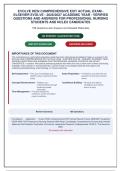
EVOLVE HESI COMPREHENSIVE EXIT ACTUAL EXAM -
ELSEVIER EVOLVE - 2026/2027 ACADEMIC YEAR - VERIFIED
QUESTIONS AND ANSWERS FOR PROFESSIONAL NURSING
STUDENTS AND NCLEX CANDIDATES
189 Questions with Answers and Detailed Rationales
100 PERCENT GUARANTEED PASS
INSTANT DOWNLOAD ANSWERS INCLUDED
IMPORTANCE OF THIS DOCUMENT
This comprehensive examination preparation guide has been meticulously developed to help you succeed in the
EVOLVE HESI COMPREHENSIVE EXIT ACTUAL EXAM - ELSEVIER EVOLVE - 2026/2027 ACADEMIC YEAR -
VERIFIED QUESTIONS AND ANSWERS FOR PROFESSIONAL NURSING STUDENTS AND NCLEX
CANDIDATES. It contains 189 carefully selected questions that reflect the most current exam content and testing
strategies. Each question is accompanied by a correct answer and a detailed rationale that explains the
underlying pathophysiology, pharmacology, or clinical reasoning.
Self-Assessment – Test your knowledge and Exam Preparation – Familiarize yourself with the
identify areas requiring further question format and content
study areas
Concept Reinforcement – Deepen your Confidence Building – Develop test-taking
understanding through strategies and reduce
evidence-based exam anxiety
rationales
Time Management – Practice answering
questions under simulated
exam conditions
Review Summary 189 Questions
Foundations - Application - Evolve HESI Comprehensive EXIT Actual Elsevier Evolve 2026/2027 Academic
YEAR AND FOR Professional Nursing Students AND Nclex Candidates Comprehensive Nursing Adult Health
Maternal-child Pediatric Psychiatric Community Leadership Research Undergraduate YEAR 4 / Pre-licensure
BSN
All answers with rationales
,Table of Contents
Content Area Questions Key Topics
Evolve HESI Comprehensive 1-32 Finding, Receiving, Intervention, Requires, Indicates
EXIT Actual Elsevier Evolve
2026/2027 Academic YEAR
AND FOR Professional
Nursing Students AND Nclex
Candidates Comprehensive
Nursing Adult Health
Maternal-child Pediatric
Psychiatric Community
Leadership Research
Undergraduate YEAR 4 /
Pre-licensure BSN
Receiving 33-64 Finding, Laboratory, Immediate, Intervention, Value
Intervention 65-96 Finding, Receiving, Blood, Serum, Patient S
Appropriate 97-128 Finding, Indicates, Blood, Intervention, Prescribed
Prescribed 129-160 Finding, Medication, Appropriate, Chest, Intervention
Indicates 161-189 Finding, Receiving, Pressure, Acute, Prescribed
TOTAL 189 All questions include answers and detailed rationales
,Section A - Evolve HESI Comprehensive EXIT Actual
Elsevier Evolve 2026/2027 Academic YEAR AND FOR
Professional Nursing Students AND Nclex Candidates
Comprehensive Nursing Adult Health Maternal-child
Pediatric Psychiatric Community Leadership Research
Undergraduate YEAR 4 / Pre-licensure BSN
Q1.
A patient with a history of chronic heart failure and atrial fibrillation is prescribed warfarin
and amiodarone. Which factor most significantly alters the expected international
normalized ratio (INR) response, requiring a dose adjustment?
A. Amiodarone inhibits CYP2C9, increasing B. Warfarin induces CYP3A4, decreasing
warfarin levels and INR. amiodarone levels and its efficacy.
C. The combination increases vitamin K D. Amiodarone displaces warfarin from
absorption, reducing warfarin effect. protein binding, decreasing free warfarin.
Correct: A - Amiodarone inhibits CYP2C9, increasing warfarin levels and INR.
Rationale:Amiodarone is a potent inhibitor of CYP2C9, the primary enzyme that metabolizes
the S-enantiomer of warfarin, leading to increased warfarin levels and prolonged INR. The
other options are incorrect: warfarin does not induce CYP3A4, the combination does not
increase vitamin K absorption, and protein-binding displacement is not the primary
mechanism.
Q2.
A patient with diabetic ketoacidosis (DKA) has a serum potassium of 5.8 mEq/L. After
initiating insulin therapy, the nurse anticipates which change in potassium levels and
prepares for what intervention?
A. Potassium will decrease, and the nurse B. Potassium will increase further, requiring
should prepare for IV potassium aggressive potassium-lowering measures.
replacement.
C. Potassium will remain unchanged, and D. Potassium will shift into cells, but no
no specific action is needed. replacement is needed if urine output is
adequate.
Correct: A - Potassium will decrease, and the nurse should prepare for IV potassium
replacement.
Page 3
, Section A - Evolve HESI Comprehensive EXIT Actual Elsevier Evolve 2026/2027 Academic YEAR AND FOR Professional Nursing Students
AND Nclex Candidates Comprehensive Nursing Adult Health Maternal-child Pediatric Psychiatric Community Leadership Research
Rationale: Insulin drives potassium into cells, causing serum potassium to fall, which can
precipitate hypokalemia. In DKA, total body potassium is depleted, so as insulin lowers
glucose, potassium levels drop, and replacement is often needed. The other options are
incorrect because insulin does not cause further hyperkalemia, and replacement is typically
required.
Q3.
A nurse is assessing a postpartum patient who gave birth 12 hours ago. Which finding
requires immediate intervention?
A. Fundus is firm, midline, and at the level of B. Lochia rubra with a moderate amount of
the umbilicus. bright red bleeding.
C. A saturated perineal pad in 30 minutes D. Temperature of 99.8°F (37.7°C) and a
with a boggy uterus. pulse of 90 beats per minute.
Correct: C - A saturated perineal pad in 30 minutes with a boggy uterus.
Rationale:A saturated pad in 30 minutes with a boggy uterus indicates uterine atony and
potential postpartum hemorrhage, requiring immediate intervention. A firm fundus at the
umbilicus is normal, lochia rubra is expected, and a slight temperature elevation can be
normal. The other options are expected postpartum findings.
Q4.
A school nurse is developing a plan of care for a child with attention-deficit/hyperactivity
disorder (ADHD) who is taking methylphenidate. Which nursing consideration is most
important?
A. Monitor for growth suppression and B. Administer the medication with a high-fat
assess height and weight regularly. meal to enhance absorption.
C. Encourage the child to take the D. Advise the parents to stop the medication
medication only on school days. if the child develops insomnia.
Correct: A - Monitor for growth suppression and assess height and weight regularly.
Rationale:Methylphenidate can cause growth suppression, so monitoring height and weight
is essential. It should be given consistently, not just on school days, and food intake may
decrease appetite, not enhance absorption. Insomnia is a side effect that should be managed,
but discontinuing the medication without provider input is not appropriate.
Q5.
A patient with major depressive disorder has been taking fluoxetine for 6 weeks with
minimal improvement. The provider prescribes phenelzine. Which action by the nurse is
most appropriate?
Page 4
ELSEVIER EVOLVE - 2026/2027 ACADEMIC YEAR - VERIFIED
QUESTIONS AND ANSWERS FOR PROFESSIONAL NURSING
STUDENTS AND NCLEX CANDIDATES
189 Questions with Answers and Detailed Rationales
100 PERCENT GUARANTEED PASS
INSTANT DOWNLOAD ANSWERS INCLUDED
IMPORTANCE OF THIS DOCUMENT
This comprehensive examination preparation guide has been meticulously developed to help you succeed in the
EVOLVE HESI COMPREHENSIVE EXIT ACTUAL EXAM - ELSEVIER EVOLVE - 2026/2027 ACADEMIC YEAR -
VERIFIED QUESTIONS AND ANSWERS FOR PROFESSIONAL NURSING STUDENTS AND NCLEX
CANDIDATES. It contains 189 carefully selected questions that reflect the most current exam content and testing
strategies. Each question is accompanied by a correct answer and a detailed rationale that explains the
underlying pathophysiology, pharmacology, or clinical reasoning.
Self-Assessment – Test your knowledge and Exam Preparation – Familiarize yourself with the
identify areas requiring further question format and content
study areas
Concept Reinforcement – Deepen your Confidence Building – Develop test-taking
understanding through strategies and reduce
evidence-based exam anxiety
rationales
Time Management – Practice answering
questions under simulated
exam conditions
Review Summary 189 Questions
Foundations - Application - Evolve HESI Comprehensive EXIT Actual Elsevier Evolve 2026/2027 Academic
YEAR AND FOR Professional Nursing Students AND Nclex Candidates Comprehensive Nursing Adult Health
Maternal-child Pediatric Psychiatric Community Leadership Research Undergraduate YEAR 4 / Pre-licensure
BSN
All answers with rationales
,Table of Contents
Content Area Questions Key Topics
Evolve HESI Comprehensive 1-32 Finding, Receiving, Intervention, Requires, Indicates
EXIT Actual Elsevier Evolve
2026/2027 Academic YEAR
AND FOR Professional
Nursing Students AND Nclex
Candidates Comprehensive
Nursing Adult Health
Maternal-child Pediatric
Psychiatric Community
Leadership Research
Undergraduate YEAR 4 /
Pre-licensure BSN
Receiving 33-64 Finding, Laboratory, Immediate, Intervention, Value
Intervention 65-96 Finding, Receiving, Blood, Serum, Patient S
Appropriate 97-128 Finding, Indicates, Blood, Intervention, Prescribed
Prescribed 129-160 Finding, Medication, Appropriate, Chest, Intervention
Indicates 161-189 Finding, Receiving, Pressure, Acute, Prescribed
TOTAL 189 All questions include answers and detailed rationales
,Section A - Evolve HESI Comprehensive EXIT Actual
Elsevier Evolve 2026/2027 Academic YEAR AND FOR
Professional Nursing Students AND Nclex Candidates
Comprehensive Nursing Adult Health Maternal-child
Pediatric Psychiatric Community Leadership Research
Undergraduate YEAR 4 / Pre-licensure BSN
Q1.
A patient with a history of chronic heart failure and atrial fibrillation is prescribed warfarin
and amiodarone. Which factor most significantly alters the expected international
normalized ratio (INR) response, requiring a dose adjustment?
A. Amiodarone inhibits CYP2C9, increasing B. Warfarin induces CYP3A4, decreasing
warfarin levels and INR. amiodarone levels and its efficacy.
C. The combination increases vitamin K D. Amiodarone displaces warfarin from
absorption, reducing warfarin effect. protein binding, decreasing free warfarin.
Correct: A - Amiodarone inhibits CYP2C9, increasing warfarin levels and INR.
Rationale:Amiodarone is a potent inhibitor of CYP2C9, the primary enzyme that metabolizes
the S-enantiomer of warfarin, leading to increased warfarin levels and prolonged INR. The
other options are incorrect: warfarin does not induce CYP3A4, the combination does not
increase vitamin K absorption, and protein-binding displacement is not the primary
mechanism.
Q2.
A patient with diabetic ketoacidosis (DKA) has a serum potassium of 5.8 mEq/L. After
initiating insulin therapy, the nurse anticipates which change in potassium levels and
prepares for what intervention?
A. Potassium will decrease, and the nurse B. Potassium will increase further, requiring
should prepare for IV potassium aggressive potassium-lowering measures.
replacement.
C. Potassium will remain unchanged, and D. Potassium will shift into cells, but no
no specific action is needed. replacement is needed if urine output is
adequate.
Correct: A - Potassium will decrease, and the nurse should prepare for IV potassium
replacement.
Page 3
, Section A - Evolve HESI Comprehensive EXIT Actual Elsevier Evolve 2026/2027 Academic YEAR AND FOR Professional Nursing Students
AND Nclex Candidates Comprehensive Nursing Adult Health Maternal-child Pediatric Psychiatric Community Leadership Research
Rationale: Insulin drives potassium into cells, causing serum potassium to fall, which can
precipitate hypokalemia. In DKA, total body potassium is depleted, so as insulin lowers
glucose, potassium levels drop, and replacement is often needed. The other options are
incorrect because insulin does not cause further hyperkalemia, and replacement is typically
required.
Q3.
A nurse is assessing a postpartum patient who gave birth 12 hours ago. Which finding
requires immediate intervention?
A. Fundus is firm, midline, and at the level of B. Lochia rubra with a moderate amount of
the umbilicus. bright red bleeding.
C. A saturated perineal pad in 30 minutes D. Temperature of 99.8°F (37.7°C) and a
with a boggy uterus. pulse of 90 beats per minute.
Correct: C - A saturated perineal pad in 30 minutes with a boggy uterus.
Rationale:A saturated pad in 30 minutes with a boggy uterus indicates uterine atony and
potential postpartum hemorrhage, requiring immediate intervention. A firm fundus at the
umbilicus is normal, lochia rubra is expected, and a slight temperature elevation can be
normal. The other options are expected postpartum findings.
Q4.
A school nurse is developing a plan of care for a child with attention-deficit/hyperactivity
disorder (ADHD) who is taking methylphenidate. Which nursing consideration is most
important?
A. Monitor for growth suppression and B. Administer the medication with a high-fat
assess height and weight regularly. meal to enhance absorption.
C. Encourage the child to take the D. Advise the parents to stop the medication
medication only on school days. if the child develops insomnia.
Correct: A - Monitor for growth suppression and assess height and weight regularly.
Rationale:Methylphenidate can cause growth suppression, so monitoring height and weight
is essential. It should be given consistently, not just on school days, and food intake may
decrease appetite, not enhance absorption. Insomnia is a side effect that should be managed,
but discontinuing the medication without provider input is not appropriate.
Q5.
A patient with major depressive disorder has been taking fluoxetine for 6 weeks with
minimal improvement. The provider prescribes phenelzine. Which action by the nurse is
most appropriate?
Page 4


