

Name: Discussion Section Page 1
BCMB 401 Exam |, Spring 2026
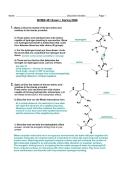
1. (5pts) a) Give the names of the two amino acid o
residues in the blanks provided. //
b) These amino acid residues have side chains . / B \
capable of hydrogen bonding to one another. Show asparagine H. H
one hydrogen bond (with a dotted line) that could
form between these two side chains (R groups)
c) For the hydrogen bond you have drawn: circle H
the atoms that are considered the hydrogen bond
s
donor. see other correct answer possibility on next page &
d) There are four factors that determine the .
strength of a hydrogen bond. List two of them. sernino
any two of: H
bond distance — shorter is stronger C
bond angle -closerto 180° is stronger \N/ \c/
strength of partial charges (due to electronegativity) H ”
water/high dielectric constant weakens o
2. (5pts) a) Give the names of the two amino acid
residues in the blanks provided.
These amino acid residues have side chains
capable of forming hydrophobic interactions (van valine
der Waals formed due to the hydrophobic effect).
b) Describe how van der Waals interactions form.
At a certain distance, the electrons of one atom
will repel the electrons of a neighboring atom,
allowing a weak attraction between the positive
nucleus of one atom (one with i repelled electrons) /S
and the electrons of the neighboring atom H,C
methionine
CH,
c) Describe how and why the hydrophobic effect
"/
<
occurs. include the energetic driving force in your \H/ \c/
answer
o
I
When nonpolar molecules are in an aqueous environment, the water will push together the
nonpolar molecules (or nonpolar parts of molecules) to reduce the water-exposed nonpolar
surface area. Reducing water-exposed nonpolar surface area will minimize the number of
H.0 molecules trapped in an entropically unfavorable situation on nonpolar surfaces.
The energetic driving force is increasing the favorable entropy of water by releasing H.O
from nonpolar surfaces to interacting with other water molecules where they have much
more randomness and disorder with very transient hydrogen bonding.
, Name: Discussion Section Page 1
Other correct answer possibility for 1c:
o
é/
H
- \q/"\
ne’
\c
>0
H ( : )
“ H
\
o
\CH
Wy 2
\N /c\c/
H I
o
H:N
\t:Mz
H,C,
/
N\/cu,
3. (12pts) For the four-residue 0 HC o H,C
peptide shown to the right: . ” \ .‘\H H || oH
H,N\c/c\u/c\c/u\ /c\N/c\ ‘/‘,o
v ", H | H
H "cn, -
o
BCMB 401 Exam |, Spring 2026
1. (5pts) a) Give the names of the two amino acid o
residues in the blanks provided. //
b) These amino acid residues have side chains . / B \
capable of hydrogen bonding to one another. Show asparagine H. H
one hydrogen bond (with a dotted line) that could
form between these two side chains (R groups)
c) For the hydrogen bond you have drawn: circle H
the atoms that are considered the hydrogen bond
s
donor. see other correct answer possibility on next page &
d) There are four factors that determine the .
strength of a hydrogen bond. List two of them. sernino
any two of: H
bond distance — shorter is stronger C
bond angle -closerto 180° is stronger \N/ \c/
strength of partial charges (due to electronegativity) H ”
water/high dielectric constant weakens o
2. (5pts) a) Give the names of the two amino acid
residues in the blanks provided.
These amino acid residues have side chains
capable of forming hydrophobic interactions (van valine
der Waals formed due to the hydrophobic effect).
b) Describe how van der Waals interactions form.
At a certain distance, the electrons of one atom
will repel the electrons of a neighboring atom,
allowing a weak attraction between the positive
nucleus of one atom (one with i repelled electrons) /S
and the electrons of the neighboring atom H,C
methionine
CH,
c) Describe how and why the hydrophobic effect
"/
<
occurs. include the energetic driving force in your \H/ \c/
answer
o
I
When nonpolar molecules are in an aqueous environment, the water will push together the
nonpolar molecules (or nonpolar parts of molecules) to reduce the water-exposed nonpolar
surface area. Reducing water-exposed nonpolar surface area will minimize the number of
H.0 molecules trapped in an entropically unfavorable situation on nonpolar surfaces.
The energetic driving force is increasing the favorable entropy of water by releasing H.O
from nonpolar surfaces to interacting with other water molecules where they have much
more randomness and disorder with very transient hydrogen bonding.
, Name: Discussion Section Page 1
Other correct answer possibility for 1c:
o
é/
H
- \q/"\
ne’
\c
>0
H ( : )
“ H
\
o
\CH
Wy 2
\N /c\c/
H I
o
H:N
\t:Mz
H,C,
/
N\/cu,
3. (12pts) For the four-residue 0 HC o H,C
peptide shown to the right: . ” \ .‘\H H || oH
H,N\c/c\u/c\c/u\ /c\N/c\ ‘/‘,o
v ", H | H
H "cn, -
o


