

Name: Page 1
BCMB 401 Exam lll, Spring 2026
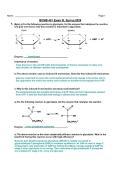
1. (6pts) a) For the following reaction in glycolysis, list the enzyme that catalyzes the reaction
and give one reason why this reaction is important in glycolysis.
CH,0P0,*
+ ADP + H*
Enzyme: hexokinase
Importance of reaction:
traps glucose in the cell OR adds first phosphate of the two necessary to make sure
each product of aldolase reaction has a phosphate
b) The above reaction uses an induced fit mechanism. Describe this induced fit mechanism.
glucose must bind to cause the conformational (structural) change in the active site to
set up/position the active site amino acid residues to transfer the phosphate from ATP
c) Why is this induced fit mechanism necessary and beneficial ?
Prevents/minimizes the wasteful hydrolysis of ATP. Ensures that if phosphate cleaved
from ATP, it (and the favorable free energy is utilized and not wasted.
d) For the following reaction in glycolysis, list the enzyme that catalyzes the reaction.
[
NN Nc
C—OH
—_—
[« c\ H—C—OH
CH,0PO,* CH,0PO,?
Enzyme: _triose phosphate isomerase
e) The above reaction is the most catalytically efficient reaction in glycolysis. What is the
benefit of having this reaction occur with high efficiency?
Ensures that dihydroxyacetone phosphate (DHAP) is rapidly converted to
glyceraldehyde 3-phosphate (GAP) to maintain equilibrium. As GAP is used in stage 2
of glycolysis, new molecules of GAP are formed providing a steady supply of GAP for
stage 2 when glycolysis is occurring. (Two molecules of glyceraldehyde 3-phosphate
are available for stage 2 for every one glucose)
, Name: Page 2
2. (5pts) a) The following two reactions occur consecutively in glycolysis List the enzyme that
catalyzes each reaction.
0.~ .o
H—C—OH H—C—0PO,*
CH,0P0,> CH,0H
Enzyme: phosphoglycerate mutase
o,
H
Enzyme: enolase
b) The two reactions above work toward the same purpose in glycolysis. What is the
purpose (importance) of these two reactions?
To produce a high phosphoryl transfer potential compound (phosphoenolpyruvate)
that can be used to produce ATP in the next reaction.
c) For the following reaction in glycolysis, list the enzyme that catalyzes the reaction and
list the purpose of this reaction in glycolysis.
e, @ o g- 8- §»
w N\
Wi
LRGN
SO
°” 4
A
-
w
"\
M
Va
Mo
No~
o
TN
o
N0 T
o
noowd
Enzyme: pyruvate kinase
Importance of reaction:
To produce a molecule of ATP by substrate level phosphorylation
BCMB 401 Exam lll, Spring 2026
1. (6pts) a) For the following reaction in glycolysis, list the enzyme that catalyzes the reaction
and give one reason why this reaction is important in glycolysis.
CH,0P0,*
+ ADP + H*
Enzyme: hexokinase
Importance of reaction:
traps glucose in the cell OR adds first phosphate of the two necessary to make sure
each product of aldolase reaction has a phosphate
b) The above reaction uses an induced fit mechanism. Describe this induced fit mechanism.
glucose must bind to cause the conformational (structural) change in the active site to
set up/position the active site amino acid residues to transfer the phosphate from ATP
c) Why is this induced fit mechanism necessary and beneficial ?
Prevents/minimizes the wasteful hydrolysis of ATP. Ensures that if phosphate cleaved
from ATP, it (and the favorable free energy is utilized and not wasted.
d) For the following reaction in glycolysis, list the enzyme that catalyzes the reaction.
[
NN Nc
C—OH
—_—
[« c\ H—C—OH
CH,0PO,* CH,0PO,?
Enzyme: _triose phosphate isomerase
e) The above reaction is the most catalytically efficient reaction in glycolysis. What is the
benefit of having this reaction occur with high efficiency?
Ensures that dihydroxyacetone phosphate (DHAP) is rapidly converted to
glyceraldehyde 3-phosphate (GAP) to maintain equilibrium. As GAP is used in stage 2
of glycolysis, new molecules of GAP are formed providing a steady supply of GAP for
stage 2 when glycolysis is occurring. (Two molecules of glyceraldehyde 3-phosphate
are available for stage 2 for every one glucose)
, Name: Page 2
2. (5pts) a) The following two reactions occur consecutively in glycolysis List the enzyme that
catalyzes each reaction.
0.~ .o
H—C—OH H—C—0PO,*
CH,0P0,> CH,0H
Enzyme: phosphoglycerate mutase
o,
H
Enzyme: enolase
b) The two reactions above work toward the same purpose in glycolysis. What is the
purpose (importance) of these two reactions?
To produce a high phosphoryl transfer potential compound (phosphoenolpyruvate)
that can be used to produce ATP in the next reaction.
c) For the following reaction in glycolysis, list the enzyme that catalyzes the reaction and
list the purpose of this reaction in glycolysis.
e, @ o g- 8- §»
w N\
Wi
LRGN
SO
°” 4
A
-
w
"\
M
Va
Mo
No~
o
TN
o
N0 T
o
noowd
Enzyme: pyruvate kinase
Importance of reaction:
To produce a molecule of ATP by substrate level phosphorylation


