
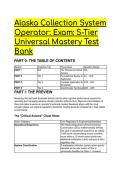
Alaska Collection System
Operator: Exam: S-Tier
Universal Mastery Test
Bank
PART 0: THE TABLE OF CONTENTS
Section Cognitive Tier Focus Area Question Range
PART I N/A The Preview & Critical N/A
Axioms
PART II Tier 1 Foundational Syntax & Q1 – Q18
Application
PART II Tier 2 Complex Application & Q19 – Q37
Simulation
PART II Tier 3 Grandmaster Synthesis Q38 – Q55
PART I: THE PREVIEW
Mastering this test bank translates directly into the elite cognitive performance required for
operating and managing extreme-climate collection infrastructure. Rigorous internalization of
these principles ensures an operator's technical mastery flawlessly aligns with the most
stringent global and regional regulatory standards, forging absolute competence in high-stakes
environments.
The "Critical Axioms" Cheat Sheet
Axiom Category Core Regulatory & Engineering Mandates
Operational Experience The Alaska Department of Environmental
Conservation (DEC) mathematically defines
one year of operational experience as exactly
1,950 hours; accumulating excess overtime
hours within a 12-month period yields zero
additional certification credit, acting as a strict
regulatory cap.
System Classification A wastewater collection system where gravity
operates as the sole means of flow is
universally classified as Class 1. However,
,Axiom Category Core Regulatory & Engineering Mandates
integrating 15 or more main line lift stations
mandates an immediate, non-negotiable
single-class upgrade to Class 2.
Thermal Isolation Cold climate utilidors necessitate highly
engineered R-20 to R-40 insulation assemblies
to contain the 3 to 6-foot radial thaw bulb
generated by a standard 45°F utility line,
thereby preventing catastrophic permafrost
degradation, frost heave, and differential
settlement.
Shift Architecture A primary shift must exceed six hours in
duration and be overseen by a supervising
operator certified at or above the system’s
class. Secondary shifts permit supervision one
level below but are strictly limited to two
instances per seven-day period without a
concurrent primary shift.
Cross-Disciplinary Reciprocity Wastewater collection experience and water
distribution experience are 100%
interchangeable for certification eligibility due to
network symmetries. Conversely, wastewater
collection and wastewater treatment experience
are only interchangeable at a strict 25%
threshold.
PART II: THE ELITE TEST BANK
Tier 1: Foundational Syntax & Application
Q1: An applicant submits documentation demonstrating 2,400 hours of active operations work
logged over a single 12-month period in a Class 2 facility. Based on DEC eligibility parameters,
what is the MAXIMUM operational experience credited to this applicant for certification
progression? A) 1.23 years B) 1.5 years C) 1.0 years D) 0.8 years
● Answer: C (1.0 years)
● Distractor Analysis:
○ A is incorrect: This mathematically calculates 2400 divided by 1950, representing a
dangerous administrative oversight that ignores the absolute regulatory cap on
annual hours.
○ B is incorrect: Assumes a standard 2080-hour work year with overtime factored,
representing a common novice miscalculation inherited from standard human
resources practices.
○ D is incorrect: Represents an arbitrary prorated penalty that does not exist within
the administrative code framework.
The Mentor's Analysis: Regulatory frameworks strictly bound experience accumulation to
prevent accelerated, superficial mastery. By utilizing the 1,950-hour absolute annual cap, one
bypasses the common trap of equating raw overtime hours directly to professional maturity.
Professional Intuition: Always truncate annual experience at 1,950 hours regardless of total
, hours worked; time-in-service cannot be rushed.
Q2: A municipal collection system relies entirely on gravity to transport wastewater to the
regional treatment facility. The system services an expanding population of 1,500 active
connections. Which classification is the MOST APPROPRIATE baseline for this system? A)
Class 2 B) Provisional C) Class 1 D) Class 3
● Answer: C (Class 1)
● Distractor Analysis:
○ A is incorrect: Assumes the high volume of service connections inherently dictates
a class upgrade, which does not apply to gravity-only conveyance networks.
○ B is incorrect: Provisional identifies an operator certification credential level, not a
physical facility classification tier.
○ D is incorrect: Represents an arbitrary inflation of facility class based on population
density rather than mechanical complexity.
The Mentor's Analysis: Mechanical complexity, rather than raw volume alone, drives collection
system classification in this jurisdiction. By identifying the absolute absence of lift stations, one
easily bypasses the common trap of correlating connection count directly with the system class.
Professional Intuition: Gravity-only flow dictates a Class 1 designation universally,
insulating the classification from population surges.
Q3: When installing a new utilidor in an arctic coastal village prone to severe permafrost
degradation and massive wind-driven snow accumulation, which structural mounting
configuration is the MOST LOGICAL choice? A) Shallow-buried enclosure with thermosiphons
B) At-grade surface-mounted on insulating pads C) Above-grade elevated on 18 to 36-inch
posts D) Deep-trench continuous burial
● Answer: C (Above-grade elevated on 18 to 36-inch posts)
● Distractor Analysis:
○ A is incorrect: While technically viable for stabilizing permafrost, it catastrophically
fails to address the severe snowdrift burial risk common in isolated coastal villages.
○ B is incorrect: Surface mounting is utilized strictly in seasonally unfrozen ground,
not sensitive, continuous ice-rich permafrost.
○ D is incorrect: A catastrophic legacy error that induces rapid thermal permafrost
degradation and inevitable pipeline shear.
The Mentor's Analysis: Environmental variables dictate infrastructure geometry in extreme
climates. By utilizing elevated post-mounting, the design elegantly mitigates both permafrost
thermal transfer and snowdrift burial, bypassing the trap of relying on standard temperate burial
practices. Professional Intuition: Elevate arctic coastal utilidors to decouple thermal loads
from the earth and evade the crushing weight of snowpack.
Q4: A Level 2 operator is seeking to renew their Alaska DEC certification. How many Continuing
Education Units (CEUs) are strictly REQUIRED to be completed over the standard 3-year
validation period? A) 1.5 CEUs B) 3.0 CEUs C) 5.0 CEUs D) 24.0 CEUs
● Answer: B (3.0 CEUs)
● Distractor Analysis:
○ A is incorrect: This is a fabricated number representing half the actual requirement,
leading to license expiration.
○ C is incorrect: This exceeds the mandated regulatory threshold for Level 1-4
operators and wastes operator resources.
○ D is incorrect: Represents 24 contact hours, which is the standard in other states
(like Alabama), but Alaska utilizes the CEU metric where 1 CEU typically equals 10
contact hours.
Operator: Exam: S-Tier
Universal Mastery Test
Bank
PART 0: THE TABLE OF CONTENTS
Section Cognitive Tier Focus Area Question Range
PART I N/A The Preview & Critical N/A
Axioms
PART II Tier 1 Foundational Syntax & Q1 – Q18
Application
PART II Tier 2 Complex Application & Q19 – Q37
Simulation
PART II Tier 3 Grandmaster Synthesis Q38 – Q55
PART I: THE PREVIEW
Mastering this test bank translates directly into the elite cognitive performance required for
operating and managing extreme-climate collection infrastructure. Rigorous internalization of
these principles ensures an operator's technical mastery flawlessly aligns with the most
stringent global and regional regulatory standards, forging absolute competence in high-stakes
environments.
The "Critical Axioms" Cheat Sheet
Axiom Category Core Regulatory & Engineering Mandates
Operational Experience The Alaska Department of Environmental
Conservation (DEC) mathematically defines
one year of operational experience as exactly
1,950 hours; accumulating excess overtime
hours within a 12-month period yields zero
additional certification credit, acting as a strict
regulatory cap.
System Classification A wastewater collection system where gravity
operates as the sole means of flow is
universally classified as Class 1. However,
,Axiom Category Core Regulatory & Engineering Mandates
integrating 15 or more main line lift stations
mandates an immediate, non-negotiable
single-class upgrade to Class 2.
Thermal Isolation Cold climate utilidors necessitate highly
engineered R-20 to R-40 insulation assemblies
to contain the 3 to 6-foot radial thaw bulb
generated by a standard 45°F utility line,
thereby preventing catastrophic permafrost
degradation, frost heave, and differential
settlement.
Shift Architecture A primary shift must exceed six hours in
duration and be overseen by a supervising
operator certified at or above the system’s
class. Secondary shifts permit supervision one
level below but are strictly limited to two
instances per seven-day period without a
concurrent primary shift.
Cross-Disciplinary Reciprocity Wastewater collection experience and water
distribution experience are 100%
interchangeable for certification eligibility due to
network symmetries. Conversely, wastewater
collection and wastewater treatment experience
are only interchangeable at a strict 25%
threshold.
PART II: THE ELITE TEST BANK
Tier 1: Foundational Syntax & Application
Q1: An applicant submits documentation demonstrating 2,400 hours of active operations work
logged over a single 12-month period in a Class 2 facility. Based on DEC eligibility parameters,
what is the MAXIMUM operational experience credited to this applicant for certification
progression? A) 1.23 years B) 1.5 years C) 1.0 years D) 0.8 years
● Answer: C (1.0 years)
● Distractor Analysis:
○ A is incorrect: This mathematically calculates 2400 divided by 1950, representing a
dangerous administrative oversight that ignores the absolute regulatory cap on
annual hours.
○ B is incorrect: Assumes a standard 2080-hour work year with overtime factored,
representing a common novice miscalculation inherited from standard human
resources practices.
○ D is incorrect: Represents an arbitrary prorated penalty that does not exist within
the administrative code framework.
The Mentor's Analysis: Regulatory frameworks strictly bound experience accumulation to
prevent accelerated, superficial mastery. By utilizing the 1,950-hour absolute annual cap, one
bypasses the common trap of equating raw overtime hours directly to professional maturity.
Professional Intuition: Always truncate annual experience at 1,950 hours regardless of total
, hours worked; time-in-service cannot be rushed.
Q2: A municipal collection system relies entirely on gravity to transport wastewater to the
regional treatment facility. The system services an expanding population of 1,500 active
connections. Which classification is the MOST APPROPRIATE baseline for this system? A)
Class 2 B) Provisional C) Class 1 D) Class 3
● Answer: C (Class 1)
● Distractor Analysis:
○ A is incorrect: Assumes the high volume of service connections inherently dictates
a class upgrade, which does not apply to gravity-only conveyance networks.
○ B is incorrect: Provisional identifies an operator certification credential level, not a
physical facility classification tier.
○ D is incorrect: Represents an arbitrary inflation of facility class based on population
density rather than mechanical complexity.
The Mentor's Analysis: Mechanical complexity, rather than raw volume alone, drives collection
system classification in this jurisdiction. By identifying the absolute absence of lift stations, one
easily bypasses the common trap of correlating connection count directly with the system class.
Professional Intuition: Gravity-only flow dictates a Class 1 designation universally,
insulating the classification from population surges.
Q3: When installing a new utilidor in an arctic coastal village prone to severe permafrost
degradation and massive wind-driven snow accumulation, which structural mounting
configuration is the MOST LOGICAL choice? A) Shallow-buried enclosure with thermosiphons
B) At-grade surface-mounted on insulating pads C) Above-grade elevated on 18 to 36-inch
posts D) Deep-trench continuous burial
● Answer: C (Above-grade elevated on 18 to 36-inch posts)
● Distractor Analysis:
○ A is incorrect: While technically viable for stabilizing permafrost, it catastrophically
fails to address the severe snowdrift burial risk common in isolated coastal villages.
○ B is incorrect: Surface mounting is utilized strictly in seasonally unfrozen ground,
not sensitive, continuous ice-rich permafrost.
○ D is incorrect: A catastrophic legacy error that induces rapid thermal permafrost
degradation and inevitable pipeline shear.
The Mentor's Analysis: Environmental variables dictate infrastructure geometry in extreme
climates. By utilizing elevated post-mounting, the design elegantly mitigates both permafrost
thermal transfer and snowdrift burial, bypassing the trap of relying on standard temperate burial
practices. Professional Intuition: Elevate arctic coastal utilidors to decouple thermal loads
from the earth and evade the crushing weight of snowpack.
Q4: A Level 2 operator is seeking to renew their Alaska DEC certification. How many Continuing
Education Units (CEUs) are strictly REQUIRED to be completed over the standard 3-year
validation period? A) 1.5 CEUs B) 3.0 CEUs C) 5.0 CEUs D) 24.0 CEUs
● Answer: B (3.0 CEUs)
● Distractor Analysis:
○ A is incorrect: This is a fabricated number representing half the actual requirement,
leading to license expiration.
○ C is incorrect: This exceeds the mandated regulatory threshold for Level 1-4
operators and wastes operator resources.
○ D is incorrect: Represents 24 contact hours, which is the standard in other states
(like Alabama), but Alaska utilizes the CEU metric where 1 CEU typically equals 10
contact hours.


