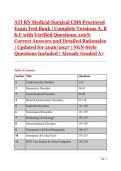
ATI RN Medical-Surgical CMS Proctored
Exam Test Bank | Complete Versions A, B
& C with Verified Questions, 100%
Correct Answers and Detailed Rationales
| Updated for 2026/2027 | NGN-Style
Questions Included | Already Graded A+
Table of Contents
Section Title Questions
1 Cardiovascular Disorders 1-35
2 Respiratory Disorders 36-65
3 Gastrointestinal Disorders 66-90
4 Renal & Genitourinary Disorders 91-110
5 Endocrine Disorders 111-130
6 Neurological Disorders 131-155
7 Hematology & Oncology 156-175
8 Musculoskeletal Disorders 176-195
9 Perioperative & Pain Management 196-215
10 Emergency & Critical Care 216-235
11 NGN Case Studies & Clinical Judgment 236-250
pg. 1
,SECTION 1: CARDIOVASCULAR DISORDERS
Questions 1-35
Question 1
A nurse is caring for a client who was admitted 4 hours ago with acute
decompensated heart failure (ADHF). The client is receiving a continuous infusion
of dobutamine at 5 mcg/kg/min and furosemide 40 mg IV push. Which assessment
finding requires immediate intervention?
A. Heart rate increase from 88 to 102 beats per minute
B. Urine output of 180 mL over the past 4 hours
C. Blood pressure decrease from 142/88 to 108/64 mm Hg
D. Respiratory rate of 22 breaths/min with crackles in bilateral lung bases
Answer: C
Rationale: A systolic blood pressure below 110 mm Hg in a client receiving
dobutamine (a beta-1 agonist that increases cardiac output and contractility)
suggests inadequate perfusion and potential cardiogenic shock. This finding
requires immediate intervention, including possibly titrating the dobutamine or
initiating additional vasopressors. Dobutamine can cause hypotension due to beta-2
mediated vasodilation; in ADHF, maintaining adequate perfusion pressure is
critical for end-organ function.
Question 2
A client is admitted with a diagnosis of rule-out myocardial infarction (MI). The
nurse reviews the client's troponin I levels. Which finding indicates the client has
experienced an acute myocardial injury?
A. Troponin I of 0.02 ng/mL
B. Troponin I of 0.05 ng/mL
C. Troponin I of 1.5 ng/mL
D. Troponin I of 0.03 ng/mL
Answer: C
pg. 2
,Rationale: Troponin I is a cardiac-specific biomarker. Normal levels are typically
less than 0.04 ng/mL. A level of 1.5 ng/mL is significantly elevated and confirms
myocardial necrosis. Troponin rises within 3-4 hours of injury and remains
elevated for 7-10 days.
Question 3
A nurse in a telemetry unit is caring for a client who was admitted 12 hours ago
with an acute myocardial infarction. The client suddenly reports increased chest
pressure, becomes restless, and states, "I feel like something is very wrong." Vital
signs are BP 86/52 mmHg, HR 124/min, RR 26/min, and oxygen saturation 89%
on 2 L nasal cannula. Which action should the nurse take first?
A. Administer IV morphine sulfate
B. Increase oxygen to 4 L/min via nasal cannula
C. Obtain a 12-lead ECG
D. Notify the rapid response team
Answer: D
Rationale: This client is showing signs of cardiogenic shock with hypotension,
tachycardia, tachypnea, and hypoxia. The priority is to activate the rapid response
team for immediate intervention. While morphine, oxygen, and ECG are important,
the unstable nature of the client requires escalation of care first.
Question 4
A nurse is caring for a client who has heart failure and a new prescription for
furosemide. Which of the following findings should the nurse monitor as an
adverse effect of this medication?
A. Hyperkalemia
B. Hypertension
C. Bradycardia
D. Weight gain
E. Hypokalemia
Answer: E
pg. 3
, Rationale: Furosemide is a loop diuretic that causes excretion of potassium along
with sodium and water, leading to hypokalemia. The nurse should monitor
potassium levels and watch for signs such as muscle weakness, leg cramps, and
cardiac dysrhythmias.
Question 5
A nurse is providing discharge teaching to a client who has a new prescription for
sublingual nitroglycerin. Which of the following client statements indicates an
understanding of the teaching?
A. "I can keep my medications for 1 year before replacing it."
B. "I should lie down when I take this medication."
C. "I should discontinue this medication if I develop a headache."
D. "I can take up to 5 tablets in 15 minutes before seeking medical attention."
Answer: B
Rationale: Sublingual nitroglycerin can cause hypotension, so it is advisable for
the client to lie down to minimize the risk of falling. Headache is a common
adverse effect of this medication and should not be a reason to discontinue it.
Nitroglycerin should be replaced every 6 months, and the maximum dose is 3
tablets in 15 minutes.
Question 6
A nurse is planning care for a client following a cardiac catheterization. Which of
the following actions should the nurse take?
A. Keep the client on bed rest for 24 hours
B. Limit the client's fluid intake to 1 L per day
C. Maintain the client's affected extremity in extension
D. Change the client's dressing every 8 hours
Answer: C
Rationale: Following cardiac catheterization, the affected extremity should be
maintained in extension to prevent bleeding and hematoma formation at the
pg. 4
Exam Test Bank | Complete Versions A, B
& C with Verified Questions, 100%
Correct Answers and Detailed Rationales
| Updated for 2026/2027 | NGN-Style
Questions Included | Already Graded A+
Table of Contents
Section Title Questions
1 Cardiovascular Disorders 1-35
2 Respiratory Disorders 36-65
3 Gastrointestinal Disorders 66-90
4 Renal & Genitourinary Disorders 91-110
5 Endocrine Disorders 111-130
6 Neurological Disorders 131-155
7 Hematology & Oncology 156-175
8 Musculoskeletal Disorders 176-195
9 Perioperative & Pain Management 196-215
10 Emergency & Critical Care 216-235
11 NGN Case Studies & Clinical Judgment 236-250
pg. 1
,SECTION 1: CARDIOVASCULAR DISORDERS
Questions 1-35
Question 1
A nurse is caring for a client who was admitted 4 hours ago with acute
decompensated heart failure (ADHF). The client is receiving a continuous infusion
of dobutamine at 5 mcg/kg/min and furosemide 40 mg IV push. Which assessment
finding requires immediate intervention?
A. Heart rate increase from 88 to 102 beats per minute
B. Urine output of 180 mL over the past 4 hours
C. Blood pressure decrease from 142/88 to 108/64 mm Hg
D. Respiratory rate of 22 breaths/min with crackles in bilateral lung bases
Answer: C
Rationale: A systolic blood pressure below 110 mm Hg in a client receiving
dobutamine (a beta-1 agonist that increases cardiac output and contractility)
suggests inadequate perfusion and potential cardiogenic shock. This finding
requires immediate intervention, including possibly titrating the dobutamine or
initiating additional vasopressors. Dobutamine can cause hypotension due to beta-2
mediated vasodilation; in ADHF, maintaining adequate perfusion pressure is
critical for end-organ function.
Question 2
A client is admitted with a diagnosis of rule-out myocardial infarction (MI). The
nurse reviews the client's troponin I levels. Which finding indicates the client has
experienced an acute myocardial injury?
A. Troponin I of 0.02 ng/mL
B. Troponin I of 0.05 ng/mL
C. Troponin I of 1.5 ng/mL
D. Troponin I of 0.03 ng/mL
Answer: C
pg. 2
,Rationale: Troponin I is a cardiac-specific biomarker. Normal levels are typically
less than 0.04 ng/mL. A level of 1.5 ng/mL is significantly elevated and confirms
myocardial necrosis. Troponin rises within 3-4 hours of injury and remains
elevated for 7-10 days.
Question 3
A nurse in a telemetry unit is caring for a client who was admitted 12 hours ago
with an acute myocardial infarction. The client suddenly reports increased chest
pressure, becomes restless, and states, "I feel like something is very wrong." Vital
signs are BP 86/52 mmHg, HR 124/min, RR 26/min, and oxygen saturation 89%
on 2 L nasal cannula. Which action should the nurse take first?
A. Administer IV morphine sulfate
B. Increase oxygen to 4 L/min via nasal cannula
C. Obtain a 12-lead ECG
D. Notify the rapid response team
Answer: D
Rationale: This client is showing signs of cardiogenic shock with hypotension,
tachycardia, tachypnea, and hypoxia. The priority is to activate the rapid response
team for immediate intervention. While morphine, oxygen, and ECG are important,
the unstable nature of the client requires escalation of care first.
Question 4
A nurse is caring for a client who has heart failure and a new prescription for
furosemide. Which of the following findings should the nurse monitor as an
adverse effect of this medication?
A. Hyperkalemia
B. Hypertension
C. Bradycardia
D. Weight gain
E. Hypokalemia
Answer: E
pg. 3
, Rationale: Furosemide is a loop diuretic that causes excretion of potassium along
with sodium and water, leading to hypokalemia. The nurse should monitor
potassium levels and watch for signs such as muscle weakness, leg cramps, and
cardiac dysrhythmias.
Question 5
A nurse is providing discharge teaching to a client who has a new prescription for
sublingual nitroglycerin. Which of the following client statements indicates an
understanding of the teaching?
A. "I can keep my medications for 1 year before replacing it."
B. "I should lie down when I take this medication."
C. "I should discontinue this medication if I develop a headache."
D. "I can take up to 5 tablets in 15 minutes before seeking medical attention."
Answer: B
Rationale: Sublingual nitroglycerin can cause hypotension, so it is advisable for
the client to lie down to minimize the risk of falling. Headache is a common
adverse effect of this medication and should not be a reason to discontinue it.
Nitroglycerin should be replaced every 6 months, and the maximum dose is 3
tablets in 15 minutes.
Question 6
A nurse is planning care for a client following a cardiac catheterization. Which of
the following actions should the nurse take?
A. Keep the client on bed rest for 24 hours
B. Limit the client's fluid intake to 1 L per day
C. Maintain the client's affected extremity in extension
D. Change the client's dressing every 8 hours
Answer: C
Rationale: Following cardiac catheterization, the affected extremity should be
maintained in extension to prevent bleeding and hematoma formation at the
pg. 4