
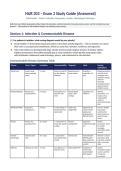
NUR 203 – Exam 2 Study Guide (Answered)
Child Health – Week 2: Infection, Respiratory, Cardiac, Hematologic/Oncologic
Built from your official study guide, all four Week 2 lecture decks, and the instructor's live exam-review session. Use this to check your own
answers — then go back to the textbook chapters for anything you got wrong.
Section 1: Infection & Communicable Disease
Q1. For patients in isolation, what nursing diagnosis would be your priority?
● Social Isolation r/t transmission-based precautions is the classic priority diagnosis — kids on isolation can't leave
their room or use playrooms/schoolrooms, which can cause fear, boredom, loneliness, and regression.
● Tailor interventions to developmental stage: infants need increased caregiver presence & familiar objects;
toddlers/preschoolers need safely-cleanable play & visual schedules; school-age kids need games/video
calls/schoolwork; adolescents need technology, privacy, and involvement in care decisions.
Communicable Disease Summary Table
Disease Cause / Agent Incubation Communicability Diagnosis Meds Nursing
Implications
Scarlet Fever Group A strep 2–5 days Onset of sx until 24 Rapid strep test / Penicillin or Droplet precautions
(toxin-producing hrs after starting throat culture amoxicillin x 10 until 24h of abx;
strain) antibiotics days sandpaper rash +
strawberry tongue;
watch for
rheumatic
fever/glomerulone
phritis; finish full
antibiotic course
Measles (Rubeola) Measles virus 8–12 days 4 days before to 4 Clinical (Koplik Supportive care; Airborne
(paramyxovirus) days after rash spots) + IgM Vitamin A precautions; 3 C's
onset serology (cough, coryza,
conjunctivitis);
watch for
pneumonia/enceph
alitis
RSV (Bronchiolitis) Respiratory 2–8 days 3–8 days (longer in Nasal swab Supportive (O2, Contact + droplet
syncytial virus infants/immunoco antigen/PCR suction, fluids); precautions;
mpromised) palivizumab suction before
prophylaxis for feeds; monitor for
high-risk infants apnea in young
infants
Mumps Mumps virus 12–25 days 1–2 days before to Clinical + Supportive; Droplet
(paramyxovirus) 5 days after parotid serology/PCR antipyretics/analge precautions; watch
swelling sics for orchitis,
meningitis,
pancreatitis; MMR
prevents
Varicella Varicella zoster 10–21 days 1–2 days before Clinical exam Acetaminophen Airborne + contact
(Chickenpox) virus rash until all lesions (NEVER aspirin – precautions; keep
crusted Reye syndrome); nails short; oatmeal
antihistamines/anti baths; encourage
pruritics fluids
Influenza Influenza virus A/B 1–4 days 1 day before to 5–7 Rapid antigen/PCR Oseltamivir if Droplet
days after onset started early; precautions; annual
acetaminophen vaccine; watch for
(NOT aspirin) 2° bacterial
pneumonia
, Disease Cause / Agent Incubation Communicability Diagnosis Meds Nursing
Implications
Pertussis Bordetella pertussis 6–21 days Catarrhal stage Nasopharyngeal Macrolide Droplet
through ~3 wks culture/PCR (azithromycin – precautions;
after paroxysmal caution w/ cardiac highest risk <1 yr;
cough (or until 5 hx) Tdap booster;
days of abx) cough can last
weeks ("100-day
cough")
Q2. Give examples of primary and secondary prevention of communicable disease.
● Primary prevention (before disease occurs): immunizations, hand hygiene education, safe food/water practices.
● Secondary prevention (early detection/treatment): screening tests (e.g., Mantoux/TB skin test), prompt treatment
of strep throat to prevent rheumatic fever, contact tracing.
Q3. Identify standard vs. transmission-based precautions for: Scarlet fever, Measles, TB, Pertussis, RSV, Varicella,
Meningitis, Erythema infectiosum, Influenza, Mumps.
● Scarlet fever — Droplet
● Measles — Airborne
● TB — Airborne
● Pertussis — Droplet
● RSV — Contact + Droplet
● Varicella — Airborne + Contact
● Meningitis (bacterial) — Droplet until 24 hrs of effective antibiotics
● Erythema infectiosum (Fifth disease/parvovirus B19) — Droplet during the prodromal phase; Standard precautions
once the rash appears (no longer contagious by then)
● Influenza — Droplet
● Mumps — Droplet
Q4. Describe the S/S associated with an infant with sepsis. Review normal vital signs in neonates and infants.
● Temperature instability (fever OR hypothermia — a low temp in a neonate is an ominous early sign), tachycardia,
tachypnea, lethargy/poor feeding, irritability, cool extremities, delayed cap refill (>3 sec), mottled skin, and
hypotension (a LATE sign in kids — don't wait for it).
● Newborn (birth–1 month): HR ~100–180 bpm, RR ~30–60/min, Temp ~97.7–100.3°F axillary.
● Infant (up to 12 months): HR ~90–160 bpm, RR ~25–40/min, Temp ~97.9–100.4°F axillary.
● (Confirm exact ranges against your textbook table — values vary slightly by source.)
Q5. What would we do if a patient with invasive tubes shows signs of sepsis?
A: Notify the provider immediately, obtain cultures (blood, urine, and from the line/tube site) BEFORE starting
antibiotics, assess the device for signs of infection, begin the sepsis bundle (labs, IV access, fluids), and monitor
vitals/perfusion closely.
Q6. What is the most common pathogen in septic arthritis and osteomyelitis? How is it typically treated?
● Staphylococcus aureus (including rising rates of MRSA) is the most common causative organism.
● Treatment: prolonged IV antibiotics (often weeks), possible surgical drainage/washout for septic arthritis,
immobilization of the affected limb, and pain management.
● Septic arthritis is an orthopedic emergency — cartilage can be destroyed within days if untreated.
● This is very disruptive to a child's ADLs: extended hospitalization, non-weight-bearing status, and long-term IV
antibiotic therapy.
Child Health – Week 2: Infection, Respiratory, Cardiac, Hematologic/Oncologic
Built from your official study guide, all four Week 2 lecture decks, and the instructor's live exam-review session. Use this to check your own
answers — then go back to the textbook chapters for anything you got wrong.
Section 1: Infection & Communicable Disease
Q1. For patients in isolation, what nursing diagnosis would be your priority?
● Social Isolation r/t transmission-based precautions is the classic priority diagnosis — kids on isolation can't leave
their room or use playrooms/schoolrooms, which can cause fear, boredom, loneliness, and regression.
● Tailor interventions to developmental stage: infants need increased caregiver presence & familiar objects;
toddlers/preschoolers need safely-cleanable play & visual schedules; school-age kids need games/video
calls/schoolwork; adolescents need technology, privacy, and involvement in care decisions.
Communicable Disease Summary Table
Disease Cause / Agent Incubation Communicability Diagnosis Meds Nursing
Implications
Scarlet Fever Group A strep 2–5 days Onset of sx until 24 Rapid strep test / Penicillin or Droplet precautions
(toxin-producing hrs after starting throat culture amoxicillin x 10 until 24h of abx;
strain) antibiotics days sandpaper rash +
strawberry tongue;
watch for
rheumatic
fever/glomerulone
phritis; finish full
antibiotic course
Measles (Rubeola) Measles virus 8–12 days 4 days before to 4 Clinical (Koplik Supportive care; Airborne
(paramyxovirus) days after rash spots) + IgM Vitamin A precautions; 3 C's
onset serology (cough, coryza,
conjunctivitis);
watch for
pneumonia/enceph
alitis
RSV (Bronchiolitis) Respiratory 2–8 days 3–8 days (longer in Nasal swab Supportive (O2, Contact + droplet
syncytial virus infants/immunoco antigen/PCR suction, fluids); precautions;
mpromised) palivizumab suction before
prophylaxis for feeds; monitor for
high-risk infants apnea in young
infants
Mumps Mumps virus 12–25 days 1–2 days before to Clinical + Supportive; Droplet
(paramyxovirus) 5 days after parotid serology/PCR antipyretics/analge precautions; watch
swelling sics for orchitis,
meningitis,
pancreatitis; MMR
prevents
Varicella Varicella zoster 10–21 days 1–2 days before Clinical exam Acetaminophen Airborne + contact
(Chickenpox) virus rash until all lesions (NEVER aspirin – precautions; keep
crusted Reye syndrome); nails short; oatmeal
antihistamines/anti baths; encourage
pruritics fluids
Influenza Influenza virus A/B 1–4 days 1 day before to 5–7 Rapid antigen/PCR Oseltamivir if Droplet
days after onset started early; precautions; annual
acetaminophen vaccine; watch for
(NOT aspirin) 2° bacterial
pneumonia
, Disease Cause / Agent Incubation Communicability Diagnosis Meds Nursing
Implications
Pertussis Bordetella pertussis 6–21 days Catarrhal stage Nasopharyngeal Macrolide Droplet
through ~3 wks culture/PCR (azithromycin – precautions;
after paroxysmal caution w/ cardiac highest risk <1 yr;
cough (or until 5 hx) Tdap booster;
days of abx) cough can last
weeks ("100-day
cough")
Q2. Give examples of primary and secondary prevention of communicable disease.
● Primary prevention (before disease occurs): immunizations, hand hygiene education, safe food/water practices.
● Secondary prevention (early detection/treatment): screening tests (e.g., Mantoux/TB skin test), prompt treatment
of strep throat to prevent rheumatic fever, contact tracing.
Q3. Identify standard vs. transmission-based precautions for: Scarlet fever, Measles, TB, Pertussis, RSV, Varicella,
Meningitis, Erythema infectiosum, Influenza, Mumps.
● Scarlet fever — Droplet
● Measles — Airborne
● TB — Airborne
● Pertussis — Droplet
● RSV — Contact + Droplet
● Varicella — Airborne + Contact
● Meningitis (bacterial) — Droplet until 24 hrs of effective antibiotics
● Erythema infectiosum (Fifth disease/parvovirus B19) — Droplet during the prodromal phase; Standard precautions
once the rash appears (no longer contagious by then)
● Influenza — Droplet
● Mumps — Droplet
Q4. Describe the S/S associated with an infant with sepsis. Review normal vital signs in neonates and infants.
● Temperature instability (fever OR hypothermia — a low temp in a neonate is an ominous early sign), tachycardia,
tachypnea, lethargy/poor feeding, irritability, cool extremities, delayed cap refill (>3 sec), mottled skin, and
hypotension (a LATE sign in kids — don't wait for it).
● Newborn (birth–1 month): HR ~100–180 bpm, RR ~30–60/min, Temp ~97.7–100.3°F axillary.
● Infant (up to 12 months): HR ~90–160 bpm, RR ~25–40/min, Temp ~97.9–100.4°F axillary.
● (Confirm exact ranges against your textbook table — values vary slightly by source.)
Q5. What would we do if a patient with invasive tubes shows signs of sepsis?
A: Notify the provider immediately, obtain cultures (blood, urine, and from the line/tube site) BEFORE starting
antibiotics, assess the device for signs of infection, begin the sepsis bundle (labs, IV access, fluids), and monitor
vitals/perfusion closely.
Q6. What is the most common pathogen in septic arthritis and osteomyelitis? How is it typically treated?
● Staphylococcus aureus (including rising rates of MRSA) is the most common causative organism.
● Treatment: prolonged IV antibiotics (often weeks), possible surgical drainage/washout for septic arthritis,
immobilization of the affected limb, and pain management.
● Septic arthritis is an orthopedic emergency — cartilage can be destroyed within days if untreated.
● This is very disruptive to a child's ADLs: extended hospitalization, non-weight-bearing status, and long-term IV
antibiotic therapy.


