
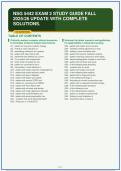
NSG 5442 EXAM 2 STUDY GUIDE FALL
2025/26 UPDATE WITH COMPLETE
SOLUTIONS.
190 QUESTIONS
TABLE OF CONTENTS
Critically analyze complex clinical scenarios Evaluate the latest research and guidelines
to formulate evidence-based interventions for applicability in advanced nursing
Q1 - patient on long-term warfarin therapy Q23 - patient with septic shock remains
Q2 - finding is most indicative of Q24 - ventilator setting adjustment is most
Q3 - prescribing metformin for a patient Q25 - finding is most consistent with
Q4 - patient with heart failure with Q26 - patient with severe metabolic acidosis
Q5 - statement best reflects the current Q27 - patient receiving continuous renal replac...
Q6 - For a patient with anaphylaxis, Q28 - electrocardiographic change is most indic...
Q7 - factor most increases the risk Q29 - patient with cirrhosis and acute
Q8 - patient on vancomycin has a Q30 - of the following best describes
Q9 - intervention is most effective in Q31 - a patient with an acute
Q10 - patient with sepsis requires norepinephrine. Q32 - patient with sepsis and acute
Q11 - patient with acute ischemic stroke Q33 - of the following best explains
Q12 - patient with type 2 diabetes Q34 - patient with a large pulmonary
Q13 - patient with sepsis and lactate Q35 - of the following findings is
Q14 - patient with severe COPD and Q36 - According to current neurocritical care
Q15 - patient on vancomycin for MRSA Q37 - patient with a subarachnoid hemorrhage
Q16 - patient with heart failure with Q38 - of the following best describes
Q17 - patient with cirrhosis and ascites Q39 - of the following is the
Q18 - patient with major depressive disorder Q40 - of the following best explains
Q19 - patient with atrial fibrillation and Q41 - patient on warfarin presents with
Q20 - patient with acute pancreatitis has Q42 - finding is most indicative of
Q21 - a patient with acute decompensated Q43 - researcher plans a study to
Q22 - finding on a 12-lead ECG
Page 1
,Integrate pharmacological and 26 Update with complete solutions.
pathophysiological principles to optimize Q86 - patient with ARDS is on
Q44 - medication requires dosage adjustment in Q87 - patient with sepsis develops acute
Q45 - change in vital signs most Q88 - patient with septic shock is
Q46 - patient on lithium has a Q89 - ventilator mode is most appropriate
Q47 - finding is most consistent with Q90 - patient with ARDS has a
Q48 - assessment finding is most indicative Q91 - a patient with chronic heart
Q49 - patient with heart failure is Q92 - pathophysiological mechanism best explain...
Q50 - action best demonstrates the principle Q93 - patient on warfarin has an
Q51 - a clinical trial, a new Q94 - managing a patient with septic
Q52 - of the following best illustrates Q95 - finding in a patient with
Q53 - researcher is designing a study Q96 - drug interaction is most likely
Q54 - a meta-analysis, the I² statistic Q97 - patient with type 2 diabetes
Q55 - study design provides the strongest Q98 - finding on a patient's ECG
Q56 - patient with type 2 diabetes Q99 - a patient with acute pancreatitis,
Q57 - of the following is a Q100 - of the following is a
Q58 - hospital is implementing a new Q101 - healthcare system implementing a new
Q59 - statistical method is most appropriate Q102 - a systematic review of mobile
Q60 - nurse researcher is developing a Q103 - community health center is designing
Q61 - a patient with refractory septic Q104 - nurse informaticist is evaluating a
Q62 - of the following best explains Q105 - a pragmatic clinical trial comparing
Q63 - patient with acute respiratory distress Q106 - nurse researcher plans to use
Q64 - managing a patient with acute
Foundations of Nursing (Advanced Practice)
NSG 5442 Exam 2 Study Guide Fall 2025 Q107 - applying the American Nurses Association
Q65 - of the following best describes Q108 - nurse informaticist is leading a
Q66 - patient on continuous renal replacement Q109 - hospital is implementing a barcode
Q67 - of the following statements best Q110 - nurse researcher is conducting a
Q68 - of the following is the Q111 - a double-blind RCT, a new
Q69 - patient with a subarachnoid hemorrhage Q112 - hospitalized patient receiving IV furosemide
Q70 - of the following best describes Q113 - patient on long-term omeprazole for
Q71 - a patient with acute decompensated Q114 - patient with resistant hypertension is
Q72 - patient on continuous renal replacement Q115 - drug interaction is most likely
Q73 - For a mechanically ventilated patient Q116 - patient with type 2 diabetes
Q74 - of the following findings best Q117 - patient on warfarin for mechanical
Q75 - a patient with septic shock Q118 - finding is most consistent with
Q76 - patient with acute pancreatitis develops Q119 - patient on lithium for bipolar
Q77 - of the following electrocardiographic fin... Q120 - patient with chronic kidney disease
Q78 - patient with severe traumatic brain Q121 - patient with severe sepsis and
Q79 - a patient with septic shock Q122 - a patient with septic shock
Q80 - patient on veno-venous ECMO for Q123 - of the following best explains
Q81 - a high-acuity critical care unit, Q124 - patient with acute respiratory distress
Q82 - patient with septic shock remains Q125 - patient with suspected heparin-induced th...
Q83 - pathophysiological mechanism most directl... Q126 - of the following acid-base disturbances
Q84 - patient with acute pancreatitis develops Q127 - patient in cardiogenic shock has
Q85 - managing a patient with severe
Page 2
,Applied Nursing (Advanced Practice) Nursing (Advanced Practice) Review
Q128 - patient with acute liver failure Q170 - patient with acute decompensated heart
Q129 - of the following is the Q171 - patient presents with acute-onset, severe,
Q130 - patient with acute pancreatitis develops Q172 - patient with atrial fibrillation is
Q131 - a patient with acute decompensated Q173 - a patient with type 2
Q132 - combination of findings most accurately Q174 - researcher is analyzing a study
Q133 - patient with septic shock remains Q175 - patient is prescribed a drug
Q134 - finding is most consistent with Q176 - patient with chronic heart failure
Q135 - patient with cirrhosis and ascites Q177 - patient on long-term phenytoin therapy
Q136 - Electrocardiogram (ECG) finding is most Q178 - patient with suspected bacterial meningitis
Q137 - patient with diabetic ketoacidosis has Q179 - patient with major depressive disorder
Q138 - ventilator setting adjustment is most Q180 - patient with pneumonia is prescribed
Q139 - patient with a pulmonary embolism Q181 - patient with an elevated ammonia
Q140 - of the following is the Q182 - pathophysiologic mechanism best explains the
Q141 - 45-year-old with type 2 diabetes Q183 - patient with cirrhosis develops acute
Q142 - pathophysiological mechanism best explain... Q184 - combination of clinical findings is
Q143 - nurse practitioner is considering prescri... Q185 - patient with acute pancreatitis develops
Q144 - clinical presentation is most consistent Q186 - patient with chronic pancreatitis presents
Q145 - finding on an arterial blood Q187 - patient with acute cholecystitis is
Q146 - electrolyte abnormality is most likely Q188 - electrocardiographic finding is most char...
Q147 - intervention is most appropriate for Q189 - patient with chronic kidney disease
Q148 - patient with sepsis is prescribed Q190 - of the following is the
Advanced Nursing (Advanced Practice)
Q149 - assessment finding in a patient
Q150 - finding is most indicative of
Q151 - patient with a history of
Q152 - a patient with suspected acute
Q153 - pathophysiologic mechanism best explains the
Q154 - patient with type 2 diabetes
Q155 - patient with cirrhosis and ascites
Q156 - of the following best describes
Q157 - patient on warfarin for atrial
Q158 - finding is most indicative of
Q159 - patient with acute decompensated heart
Q160 - of the following is a
Q161 - patient with a history of
Q162 - patient with cirrhosis and ascites
Q163 - patient with severe sepsis and
Q164 - a patient with refractory hypoxemia
Q165 - patient presents with acute-onset flank
Q166 - patient with suspected acute pancreatitis
Q167 - patient with liver cirrhosis and
Q168 - patient with chronic kidney disease
Q169 - patient with acute respiratory distress
Page 3
, Q1 CRITICALLY ANALYZE COMPLEX CLINICAL SCENARIOS TO FORMULATE
EVIDENCE-BASED INTERVENTIONS
A patient on long-term warfarin therapy presents with an INR of 5.2 and minor
bleeding. Which intervention is most appropriate?
A. Administer vitamin K 10 mg IV CORRECT
B. Hold warfarin and observe
C. Give fresh frozen plasma
D. Administer prothrombin complex concentrate
RATIONALE: In patients with INR >5 and minor bleeding, vitamin K is first-line to reverse
anticoagulation. FFP or PCC are for serious/life-threatening bleeding. Holding alone is insufficient
with active bleeding.
Q2 CRITICALLY ANALYZE COMPLEX CLINICAL SCENARIOS TO FORMULATE
EVIDENCE-BASED INTERVENTIONS
Which finding is most indicative of malignant hyperthermia in a patient receiving
volatile anesthetics?
A. Bradycardia and hypotension
B. Elevated end-tidal CO2 and muscle rigidity CORRECT
C. Hyperthermia and respiratory alkalosis
D. Metabolic acidosis and hypokalemia
RATIONALE: Early signs include unexplained rise in ETCO2 and muscle rigidity due to
hypermetabolism. Hyperthermia is a late sign. Acidosis and hyperkalemia occur, not
hypokalemia.
Page 4


