
NUR 621 Topic 3 Assignment — Delivery Models Essay | Comprehensive Examination Page 1
NUR 621 TOPIC 3 ASSIGNMENT, DELIVERY MODELS
ESSAY
Comprehensive Examination | Aligned with NUR 621 Healthcare Finance & Budgeting
Curriculum
AACN Essentials of Master's Education | Healthcare Delivery System Standards 2026/2027 Edition
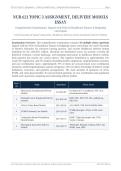
Examination Overview: This comprehensive examination contains 50 multiple-choice questions
aligned with the NUR 621 Healthcare Finance & Budgeting course curriculum, the AACN Essentials
of Master's Education for advanced nursing practice, and current Healthcare Delivery System
Standards for the 2026/2027 edition. Questions are distributed across six sections covering the
historical evolution, current landscape, and emerging innovations in healthcare delivery models.
Each question has exactly one correct answer. The cognitive distribution is approximately 25%
recall, 50% application, and 25% analysis (including model comparisons, implementation scenarios,
and care coordination cases). Approximately 70% of items are scenario-based (care coordination
situations, model implementation, patient navigation); 30% test direct knowledge of delivery model
definitions, structures, and payment arrangements. The exam includes 10 questions on ACOs,
PCMH, and value-based models; 10 scenario-based questions on care coordination and population
health; and 5 questions comparing and contrasting delivery models.
Secti
Topic Questions Focus Areas
on
Historical & Foundational Delivery Evolution of U.S. healthcare, FFS, ACA,
1 Q1–Q10 (10)
Models international models
Managed Care & Integrated Delivery HMO, PPO, EPO, POS, IPA, staff/group,
2 Q11–Q20 (10)
Systems PHO, IDS
3 ACOs & Value-Based Models Q21–Q28 (8) ACO, MSSP, VBP, MACRA/MIPS/APMs
PCMH principles, NCQA, CoCM, team
4 PCMH & Primary Care Models Q29–Q36 (8)
roles
Community-Based & Population FQHC, Triple/Quadruple Aim, CCM,
5 Q37–Q43 (7)
Health Models Naylor, Coleman
Emerging & Innovative Delivery Telehealth, Hospital-at-Home, BPCI, MA,
6 Q44–Q50 (7)
Models SDOH, Lean, HRO
AACN Essentials of Master's Education | Healthcare Delivery System Standards 2026/2027 Edition
,NUR 621 Topic 3 Assignment — Delivery Models Essay | Comprehensive Examination Page 2
Section 1: Historical & Foundational Delivery Models
10 questions • Questions Q1–Q10
Q1: A nurse leader is preparing a continuing education module on the historical evolution of
U.S. healthcare delivery. Which of the following BEST describes the dominant payment
model in the pre-industrial era of U.S. healthcare (before 1900)?
A. Fee-for-service insurance through employer-based plans
B. Capitated payments to physician groups
C. Predominantly out-of-pocket payment by patients to physicians, with limited insurance
and minimal government involvement; most care was delivered in the home by family
members or general practitioners *[CORRECT]*
D. Government-funded national health insurance
Correct Answer: C
Rationale: The pre-industrial era (before ~1900) of U.S. healthcare was characterized by out-of-pocket
payment, home-based care by family and general practitioners, minimal hospitals, and absence of health
insurance. Modern insurance (Blue Cross, 1929), employer-based coverage (post-WWII), and government
programs (Medicare/Medicaid, 1965) came later. The NUR 621 curriculum emphasizes that understanding
this evolution helps nurse leaders contextualize current payment reform.
Q2: Which landmark federal legislation, enacted in 1965, created the Medicare and
Medicaid programs and fundamentally transformed U.S. healthcare delivery by extending
coverage to the elderly and low-income populations?
A. The Social Security Act Amendments of 1965 *[CORRECT]*
B. The Affordable Care Act (ACA) of 2010
C. The Health Insurance Portability and Accountability Act (HIPAA) of 1996
D. The Medicare Modernization Act (MMA) of 2003
Correct Answer: A
Rationale: The Social Security Act Amendments of 1965 (signed by President Johnson) created Medicare
(Title XVIII, for those 65+ and certain disabled populations) and Medicaid (Title XIX, for low-income
populations). These programs fundamentally transformed healthcare delivery by extending coverage to
previously uninsured populations and establishing federal financing as a major payer. The ACA (2010)
expanded coverage further; HIPAA (1996) addressed privacy and portability; MMA (2003) added Medicare
Part D prescription drug coverage.
AACN Essentials of Master's Education | Healthcare Delivery System Standards 2026/2027 Edition
, NUR 621 Topic 3 Assignment — Delivery Models Essay | Comprehensive Examination Page 3
Q3: A nurse administrator is teaching staff about the fundamental weakness of the
traditional fee-for-service (FFS) payment model. Which statement most accurately
describes this weakness?
A. FFS pays providers a fixed annual amount per patient regardless of services used, leading to
underutilization
B. FFS incentivizes volume over value by paying for each service individually, rewarding
providers for performing more services rather than achieving better outcomes,
contributing to fragmentation and escalating costs *[CORRECT]*
C. FFS limits patient choice of providers
D. FFS pays providers only for outcomes achieved, regardless of services provided
Correct Answer: B
Rationale: The traditional fee-for-service (FFS) model pays for each service individually, incentivizing
volume over value. Providers are financially rewarded for performing more services, not for achieving
better outcomes or coordinating care, leading to overutilization, fragmentation, and escalating costs. NUR
621 content emphasizes that FFS is the historical baseline against which value-based models (ACOs,
PCMH, bundled payments) are compared. The weaknesses of FFS (volume incentive, fragmentation)
drove development of managed care and value-based payment reform.
Q4: Which statement BEST describes the primary goal of the Affordable Care Act (ACA),
enacted in 2010, in reshaping healthcare delivery in the United States?
A. To eliminate private health insurance and replace it with a single-payer system
B. To expand health insurance coverage through Medicaid expansion and insurance
marketplaces, prohibit discriminatory practices (pre-existing condition exclusions), and
incentivize value-based delivery models — while preserving the private insurance market
*[CORRECT]*
C. To reduce the number of insured Americans
D. To abolish Medicare and Medicaid
Correct Answer: B
Rationale: The Patient Protection and Affordable Care Act (ACA), enacted March 23, 2010, sought to: (1)
expand health insurance coverage through Medicaid expansion and Health Insurance Marketplaces (with
subsidies); (2) prohibit discriminatory practices (pre-existing condition exclusions, annual/lifetime limits,
gender rating); (3) incentivize value-based delivery models (ACOs, bundled payments, VBP); (4) preserve
the private insurance market (NOT single-payer). The ACA did not eliminate private insurance, reduce
coverage, or abolish Medicare/Medicaid. NUR 621 curriculum examines ACA as a driver of delivery model
transformation.
AACN Essentials of Master's Education | Healthcare Delivery System Standards 2026/2027 Edition
NUR 621 TOPIC 3 ASSIGNMENT, DELIVERY MODELS
ESSAY
Comprehensive Examination | Aligned with NUR 621 Healthcare Finance & Budgeting
Curriculum
AACN Essentials of Master's Education | Healthcare Delivery System Standards 2026/2027 Edition
Examination Overview: This comprehensive examination contains 50 multiple-choice questions
aligned with the NUR 621 Healthcare Finance & Budgeting course curriculum, the AACN Essentials
of Master's Education for advanced nursing practice, and current Healthcare Delivery System
Standards for the 2026/2027 edition. Questions are distributed across six sections covering the
historical evolution, current landscape, and emerging innovations in healthcare delivery models.
Each question has exactly one correct answer. The cognitive distribution is approximately 25%
recall, 50% application, and 25% analysis (including model comparisons, implementation scenarios,
and care coordination cases). Approximately 70% of items are scenario-based (care coordination
situations, model implementation, patient navigation); 30% test direct knowledge of delivery model
definitions, structures, and payment arrangements. The exam includes 10 questions on ACOs,
PCMH, and value-based models; 10 scenario-based questions on care coordination and population
health; and 5 questions comparing and contrasting delivery models.
Secti
Topic Questions Focus Areas
on
Historical & Foundational Delivery Evolution of U.S. healthcare, FFS, ACA,
1 Q1–Q10 (10)
Models international models
Managed Care & Integrated Delivery HMO, PPO, EPO, POS, IPA, staff/group,
2 Q11–Q20 (10)
Systems PHO, IDS
3 ACOs & Value-Based Models Q21–Q28 (8) ACO, MSSP, VBP, MACRA/MIPS/APMs
PCMH principles, NCQA, CoCM, team
4 PCMH & Primary Care Models Q29–Q36 (8)
roles
Community-Based & Population FQHC, Triple/Quadruple Aim, CCM,
5 Q37–Q43 (7)
Health Models Naylor, Coleman
Emerging & Innovative Delivery Telehealth, Hospital-at-Home, BPCI, MA,
6 Q44–Q50 (7)
Models SDOH, Lean, HRO
AACN Essentials of Master's Education | Healthcare Delivery System Standards 2026/2027 Edition
,NUR 621 Topic 3 Assignment — Delivery Models Essay | Comprehensive Examination Page 2
Section 1: Historical & Foundational Delivery Models
10 questions • Questions Q1–Q10
Q1: A nurse leader is preparing a continuing education module on the historical evolution of
U.S. healthcare delivery. Which of the following BEST describes the dominant payment
model in the pre-industrial era of U.S. healthcare (before 1900)?
A. Fee-for-service insurance through employer-based plans
B. Capitated payments to physician groups
C. Predominantly out-of-pocket payment by patients to physicians, with limited insurance
and minimal government involvement; most care was delivered in the home by family
members or general practitioners *[CORRECT]*
D. Government-funded national health insurance
Correct Answer: C
Rationale: The pre-industrial era (before ~1900) of U.S. healthcare was characterized by out-of-pocket
payment, home-based care by family and general practitioners, minimal hospitals, and absence of health
insurance. Modern insurance (Blue Cross, 1929), employer-based coverage (post-WWII), and government
programs (Medicare/Medicaid, 1965) came later. The NUR 621 curriculum emphasizes that understanding
this evolution helps nurse leaders contextualize current payment reform.
Q2: Which landmark federal legislation, enacted in 1965, created the Medicare and
Medicaid programs and fundamentally transformed U.S. healthcare delivery by extending
coverage to the elderly and low-income populations?
A. The Social Security Act Amendments of 1965 *[CORRECT]*
B. The Affordable Care Act (ACA) of 2010
C. The Health Insurance Portability and Accountability Act (HIPAA) of 1996
D. The Medicare Modernization Act (MMA) of 2003
Correct Answer: A
Rationale: The Social Security Act Amendments of 1965 (signed by President Johnson) created Medicare
(Title XVIII, for those 65+ and certain disabled populations) and Medicaid (Title XIX, for low-income
populations). These programs fundamentally transformed healthcare delivery by extending coverage to
previously uninsured populations and establishing federal financing as a major payer. The ACA (2010)
expanded coverage further; HIPAA (1996) addressed privacy and portability; MMA (2003) added Medicare
Part D prescription drug coverage.
AACN Essentials of Master's Education | Healthcare Delivery System Standards 2026/2027 Edition
, NUR 621 Topic 3 Assignment — Delivery Models Essay | Comprehensive Examination Page 3
Q3: A nurse administrator is teaching staff about the fundamental weakness of the
traditional fee-for-service (FFS) payment model. Which statement most accurately
describes this weakness?
A. FFS pays providers a fixed annual amount per patient regardless of services used, leading to
underutilization
B. FFS incentivizes volume over value by paying for each service individually, rewarding
providers for performing more services rather than achieving better outcomes,
contributing to fragmentation and escalating costs *[CORRECT]*
C. FFS limits patient choice of providers
D. FFS pays providers only for outcomes achieved, regardless of services provided
Correct Answer: B
Rationale: The traditional fee-for-service (FFS) model pays for each service individually, incentivizing
volume over value. Providers are financially rewarded for performing more services, not for achieving
better outcomes or coordinating care, leading to overutilization, fragmentation, and escalating costs. NUR
621 content emphasizes that FFS is the historical baseline against which value-based models (ACOs,
PCMH, bundled payments) are compared. The weaknesses of FFS (volume incentive, fragmentation)
drove development of managed care and value-based payment reform.
Q4: Which statement BEST describes the primary goal of the Affordable Care Act (ACA),
enacted in 2010, in reshaping healthcare delivery in the United States?
A. To eliminate private health insurance and replace it with a single-payer system
B. To expand health insurance coverage through Medicaid expansion and insurance
marketplaces, prohibit discriminatory practices (pre-existing condition exclusions), and
incentivize value-based delivery models — while preserving the private insurance market
*[CORRECT]*
C. To reduce the number of insured Americans
D. To abolish Medicare and Medicaid
Correct Answer: B
Rationale: The Patient Protection and Affordable Care Act (ACA), enacted March 23, 2010, sought to: (1)
expand health insurance coverage through Medicaid expansion and Health Insurance Marketplaces (with
subsidies); (2) prohibit discriminatory practices (pre-existing condition exclusions, annual/lifetime limits,
gender rating); (3) incentivize value-based delivery models (ACOs, bundled payments, VBP); (4) preserve
the private insurance market (NOT single-payer). The ACA did not eliminate private insurance, reduce
coverage, or abolish Medicare/Medicaid. NUR 621 curriculum examines ACA as a driver of delivery model
transformation.
AACN Essentials of Master's Education | Healthcare Delivery System Standards 2026/2027 Edition


