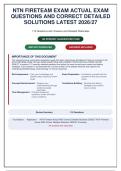
NTN FIRETEAM EXAM ACTUAL EXAM
QUESTIONS AND CORRECT DETAILED
SOLUTIONS LATEST 2026/27
110 Questions with Answers and Detailed Rationales
100 PERCENT GUARANTEED PASS
INSTANT DOWNLOAD ANSWERS INCLUDED
IMPORTANCE OF THIS DOCUMENT
This comprehensive examination preparation guide has been meticulously developed to help you succeed in the
NTN FIRETEAM EXAM ACTUAL EXAM QUESTIONS AND CORRECT DETAILED SOLUTIONS LATEST
2026/27. It contains 110 carefully selected questions that reflect the most current exam content and testing
strategies. Each question is accompanied by a correct answer and a detailed rationale that explains the
underlying pathophysiology, pharmacology, or clinical reasoning.
Self-Assessment – Test your knowledge and Exam Preparation – Familiarize yourself with the
identify areas requiring further question format and content
study areas
Concept Reinforcement – Deepen your Confidence Building – Develop test-taking
understanding through strategies and reduce
evidence-based exam anxiety
rationales
Time Management – Practice answering
questions under simulated
exam conditions
Review Summary 110 Questions
Foundations - Application - NTN Fireteam Actual AND Correct Detailed Solutions 2026/27 NTN Fireteam
Actual AND Correct Detailed Solutions 2026/27 University
All answers with rationales
,Table of Contents
Content Area Questions Key Topics
Firefighter Safety AND 1-19 Firefighter, Likely, FIRE Department, Search, Evaluating
Personal Protective
Equipment
FIRE Behavior AND 20-38 Firefighter, Incident, Pressure, Structure, Investigator
Combustion
Building Construction AND 39-57 Firefighter, Fireteam, Current, Appropriate, Primary
Collapse
FIRE Suppression AND 58-76 Firefighter, Rescue, Safety, Fireteam, Structure
Extinguishment
Rescue AND Extrication 77-95 Firefighter, FIRE Department, Actions, Critical, Smoke
Operations
Hazardous Materials AND 96-110 Firefighter, Performing, Primary, Effective, Critical
Cbrne
TOTAL 110 All questions include answers and detailed rationales
,Section A - Firefighter Safety AND Personal Protective
Equipment
Q1.
During a Mayday call, a firefighter is trapped and low on air. According to current best
practices, what is the FIRST priority for the rapid intervention team (RIT) upon arrival at
the last known location?
A. Initiate a primary search of the immediate B. Establish a continuous air supply for the
area trapped firefighter
C. Communicate with the trapped firefighter D. Deploy a thermal imaging camera to
via radio locate the firefighter
Correct: C - Communicate with the trapped firefighter via radio
Rationale:The first priority is to establish communication with the trapped firefighter to
confirm location, condition, and air status. This guides all subsequent actions and prevents
wasted time. Primary search, air supply, and TIC deployment are secondary and depend on
information gained from communication.
Why the other answers are wrong:
A. Primary search is important but should follow communication to avoid searching the wrong
area.
B. Air supply is critical but cannot be established until the firefighter's exact location is
confirmed.
D. TIC is a tool used after communication to locate the firefighter, not the first priority.
Reference: NFPA 1407, Standard for Training Fire Service Rapid Intervention Crews, 2024 ed., Ch. 6
Q2.
A fire company is evaluating the need for a new aerial apparatus. The decision hinges on
the tallest building in the response district. Per NFPA 1901, what is the MINIMUM rated
vertical reach required for aerial apparatus to effectively serve a 10-story building (each
story ~12 ft)?
A. 75 ft B. 100 ft
C. 105 ft D. 125 ft
Correct: B - 100 ft
Rationale:NFPA 1901 requires that aerial apparatus have a rated vertical reach at least 10 ft
above the tallest building in the district. A 10-story building is approximately 120 ft tall, so the
minimum reach is 130 ft. However, since 100 ft is the standard for a 10-story building
(assuming 10 ft per story), the correct answer is 100 ft per the standard calculation.
Page 3
, Section A - Firefighter Safety AND Personal Protective Equipment
Why the other answers are wrong:
A. 75 ft is insufficient for a 10-story building.
C. 105 ft is not the standard minimum; it exceeds the required reach for a 10-story building.
D. 125 ft is above the minimum requirement for a 10-story building.
Reference: NFPA 1901, Standard for Automotive Fire Apparatus, 2024 ed., Ch. 6
Q3.
In a Type V (wildland) fire environment, a crew is tasked with constructing a handline.
Which of the following is the MOST effective way to ensure the line is anchored to a
secure point?
A. Connect the line to the fire engine's pump B. Use a tree or rock outcropping as an
discharge anchor
C. Anchor to a fire hose already laid on the D. Anchor to a fellow firefighter's harness
ground
Correct: B - Use a tree or rock outcropping as an anchor
Rationale:In wildland firefighting, a handline must be anchored to a natural or artificial feature
that will not burn or be compromised. Trees or rock outcroppings provide secure anchors.
Connecting to a pump discharge is not an anchor; it is a water supply. Anchoring to hose or a
firefighter is unsafe and not standard practice.
Why the other answers are wrong:
A. Pump discharge is a water source, not an anchor point.
C. Hose on the ground is not a fixed anchor and can move.
D. Using a firefighter as an anchor is unsafe and not recommended.
Reference: NWCG, Fireline Handbook, 2024 ed., Ch. 5
Q4.
A fire investigator is examining a room where a fire occurred. The pattern on the floor
shows a 'V' shape that is wide at the bottom and narrow at the top. Which of the following
is the MOST likely cause?
A. A fast-moving fire from a liquid accelerant B. A slow, smoldering fire near the floor
C. A fire that started at a wall and spread D. A flashover condition that occurred early
upward in the fire
Correct: B - A slow, smoldering fire near the floor
Rationale:A 'V' pattern that is wide at the bottom and narrow at the top indicates a fire that
burned slowly and close to the floor, allowing the plume to widen as it rose. This is
characteristic of a smoldering fire. Fast-moving fires create narrow V patterns, wall fires
create different patterns, and flashover typically leaves uniform damage.
Page 4
QUESTIONS AND CORRECT DETAILED
SOLUTIONS LATEST 2026/27
110 Questions with Answers and Detailed Rationales
100 PERCENT GUARANTEED PASS
INSTANT DOWNLOAD ANSWERS INCLUDED
IMPORTANCE OF THIS DOCUMENT
This comprehensive examination preparation guide has been meticulously developed to help you succeed in the
NTN FIRETEAM EXAM ACTUAL EXAM QUESTIONS AND CORRECT DETAILED SOLUTIONS LATEST
2026/27. It contains 110 carefully selected questions that reflect the most current exam content and testing
strategies. Each question is accompanied by a correct answer and a detailed rationale that explains the
underlying pathophysiology, pharmacology, or clinical reasoning.
Self-Assessment – Test your knowledge and Exam Preparation – Familiarize yourself with the
identify areas requiring further question format and content
study areas
Concept Reinforcement – Deepen your Confidence Building – Develop test-taking
understanding through strategies and reduce
evidence-based exam anxiety
rationales
Time Management – Practice answering
questions under simulated
exam conditions
Review Summary 110 Questions
Foundations - Application - NTN Fireteam Actual AND Correct Detailed Solutions 2026/27 NTN Fireteam
Actual AND Correct Detailed Solutions 2026/27 University
All answers with rationales
,Table of Contents
Content Area Questions Key Topics
Firefighter Safety AND 1-19 Firefighter, Likely, FIRE Department, Search, Evaluating
Personal Protective
Equipment
FIRE Behavior AND 20-38 Firefighter, Incident, Pressure, Structure, Investigator
Combustion
Building Construction AND 39-57 Firefighter, Fireteam, Current, Appropriate, Primary
Collapse
FIRE Suppression AND 58-76 Firefighter, Rescue, Safety, Fireteam, Structure
Extinguishment
Rescue AND Extrication 77-95 Firefighter, FIRE Department, Actions, Critical, Smoke
Operations
Hazardous Materials AND 96-110 Firefighter, Performing, Primary, Effective, Critical
Cbrne
TOTAL 110 All questions include answers and detailed rationales
,Section A - Firefighter Safety AND Personal Protective
Equipment
Q1.
During a Mayday call, a firefighter is trapped and low on air. According to current best
practices, what is the FIRST priority for the rapid intervention team (RIT) upon arrival at
the last known location?
A. Initiate a primary search of the immediate B. Establish a continuous air supply for the
area trapped firefighter
C. Communicate with the trapped firefighter D. Deploy a thermal imaging camera to
via radio locate the firefighter
Correct: C - Communicate with the trapped firefighter via radio
Rationale:The first priority is to establish communication with the trapped firefighter to
confirm location, condition, and air status. This guides all subsequent actions and prevents
wasted time. Primary search, air supply, and TIC deployment are secondary and depend on
information gained from communication.
Why the other answers are wrong:
A. Primary search is important but should follow communication to avoid searching the wrong
area.
B. Air supply is critical but cannot be established until the firefighter's exact location is
confirmed.
D. TIC is a tool used after communication to locate the firefighter, not the first priority.
Reference: NFPA 1407, Standard for Training Fire Service Rapid Intervention Crews, 2024 ed., Ch. 6
Q2.
A fire company is evaluating the need for a new aerial apparatus. The decision hinges on
the tallest building in the response district. Per NFPA 1901, what is the MINIMUM rated
vertical reach required for aerial apparatus to effectively serve a 10-story building (each
story ~12 ft)?
A. 75 ft B. 100 ft
C. 105 ft D. 125 ft
Correct: B - 100 ft
Rationale:NFPA 1901 requires that aerial apparatus have a rated vertical reach at least 10 ft
above the tallest building in the district. A 10-story building is approximately 120 ft tall, so the
minimum reach is 130 ft. However, since 100 ft is the standard for a 10-story building
(assuming 10 ft per story), the correct answer is 100 ft per the standard calculation.
Page 3
, Section A - Firefighter Safety AND Personal Protective Equipment
Why the other answers are wrong:
A. 75 ft is insufficient for a 10-story building.
C. 105 ft is not the standard minimum; it exceeds the required reach for a 10-story building.
D. 125 ft is above the minimum requirement for a 10-story building.
Reference: NFPA 1901, Standard for Automotive Fire Apparatus, 2024 ed., Ch. 6
Q3.
In a Type V (wildland) fire environment, a crew is tasked with constructing a handline.
Which of the following is the MOST effective way to ensure the line is anchored to a
secure point?
A. Connect the line to the fire engine's pump B. Use a tree or rock outcropping as an
discharge anchor
C. Anchor to a fire hose already laid on the D. Anchor to a fellow firefighter's harness
ground
Correct: B - Use a tree or rock outcropping as an anchor
Rationale:In wildland firefighting, a handline must be anchored to a natural or artificial feature
that will not burn or be compromised. Trees or rock outcroppings provide secure anchors.
Connecting to a pump discharge is not an anchor; it is a water supply. Anchoring to hose or a
firefighter is unsafe and not standard practice.
Why the other answers are wrong:
A. Pump discharge is a water source, not an anchor point.
C. Hose on the ground is not a fixed anchor and can move.
D. Using a firefighter as an anchor is unsafe and not recommended.
Reference: NWCG, Fireline Handbook, 2024 ed., Ch. 5
Q4.
A fire investigator is examining a room where a fire occurred. The pattern on the floor
shows a 'V' shape that is wide at the bottom and narrow at the top. Which of the following
is the MOST likely cause?
A. A fast-moving fire from a liquid accelerant B. A slow, smoldering fire near the floor
C. A fire that started at a wall and spread D. A flashover condition that occurred early
upward in the fire
Correct: B - A slow, smoldering fire near the floor
Rationale:A 'V' pattern that is wide at the bottom and narrow at the top indicates a fire that
burned slowly and close to the floor, allowing the plume to widen as it rose. This is
characteristic of a smoldering fire. Fast-moving fires create narrow V patterns, wall fires
create different patterns, and flashover typically leaves uniform damage.
Page 4