

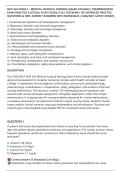
NUR 242 EXAM 2 – MEDICAL-SURGICAL NURSING (GALEN COLLEGE) | COMPREHENSIVE
EXAM PRACTICE & ACTUAL STUDY GUIDE | FULL TESTBANK | 150 ADVANCED PRACTICE
QUESTIONS & 100% CORRECT ANSWERS WITH RATIONALES | 2026/2027 LATEST UPDATE
i. Cardiovascular disorders and hemodynamic management
ii. Respiratory disorders and advanced oxygenation
iii. Neurologic disorders and neurologic emergencies
iv. Renal and urinary disorders
v. Gastrointestinal and hepatobiliary disorders
vi. Endocrine and metabolic disorders
vii. Hematologic and immune disorders
viii. Musculoskeletal and connective-tissue disorders
ix. Oncology and oncologic emergencies
x. Infection, sepsis, and multisystem complications
xi. Fluid, electrolyte, acid-base, and nutritional management
xii. Perioperative, postoperative, and complex nursing care
xiii. Prioritization, delegation, safety, documentation, and clinical judgment
DESCRIPTION
This 2026/2027 NUR 242 Medical-Surgical Nursing Exam Practice Study Guide provides
advanced preparation for students reviewing complex adult health concepts at Galen
College. It emphasizes clinical judgment, prioritization, assessment, pathophysiology,
pharmacologic considerations, complications, safety, delegation, and evidence-informed
nursing interventions. The resource contains 150 challenging practice questions and
answers with concise rationales designed to strengthen application rather than simple
memorization. It is appropriate for nursing students preparing for course examinations,
cumulative assessments, and advanced medical-surgical nursing review. Students should
expect realistic clinical scenarios requiring interpretation and prioritization. Purchase and
instantly get a downloadable and editable PDF for convenient study and review.
QUESTION 1
A patient with acute decompensated heart failure is receiving IV furosemide. Two hours
later, the patient reports generalized weakness and palpitations. The cardiac monitor shows
frequent premature ventricular contractions. Which laboratory result should the nurse
anticipate?
A. Sodium 138 mEq/L
B. Potassium 2.9 mEq/L
C. Calcium 9.4 mg/dL
D. Magnesium 2.1 mg/dL
🔴 Correct Answer: B. Potassium 2.9 mEq/L.
🔵 Explanation: Loop diuretics increase urinary potassium loss. Hypokalemia can cause
,weakness and ventricular dysrhythmias, including premature ventricular contractions. The
patient requires prompt potassium assessment and replacement as prescribed.
QUESTION 2
A patient with acute pulmonary edema is severely dyspneic, coughing pink frothy sputum,
and has an oxygen saturation of 82%. Which intervention should the nurse implement first?
A. Obtain a 12-lead ECG
B. Administer prescribed IV diuretic
C. Place the patient in high-Fowler position
D. Restrict oral fluid intake
🔴 Correct Answer: C. Place the patient in high-Fowler position.
🔵 Explanation: Positioning upright immediately improves lung expansion and decreases
venous return, helping reduce pulmonary congestion while definitive treatment is initiated.
Airway and breathing take priority over diagnostic and secondary interventions.
QUESTION 3
A patient with an acute myocardial infarction suddenly develops severe dyspnea,
hypotension, and a new loud systolic murmur. Which complication should the nurse
suspect?
A. Pericarditis
B. Papillary muscle rupture
C. Stable angina
D. Chronic ventricular remodeling
🔴 Correct Answer: B. Papillary muscle rupture.
🔵 Explanation: Acute papillary muscle rupture can produce severe mitral regurgitation,
causing pulmonary edema, hypotension, and a new systolic murmur. It is a life-threatening
mechanical complication requiring urgent intervention.
QUESTION 4
A patient with atrial fibrillation is receiving warfarin. Which finding requires the most
immediate follow-up?
A. INR 2.4
B. Heart rate 88/min
C. Black, tarry stool
D. Mild fatigue after ambulation
🔴 Correct Answer: C. Black, tarry stool.
🔵 Explanation: Melena suggests gastrointestinal bleeding, an important complication of
anticoagulation. Although an INR of 2.4 may be therapeutic for many patients with atrial
fibrillation, evidence of active bleeding requires immediate assessment.
,QUESTION 5
A patient receiving digoxin for heart failure reports nausea, blurred yellow vision, and
anorexia. Which additional finding would most strongly support suspected digoxin toxicity?
A. Potassium 5.1 mEq/L
B. Heart rate 48/min
C. Blood pressure 142/86 mmHg
D. Respiratory rate 22/min
🔴 Correct Answer: B. Heart rate 48/min.
🔵 Explanation: Bradycardia is a classic manifestation of digoxin toxicity. Gastrointestinal
symptoms and visual disturbances further support toxicity. Hypokalemia increases the risk,
although the potassium value listed is not low.
QUESTION 6
A patient with a history of peripheral arterial disease reports severe calf pain while walking
that resolves after several minutes of rest. Which nursing teaching is most appropriate?
A. Avoid all exercise to prevent ischemia
B. Elevate the legs above heart level during activity
C. Follow a structured walking program with rest periods
D. Apply heating pads to the lower extremities
🔴 Correct Answer: C. Follow a structured walking program with rest periods.
🔵 Explanation: Supervised or structured walking promotes collateral circulation and
improves functional capacity in peripheral arterial disease. Heat can cause injury, and
prolonged elevation may further reduce arterial perfusion.
QUESTION 7
A patient with aortic stenosis develops exertional chest pain and syncope. Which nursing
action is most appropriate?
A. Encourage vigorous aerobic exercise
B. Recognize the symptoms as evidence of worsening disease
C. Encourage rapid position changes
D. Increase dietary sodium
🔴 Correct Answer: B. Recognize the symptoms as evidence of worsening disease.
🔵 Explanation: Angina and syncope associated with aortic stenosis indicate significant
obstruction and reduced cardiac output during exertion. These symptoms warrant prompt
medical evaluation and activity modification.
QUESTION 8
A patient with infective endocarditis suddenly develops unilateral weakness and difficulty
speaking. Which complication should the nurse suspect?
, A. Peripheral neuropathy
B. Embolic stroke
C. Hypoglycemia
D. Pulmonary edema
🔴 Correct Answer: B. Embolic stroke.
🔵 Explanation: Vegetations associated with infective endocarditis can dislodge and travel
through systemic circulation, producing cerebral emboli and acute neurologic deficits.
QUESTION 9
A patient with acute pericarditis develops hypotension, jugular venous distention, and
muffled heart sounds. Which condition is most likely?
A. Cardiac tamponade
B. Left-sided heart failure
C. Pulmonary embolism
D. Aortic dissection
🔴 Correct Answer: A. Cardiac tamponade.
🔵 Explanation: Hypotension, jugular venous distention, and muffled heart sounds comprise
Beck's triad, strongly suggesting cardiac tamponade from impaired ventricular filling.
QUESTION 10
A patient with suspected aortic dissection reports sudden tearing chest pain radiating to the
back. Which prescription should the nurse question?
A. IV opioid analgesia
B. Continuous blood-pressure monitoring
C. IV beta-blocker
D. Routine vigorous ambulation
🔴 Correct Answer: D. Routine vigorous ambulation.
🔵 Explanation: Aortic dissection requires reduction of shear stress and close hemodynamic
monitoring. Strenuous activity can increase blood pressure and worsen the dissection.
QUESTION 11
A patient with COPD has an oxygen saturation of 84% and severe dyspnea. Which action is
most appropriate?
A. Withhold oxygen because COPD patients should not receive oxygen
B. Administer controlled supplemental oxygen as prescribed
C. Place the patient flat
D. Encourage rapid shallow breathing
🔴 Correct Answer: B. Administer controlled supplemental oxygen as prescribed.
🔵 Explanation: Hypoxemia requires treatment. Oxygen should be carefully titrated to the
EXAM PRACTICE & ACTUAL STUDY GUIDE | FULL TESTBANK | 150 ADVANCED PRACTICE
QUESTIONS & 100% CORRECT ANSWERS WITH RATIONALES | 2026/2027 LATEST UPDATE
i. Cardiovascular disorders and hemodynamic management
ii. Respiratory disorders and advanced oxygenation
iii. Neurologic disorders and neurologic emergencies
iv. Renal and urinary disorders
v. Gastrointestinal and hepatobiliary disorders
vi. Endocrine and metabolic disorders
vii. Hematologic and immune disorders
viii. Musculoskeletal and connective-tissue disorders
ix. Oncology and oncologic emergencies
x. Infection, sepsis, and multisystem complications
xi. Fluid, electrolyte, acid-base, and nutritional management
xii. Perioperative, postoperative, and complex nursing care
xiii. Prioritization, delegation, safety, documentation, and clinical judgment
DESCRIPTION
This 2026/2027 NUR 242 Medical-Surgical Nursing Exam Practice Study Guide provides
advanced preparation for students reviewing complex adult health concepts at Galen
College. It emphasizes clinical judgment, prioritization, assessment, pathophysiology,
pharmacologic considerations, complications, safety, delegation, and evidence-informed
nursing interventions. The resource contains 150 challenging practice questions and
answers with concise rationales designed to strengthen application rather than simple
memorization. It is appropriate for nursing students preparing for course examinations,
cumulative assessments, and advanced medical-surgical nursing review. Students should
expect realistic clinical scenarios requiring interpretation and prioritization. Purchase and
instantly get a downloadable and editable PDF for convenient study and review.
QUESTION 1
A patient with acute decompensated heart failure is receiving IV furosemide. Two hours
later, the patient reports generalized weakness and palpitations. The cardiac monitor shows
frequent premature ventricular contractions. Which laboratory result should the nurse
anticipate?
A. Sodium 138 mEq/L
B. Potassium 2.9 mEq/L
C. Calcium 9.4 mg/dL
D. Magnesium 2.1 mg/dL
🔴 Correct Answer: B. Potassium 2.9 mEq/L.
🔵 Explanation: Loop diuretics increase urinary potassium loss. Hypokalemia can cause
,weakness and ventricular dysrhythmias, including premature ventricular contractions. The
patient requires prompt potassium assessment and replacement as prescribed.
QUESTION 2
A patient with acute pulmonary edema is severely dyspneic, coughing pink frothy sputum,
and has an oxygen saturation of 82%. Which intervention should the nurse implement first?
A. Obtain a 12-lead ECG
B. Administer prescribed IV diuretic
C. Place the patient in high-Fowler position
D. Restrict oral fluid intake
🔴 Correct Answer: C. Place the patient in high-Fowler position.
🔵 Explanation: Positioning upright immediately improves lung expansion and decreases
venous return, helping reduce pulmonary congestion while definitive treatment is initiated.
Airway and breathing take priority over diagnostic and secondary interventions.
QUESTION 3
A patient with an acute myocardial infarction suddenly develops severe dyspnea,
hypotension, and a new loud systolic murmur. Which complication should the nurse
suspect?
A. Pericarditis
B. Papillary muscle rupture
C. Stable angina
D. Chronic ventricular remodeling
🔴 Correct Answer: B. Papillary muscle rupture.
🔵 Explanation: Acute papillary muscle rupture can produce severe mitral regurgitation,
causing pulmonary edema, hypotension, and a new systolic murmur. It is a life-threatening
mechanical complication requiring urgent intervention.
QUESTION 4
A patient with atrial fibrillation is receiving warfarin. Which finding requires the most
immediate follow-up?
A. INR 2.4
B. Heart rate 88/min
C. Black, tarry stool
D. Mild fatigue after ambulation
🔴 Correct Answer: C. Black, tarry stool.
🔵 Explanation: Melena suggests gastrointestinal bleeding, an important complication of
anticoagulation. Although an INR of 2.4 may be therapeutic for many patients with atrial
fibrillation, evidence of active bleeding requires immediate assessment.
,QUESTION 5
A patient receiving digoxin for heart failure reports nausea, blurred yellow vision, and
anorexia. Which additional finding would most strongly support suspected digoxin toxicity?
A. Potassium 5.1 mEq/L
B. Heart rate 48/min
C. Blood pressure 142/86 mmHg
D. Respiratory rate 22/min
🔴 Correct Answer: B. Heart rate 48/min.
🔵 Explanation: Bradycardia is a classic manifestation of digoxin toxicity. Gastrointestinal
symptoms and visual disturbances further support toxicity. Hypokalemia increases the risk,
although the potassium value listed is not low.
QUESTION 6
A patient with a history of peripheral arterial disease reports severe calf pain while walking
that resolves after several minutes of rest. Which nursing teaching is most appropriate?
A. Avoid all exercise to prevent ischemia
B. Elevate the legs above heart level during activity
C. Follow a structured walking program with rest periods
D. Apply heating pads to the lower extremities
🔴 Correct Answer: C. Follow a structured walking program with rest periods.
🔵 Explanation: Supervised or structured walking promotes collateral circulation and
improves functional capacity in peripheral arterial disease. Heat can cause injury, and
prolonged elevation may further reduce arterial perfusion.
QUESTION 7
A patient with aortic stenosis develops exertional chest pain and syncope. Which nursing
action is most appropriate?
A. Encourage vigorous aerobic exercise
B. Recognize the symptoms as evidence of worsening disease
C. Encourage rapid position changes
D. Increase dietary sodium
🔴 Correct Answer: B. Recognize the symptoms as evidence of worsening disease.
🔵 Explanation: Angina and syncope associated with aortic stenosis indicate significant
obstruction and reduced cardiac output during exertion. These symptoms warrant prompt
medical evaluation and activity modification.
QUESTION 8
A patient with infective endocarditis suddenly develops unilateral weakness and difficulty
speaking. Which complication should the nurse suspect?
, A. Peripheral neuropathy
B. Embolic stroke
C. Hypoglycemia
D. Pulmonary edema
🔴 Correct Answer: B. Embolic stroke.
🔵 Explanation: Vegetations associated with infective endocarditis can dislodge and travel
through systemic circulation, producing cerebral emboli and acute neurologic deficits.
QUESTION 9
A patient with acute pericarditis develops hypotension, jugular venous distention, and
muffled heart sounds. Which condition is most likely?
A. Cardiac tamponade
B. Left-sided heart failure
C. Pulmonary embolism
D. Aortic dissection
🔴 Correct Answer: A. Cardiac tamponade.
🔵 Explanation: Hypotension, jugular venous distention, and muffled heart sounds comprise
Beck's triad, strongly suggesting cardiac tamponade from impaired ventricular filling.
QUESTION 10
A patient with suspected aortic dissection reports sudden tearing chest pain radiating to the
back. Which prescription should the nurse question?
A. IV opioid analgesia
B. Continuous blood-pressure monitoring
C. IV beta-blocker
D. Routine vigorous ambulation
🔴 Correct Answer: D. Routine vigorous ambulation.
🔵 Explanation: Aortic dissection requires reduction of shear stress and close hemodynamic
monitoring. Strenuous activity can increase blood pressure and worsen the dissection.
QUESTION 11
A patient with COPD has an oxygen saturation of 84% and severe dyspnea. Which action is
most appropriate?
A. Withhold oxygen because COPD patients should not receive oxygen
B. Administer controlled supplemental oxygen as prescribed
C. Place the patient flat
D. Encourage rapid shallow breathing
🔴 Correct Answer: B. Administer controlled supplemental oxygen as prescribed.
🔵 Explanation: Hypoxemia requires treatment. Oxygen should be carefully titrated to the


