

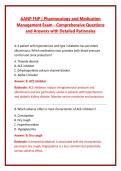
AANP FNP | Pharmacology and Medication
Management Exam - Comprehensive Questions
and Answers with Detailed Rationales
1. A patient with hypertension and type 2 diabetes has persistent
albuminuria. Which medication class provides both blood-pressure
control and renal protection?
A. Thiazide diuretic
B. ACE inhibitor
C. Dihydropyridine calcium-channel blocker
D. Alpha-1 blocker
Answer: B. ACE inhibitor
Rationale: ACE inhibitors reduce intraglomerular pressure and
albuminuria and are particularly useful in patients with hypertension
and diabetic kidney disease. Monitor serum creatinine and potassium.
2. Which adverse effect is most characteristic of ACE inhibitors?
A. Constipation
B. Dry cough
C. Hyperthyroidism
D. Hypoglycemia
Answer: B. Dry cough
Rationale: Increased bradykinin is associated with the characteristic
persistent dry cough. Angioedema is a less common but potentially
serious adverse effect.
,3. A patient develops angioedema while taking lisinopril. What is the
most appropriate action?
A. Increase the lisinopril dose
B. Continue lisinopril with an antihistamine
C. Discontinue the ACE inhibitor
D. Add hydrochlorothiazide
Answer: C. Discontinue the ACE inhibitor
Rationale: ACE-inhibitor-associated angioedema can be life-
threatening. The ACE inhibitor should be stopped and the airway
assessed urgently when symptoms are significant.
4. Which medication is an angiotensin II receptor blocker?
A. Losartan
B. Lisinopril
C. Diltiazem
D. Propranolol
Answer: A. Losartan
Rationale: Losartan is an ARB. Unlike ACE inhibitors, ARBs do not inhibit
ACE-mediated bradykinin degradation and therefore cause cough less
frequently.
5. Which laboratory abnormality is particularly important to monitor in
a patient receiving an ACE inhibitor?
A. Hypokalemia
B. Hyperkalemia
,C. Hypernatremia
D. Hypercalcemia
Answer: B. Hyperkalemia
Rationale: ACE inhibition decreases aldosterone activity, which can
increase serum potassium. Renal function and potassium should be
monitored.
6. Which antihypertensive is most likely to cause peripheral edema?
A. Amlodipine
B. Lisinopril
C. Losartan
D. Hydrochlorothiazide
Answer: A. Amlodipine
Rationale: Dihydropyridine calcium-channel blockers commonly cause
dose-related peripheral edema due to arteriolar vasodilation.
7. Which adverse effect is associated with hydrochlorothiazide?
A. Hyperkalemia
B. Hypokalemia
C. Severe bradycardia
D. Hypermagnesemia
Answer: B. Hypokalemia
Rationale: Thiazide diuretics increase urinary sodium and potassium
excretion. They can also contribute to hyponatremia, hyperuricemia,
and increased glucose levels.
, 8. A patient taking hydrochlorothiazide has recurrent gout. Why might
the medication contribute?
A. It increases uric acid levels
B. It inhibits uric acid production
C. It increases insulin secretion
D. It blocks purine metabolism
Answer: A. It increases uric acid levels
Rationale: Thiazide diuretics can decrease renal uric acid excretion and
raise serum uric acid.
9. Which medication is a beta-1 selective blocker?
A. Metoprolol
B. Propranolol
C. Carvedilol
D. Labetalol
Answer: A. Metoprolol
Rationale: Metoprolol is relatively beta-1 selective at usual doses.
Selectivity decreases as the dose increases.
10. A patient taking a beta blocker should be monitored particularly for:
A. Tachycardia
B. Bradycardia
C. Hyperthermia
D. Polyuria
Management Exam - Comprehensive Questions
and Answers with Detailed Rationales
1. A patient with hypertension and type 2 diabetes has persistent
albuminuria. Which medication class provides both blood-pressure
control and renal protection?
A. Thiazide diuretic
B. ACE inhibitor
C. Dihydropyridine calcium-channel blocker
D. Alpha-1 blocker
Answer: B. ACE inhibitor
Rationale: ACE inhibitors reduce intraglomerular pressure and
albuminuria and are particularly useful in patients with hypertension
and diabetic kidney disease. Monitor serum creatinine and potassium.
2. Which adverse effect is most characteristic of ACE inhibitors?
A. Constipation
B. Dry cough
C. Hyperthyroidism
D. Hypoglycemia
Answer: B. Dry cough
Rationale: Increased bradykinin is associated with the characteristic
persistent dry cough. Angioedema is a less common but potentially
serious adverse effect.
,3. A patient develops angioedema while taking lisinopril. What is the
most appropriate action?
A. Increase the lisinopril dose
B. Continue lisinopril with an antihistamine
C. Discontinue the ACE inhibitor
D. Add hydrochlorothiazide
Answer: C. Discontinue the ACE inhibitor
Rationale: ACE-inhibitor-associated angioedema can be life-
threatening. The ACE inhibitor should be stopped and the airway
assessed urgently when symptoms are significant.
4. Which medication is an angiotensin II receptor blocker?
A. Losartan
B. Lisinopril
C. Diltiazem
D. Propranolol
Answer: A. Losartan
Rationale: Losartan is an ARB. Unlike ACE inhibitors, ARBs do not inhibit
ACE-mediated bradykinin degradation and therefore cause cough less
frequently.
5. Which laboratory abnormality is particularly important to monitor in
a patient receiving an ACE inhibitor?
A. Hypokalemia
B. Hyperkalemia
,C. Hypernatremia
D. Hypercalcemia
Answer: B. Hyperkalemia
Rationale: ACE inhibition decreases aldosterone activity, which can
increase serum potassium. Renal function and potassium should be
monitored.
6. Which antihypertensive is most likely to cause peripheral edema?
A. Amlodipine
B. Lisinopril
C. Losartan
D. Hydrochlorothiazide
Answer: A. Amlodipine
Rationale: Dihydropyridine calcium-channel blockers commonly cause
dose-related peripheral edema due to arteriolar vasodilation.
7. Which adverse effect is associated with hydrochlorothiazide?
A. Hyperkalemia
B. Hypokalemia
C. Severe bradycardia
D. Hypermagnesemia
Answer: B. Hypokalemia
Rationale: Thiazide diuretics increase urinary sodium and potassium
excretion. They can also contribute to hyponatremia, hyperuricemia,
and increased glucose levels.
, 8. A patient taking hydrochlorothiazide has recurrent gout. Why might
the medication contribute?
A. It increases uric acid levels
B. It inhibits uric acid production
C. It increases insulin secretion
D. It blocks purine metabolism
Answer: A. It increases uric acid levels
Rationale: Thiazide diuretics can decrease renal uric acid excretion and
raise serum uric acid.
9. Which medication is a beta-1 selective blocker?
A. Metoprolol
B. Propranolol
C. Carvedilol
D. Labetalol
Answer: A. Metoprolol
Rationale: Metoprolol is relatively beta-1 selective at usual doses.
Selectivity decreases as the dose increases.
10. A patient taking a beta blocker should be monitored particularly for:
A. Tachycardia
B. Bradycardia
C. Hyperthermia
D. Polyuria


