

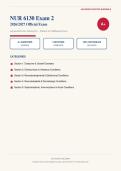
ADVANCED PRACTICE NURSING III
NUR 6130 Exam 2
2026/2027 Official Exam A+
Advanced Practice Nursing III — Pediatric & Childbearing Focus
A+ QUESTIONS 5 SECTIONS 100% RATIONALES
VERIFIED COMPLETE INCLUDED
CATEGORIES
Section 1: Endocrine & Growth Disorders
Section 2: Genitourinary & Infectious Conditions
Section 3: Neurodevelopmental & Behavioral Conditions
Section 4: Musculoskeletal & Dermatologic Conditions
Section 5: Gastrointestinal, Immunizations & Acute Conditions
STUVIAACTUALEXAM
Original practice content aligned to public course domains • For educational use
, Section 1: Endocrine & Growth Disorders
Q1. A 7-year-old girl is brought to the primary care clinic by her mother, who reports breast budding and a growth
spurt over the past 6 months. The child has no pubic hair and the mother denies any history of vaginal
bleeding. Bone age is advanced by 18 months. Which diagnostic step is the most appropriate next action for
the family nurse practitioner?
A. Start a GnRH agonist trial while awaiting laboratory confirmation of central precocious puberty
B. Obtain serum FSH, LH, and estradiol levels and refer to pediatric endocrinology
C. Order a pelvic ultrasound to evaluate ovarian volume and rule out a mass
D. Reassure the mother that this is likely premature thelarche and recheck in 6 months
Correct Answer: B
Rationale:
Breast development before age 8 years with advanced bone age raises concern for central precocious puberty. Laboratory
evaluation of gonadotropins and estradiol, followed by specialist referral, is required before any pharmacologic intervention.
Premature thelarche is a diagnosis of exclusion after organic causes are ruled out.
Q2. During a well-child visit, the nurse practitioner notes that a 9-year-old boy has testicular volume of 4 mL
bilaterally, sparse pubic hair, and a growth velocity of 7 cm per year. The parents ask whether this is normal.
Which interpretation is most accurate?
A. This represents delayed puberty and warrants laboratory evaluation for hypogonadism
B. Testicular enlargement to 4 mL marks the onset of puberty and is within the expected age range
C. Growth velocity of 7 cm/year at this age is excessive and suggests pathologic growth hormone excess
D. Pubic hair alone indicates adrenarche and no further evaluation of gonadal function is needed
Correct Answer: B
Rationale:
In boys, testicular volume ≥4 mL is the first clinical sign of central puberty and typically occurs between ages 9 and 14 years.
The accompanying growth acceleration is physiologic. Delayed puberty is defined as lack of testicular enlargement by age 14
years.
, NUR 6130 Exam 2 — 2026/2027 Page 3
Q3. A 5-year-old girl presents with vaginal bleeding lasting 3 days, no breast development, and normal growth
parameters. Physical examination reveals no signs of trauma and a normal external genital exam. Which
condition is highest on the differential diagnosis list?
A. Foreign body in the vagina until proven otherwise by examination under anesthesia
B. Isolated premature menarche, which requires only observation after imaging exclusion of pathology
C. McCune-Albright syndrome with associated fibrous dysplasia of bone
D. Central precocious puberty secondary to hypothalamic hamartoma
Correct Answer: B
Rationale:
Isolated premature menarche without other secondary sexual characteristics is uncommon but recognized; after ruling out
trauma, infection, and structural lesions, expectant management with close follow-up is appropriate. Central precocious puberty
would include breast development and growth acceleration.
Q4. Parents of a 3-year-old girl report that she has developed dark pubic hair over the past 4 months. There is no
breast development, clitoromegaly, or accelerated linear growth. Bone age is consistent with chronological
age. Which management approach is most appropriate?
A. Measurement of serum DHEA-S and 17-hydroxyprogesterone with close clinical monitoring
B. Immediate referral to pediatric endocrinology for ACTH stimulation testing
C. Initiation of topical anti-androgen therapy to reverse the pubic hair growth
D. Bone age radiograph every 6 months until puberty is complete to detect rapid advancement
Correct Answer: A
Rationale:
Premature adrenarche is characterized by isolated pubic or axillary hair without other signs of true puberty. Baseline androgen
levels help exclude non-classical congenital adrenal hyperplasia or androgen-secreting tumors, after which observation is
usually sufficient.
Q5. A 12-year-old boy with a history of growth hormone deficiency treated with recombinant GH for 4 years
presents for routine follow-up. His height is now at the 25th percentile and growth velocity has slowed to 3
cm/year. Which laboratory value is most useful in deciding whether to continue or discontinue GH therapy?
A. Bone age radiograph to determine remaining growth potential
B. Serum IGF-1 level compared with age- and puberty-matched norms
C. Random serum growth hormone level obtained at the visit
D. Thyroid-stimulating hormone and free T4 to exclude concurrent hypothyroidism
Correct Answer: A
Rationale:
Once growth velocity slows and near-final height is approached, bone age assessment helps determine residual growth
potential. GH is typically discontinued when bone age indicates epiphyseal closure is imminent or growth velocity falls below
2–2.5 cm/year.
NUR 6130 Exam 2
2026/2027 Official Exam A+
Advanced Practice Nursing III — Pediatric & Childbearing Focus
A+ QUESTIONS 5 SECTIONS 100% RATIONALES
VERIFIED COMPLETE INCLUDED
CATEGORIES
Section 1: Endocrine & Growth Disorders
Section 2: Genitourinary & Infectious Conditions
Section 3: Neurodevelopmental & Behavioral Conditions
Section 4: Musculoskeletal & Dermatologic Conditions
Section 5: Gastrointestinal, Immunizations & Acute Conditions
STUVIAACTUALEXAM
Original practice content aligned to public course domains • For educational use
, Section 1: Endocrine & Growth Disorders
Q1. A 7-year-old girl is brought to the primary care clinic by her mother, who reports breast budding and a growth
spurt over the past 6 months. The child has no pubic hair and the mother denies any history of vaginal
bleeding. Bone age is advanced by 18 months. Which diagnostic step is the most appropriate next action for
the family nurse practitioner?
A. Start a GnRH agonist trial while awaiting laboratory confirmation of central precocious puberty
B. Obtain serum FSH, LH, and estradiol levels and refer to pediatric endocrinology
C. Order a pelvic ultrasound to evaluate ovarian volume and rule out a mass
D. Reassure the mother that this is likely premature thelarche and recheck in 6 months
Correct Answer: B
Rationale:
Breast development before age 8 years with advanced bone age raises concern for central precocious puberty. Laboratory
evaluation of gonadotropins and estradiol, followed by specialist referral, is required before any pharmacologic intervention.
Premature thelarche is a diagnosis of exclusion after organic causes are ruled out.
Q2. During a well-child visit, the nurse practitioner notes that a 9-year-old boy has testicular volume of 4 mL
bilaterally, sparse pubic hair, and a growth velocity of 7 cm per year. The parents ask whether this is normal.
Which interpretation is most accurate?
A. This represents delayed puberty and warrants laboratory evaluation for hypogonadism
B. Testicular enlargement to 4 mL marks the onset of puberty and is within the expected age range
C. Growth velocity of 7 cm/year at this age is excessive and suggests pathologic growth hormone excess
D. Pubic hair alone indicates adrenarche and no further evaluation of gonadal function is needed
Correct Answer: B
Rationale:
In boys, testicular volume ≥4 mL is the first clinical sign of central puberty and typically occurs between ages 9 and 14 years.
The accompanying growth acceleration is physiologic. Delayed puberty is defined as lack of testicular enlargement by age 14
years.
, NUR 6130 Exam 2 — 2026/2027 Page 3
Q3. A 5-year-old girl presents with vaginal bleeding lasting 3 days, no breast development, and normal growth
parameters. Physical examination reveals no signs of trauma and a normal external genital exam. Which
condition is highest on the differential diagnosis list?
A. Foreign body in the vagina until proven otherwise by examination under anesthesia
B. Isolated premature menarche, which requires only observation after imaging exclusion of pathology
C. McCune-Albright syndrome with associated fibrous dysplasia of bone
D. Central precocious puberty secondary to hypothalamic hamartoma
Correct Answer: B
Rationale:
Isolated premature menarche without other secondary sexual characteristics is uncommon but recognized; after ruling out
trauma, infection, and structural lesions, expectant management with close follow-up is appropriate. Central precocious puberty
would include breast development and growth acceleration.
Q4. Parents of a 3-year-old girl report that she has developed dark pubic hair over the past 4 months. There is no
breast development, clitoromegaly, or accelerated linear growth. Bone age is consistent with chronological
age. Which management approach is most appropriate?
A. Measurement of serum DHEA-S and 17-hydroxyprogesterone with close clinical monitoring
B. Immediate referral to pediatric endocrinology for ACTH stimulation testing
C. Initiation of topical anti-androgen therapy to reverse the pubic hair growth
D. Bone age radiograph every 6 months until puberty is complete to detect rapid advancement
Correct Answer: A
Rationale:
Premature adrenarche is characterized by isolated pubic or axillary hair without other signs of true puberty. Baseline androgen
levels help exclude non-classical congenital adrenal hyperplasia or androgen-secreting tumors, after which observation is
usually sufficient.
Q5. A 12-year-old boy with a history of growth hormone deficiency treated with recombinant GH for 4 years
presents for routine follow-up. His height is now at the 25th percentile and growth velocity has slowed to 3
cm/year. Which laboratory value is most useful in deciding whether to continue or discontinue GH therapy?
A. Bone age radiograph to determine remaining growth potential
B. Serum IGF-1 level compared with age- and puberty-matched norms
C. Random serum growth hormone level obtained at the visit
D. Thyroid-stimulating hormone and free T4 to exclude concurrent hypothyroidism
Correct Answer: A
Rationale:
Once growth velocity slows and near-final height is approached, bone age assessment helps determine residual growth
potential. GH is typically discontinued when bone age indicates epiphyseal closure is imminent or growth velocity falls below
2–2.5 cm/year.


