

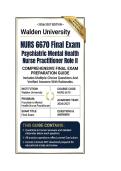
,NURS 6670 Final Exam Psychiatric Mental Health Nurse Practitioner
Role II | Questions
And Answers 2026/2027 Walden University
Course: NURS 6670
University: Walden University
Assessment: Final Exam
Area: Psychiatric Mental Health Nurse Practitioner Role II: Adults and Older
Adults
1.
Which feature is essential to obsessive-compulsive disorder?
A) Recurrent intrusive thoughts, urges, or images and/or repetitive behaviors
or mental acts
B) Persistent elevated mood
C) Progressive memory loss
D) Auditory hallucinations only
Answer: A) Recurrent intrusive thoughts, urges, or images and/or
repetitive behaviors or mental acts
Rationale: OCD is characterized by obsessions, compulsions, or both that
are time-consuming or cause clinically significant distress or impairment.
2.
A patient repeatedly fears contamination and spends several hours washing
their hands to reduce anxiety. Which diagnosis is most likely?
A) Obsessive-compulsive disorder
B) Generalized anxiety disorder
C) Illness anxiety disorder
D) Specific phobia
Answer: A) Obsessive-compulsive disorder
Rationale: The contamination fear represents an obsession, while repetitive
washing is a compulsion performed in response to the distress.
3.
Which statement best distinguishes an obsession from a compulsion?
A) An obsession is an intrusive thought or urge, whereas a compulsion is a
repetitive behavior or mental act
,B) An obsession is always a behavior
C) A compulsion is always a hallucination
D) There is no distinction
Answer: A) An obsession is an intrusive thought or urge, whereas a
compulsion is a repetitive behavior or mental act
Rationale: Obsessions are intrusive cognitions or urges; compulsions are
repetitive responses intended to reduce distress or prevent a feared event.
4.
A patient repeatedly checks the door 30 times before leaving because of fear
that someone will break in. The checking behavior is best classified as:
A) Compulsion
B) Delusion
C) Hallucination
D) Mania
Answer: A) Compulsion
Rationale: Repetitive checking performed to reduce anxiety associated with
an intrusive fear is a compulsion.
5.
Which psychotherapy has the strongest evidence base for OCD?
A) Exposure and response prevention
B) Supportive therapy alone
C) Psychoanalysis alone
D) Dream interpretation
Answer: A) Exposure and response prevention
Rationale: ERP is a specialized form of cognitive behavioral therapy in
which patients confront feared stimuli while resisting compulsive responses.
6.
Which medication class is commonly used to treat OCD?
A) SSRIs
B) Stimulants
C) Benzodiazepines as sole therapy
D) Opioids
Answer: A) SSRIs
, Rationale: SSRIs are first-line pharmacologic treatments for OCD, often
requiring adequate dosing and duration.
7.
A patient with OCD receives an SSRI but reports no meaningful improvement
after only one week. What is the best interpretation?
A) The trial is too brief to determine efficacy
B) The medication has definitively failed
C) The patient has schizophrenia
D) The medication should always be stopped immediately
Answer: A) The trial is too brief to determine efficacy
Rationale: OCD often requires an adequate therapeutic trial before
response can be evaluated.
8.
Which statement about OCD treatment is accurate?
A) Higher SSRI doses may sometimes be required than those commonly used
for depression
B) SSRIs are never effective
C) Psychotherapy has no role
D) Benzodiazepines are always first-line
Answer: A) Higher SSRI doses may sometimes be required than
those commonly used for depression
Rationale: OCD may require higher SSRI dosing and longer treatment trials
under appropriate clinical supervision.
9.
A patient recognizes that contamination fears are excessive but feels unable
to stop the associated rituals. This suggests:
A) Preserved insight
B) Psychosis
C) Delirium
D) Mania
Answer: A) Preserved insight
Rationale: Many patients with OCD recognize that their obsessions or
compulsions are unreasonable or excessive.
Role II | Questions
And Answers 2026/2027 Walden University
Course: NURS 6670
University: Walden University
Assessment: Final Exam
Area: Psychiatric Mental Health Nurse Practitioner Role II: Adults and Older
Adults
1.
Which feature is essential to obsessive-compulsive disorder?
A) Recurrent intrusive thoughts, urges, or images and/or repetitive behaviors
or mental acts
B) Persistent elevated mood
C) Progressive memory loss
D) Auditory hallucinations only
Answer: A) Recurrent intrusive thoughts, urges, or images and/or
repetitive behaviors or mental acts
Rationale: OCD is characterized by obsessions, compulsions, or both that
are time-consuming or cause clinically significant distress or impairment.
2.
A patient repeatedly fears contamination and spends several hours washing
their hands to reduce anxiety. Which diagnosis is most likely?
A) Obsessive-compulsive disorder
B) Generalized anxiety disorder
C) Illness anxiety disorder
D) Specific phobia
Answer: A) Obsessive-compulsive disorder
Rationale: The contamination fear represents an obsession, while repetitive
washing is a compulsion performed in response to the distress.
3.
Which statement best distinguishes an obsession from a compulsion?
A) An obsession is an intrusive thought or urge, whereas a compulsion is a
repetitive behavior or mental act
,B) An obsession is always a behavior
C) A compulsion is always a hallucination
D) There is no distinction
Answer: A) An obsession is an intrusive thought or urge, whereas a
compulsion is a repetitive behavior or mental act
Rationale: Obsessions are intrusive cognitions or urges; compulsions are
repetitive responses intended to reduce distress or prevent a feared event.
4.
A patient repeatedly checks the door 30 times before leaving because of fear
that someone will break in. The checking behavior is best classified as:
A) Compulsion
B) Delusion
C) Hallucination
D) Mania
Answer: A) Compulsion
Rationale: Repetitive checking performed to reduce anxiety associated with
an intrusive fear is a compulsion.
5.
Which psychotherapy has the strongest evidence base for OCD?
A) Exposure and response prevention
B) Supportive therapy alone
C) Psychoanalysis alone
D) Dream interpretation
Answer: A) Exposure and response prevention
Rationale: ERP is a specialized form of cognitive behavioral therapy in
which patients confront feared stimuli while resisting compulsive responses.
6.
Which medication class is commonly used to treat OCD?
A) SSRIs
B) Stimulants
C) Benzodiazepines as sole therapy
D) Opioids
Answer: A) SSRIs
, Rationale: SSRIs are first-line pharmacologic treatments for OCD, often
requiring adequate dosing and duration.
7.
A patient with OCD receives an SSRI but reports no meaningful improvement
after only one week. What is the best interpretation?
A) The trial is too brief to determine efficacy
B) The medication has definitively failed
C) The patient has schizophrenia
D) The medication should always be stopped immediately
Answer: A) The trial is too brief to determine efficacy
Rationale: OCD often requires an adequate therapeutic trial before
response can be evaluated.
8.
Which statement about OCD treatment is accurate?
A) Higher SSRI doses may sometimes be required than those commonly used
for depression
B) SSRIs are never effective
C) Psychotherapy has no role
D) Benzodiazepines are always first-line
Answer: A) Higher SSRI doses may sometimes be required than
those commonly used for depression
Rationale: OCD may require higher SSRI dosing and longer treatment trials
under appropriate clinical supervision.
9.
A patient recognizes that contamination fears are excessive but feels unable
to stop the associated rituals. This suggests:
A) Preserved insight
B) Psychosis
C) Delirium
D) Mania
Answer: A) Preserved insight
Rationale: Many patients with OCD recognize that their obsessions or
compulsions are unreasonable or excessive.


