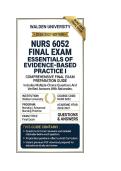
,NURS 6052 Final exam Essentials of Evidence-Based Practice I
Questions And
Answers 2026/2027 Walden University
Course: NURS 6052
University: Walden University
Assessment: Final Exam
Area: Essentials of Evidence-Based Practice
1.
A nurse is evaluating evidence about an intervention for preventing pressure
injuries. Which source generally provides the strongest evidence for
determining intervention effectiveness?
A) Expert opinion
B) Case report
C) Systematic review and meta-analysis of randomized controlled trials
D) Descriptive qualitative study
Answer: C) Systematic review and meta-analysis of randomized
controlled trials
Rationale: For intervention-effectiveness questions, a well-conducted
systematic review or meta-analysis of high-quality randomized controlled
trials generally provides stronger evidence than individual observational,
descriptive, or expert-opinion sources.
2.
Which characteristic is most important when determining whether a research
article is credible?
A) The article contains many references
B) The study uses a clear, appropriate methodology
C) The article is lengthy
D) The authors use technical terminology
Answer: B) The study uses a clear, appropriate methodology
Rationale: Methodologic rigor is central to determining whether study
findings are trustworthy and appropriate for clinical application.
3.
A nurse appraises a quantitative study and asks whether the instrument
,consistently measures the same construct. Which property is being
evaluated?
A) Reliability
B) Validity
C) Generalizability
D) Transferability
Answer: A) Reliability
Rationale: Reliability refers to consistency or stability of measurement.
4.
A nurse wants to determine whether a blood-pressure instrument actually
measures blood pressure accurately. Which concept is most relevant?
A) Reliability
B) Validity
C) Dependability
D) Credibility
Answer: B) Validity
Rationale: Validity concerns whether an instrument measures what it is
intended to measure.
5.
Which concept is most associated with the generalizability of quantitative
research findings?
A) External validity
B) Internal consistency
C) Credibility
D) Confirmability
Answer: A) External validity
Rationale: External validity addresses the extent to which findings can
reasonably be applied to other populations or settings.
6.
Which qualitative research criterion is most closely related to confidence that
findings accurately represent participants' experiences?
A) Credibility
B) Reliability
, C) Statistical power
D) Internal validity
Answer: A) Credibility
Rationale: Credibility is a major criterion for judging the trustworthiness of
qualitative findings.
7.
Which qualitative criterion describes whether findings are sufficiently
grounded in the data rather than the researcher's personal bias?
A) Confirmability
B) Transferability
C) Dependability
D) Sensitivity
Answer: A) Confirmability
Rationale: Confirmability addresses the degree to which findings are
grounded in the data and can be supported by an audit trail.
8.
Which qualitative criterion concerns whether findings may be applicable to
other contexts?
A) Transferability
B) Dependability
C) Confirmability
D) Credibility
Answer: A) Transferability
Rationale: Transferability is analogous to applicability or contextual
generalizability in qualitative research.
9.
What does dependability refer to in qualitative research?
A) Consistency and stability of the research process and findings
B) Statistical significance
C) Sample size
D) Generalizability to every population
Answer: A) Consistency and stability of the research process and
findings
Questions And
Answers 2026/2027 Walden University
Course: NURS 6052
University: Walden University
Assessment: Final Exam
Area: Essentials of Evidence-Based Practice
1.
A nurse is evaluating evidence about an intervention for preventing pressure
injuries. Which source generally provides the strongest evidence for
determining intervention effectiveness?
A) Expert opinion
B) Case report
C) Systematic review and meta-analysis of randomized controlled trials
D) Descriptive qualitative study
Answer: C) Systematic review and meta-analysis of randomized
controlled trials
Rationale: For intervention-effectiveness questions, a well-conducted
systematic review or meta-analysis of high-quality randomized controlled
trials generally provides stronger evidence than individual observational,
descriptive, or expert-opinion sources.
2.
Which characteristic is most important when determining whether a research
article is credible?
A) The article contains many references
B) The study uses a clear, appropriate methodology
C) The article is lengthy
D) The authors use technical terminology
Answer: B) The study uses a clear, appropriate methodology
Rationale: Methodologic rigor is central to determining whether study
findings are trustworthy and appropriate for clinical application.
3.
A nurse appraises a quantitative study and asks whether the instrument
,consistently measures the same construct. Which property is being
evaluated?
A) Reliability
B) Validity
C) Generalizability
D) Transferability
Answer: A) Reliability
Rationale: Reliability refers to consistency or stability of measurement.
4.
A nurse wants to determine whether a blood-pressure instrument actually
measures blood pressure accurately. Which concept is most relevant?
A) Reliability
B) Validity
C) Dependability
D) Credibility
Answer: B) Validity
Rationale: Validity concerns whether an instrument measures what it is
intended to measure.
5.
Which concept is most associated with the generalizability of quantitative
research findings?
A) External validity
B) Internal consistency
C) Credibility
D) Confirmability
Answer: A) External validity
Rationale: External validity addresses the extent to which findings can
reasonably be applied to other populations or settings.
6.
Which qualitative research criterion is most closely related to confidence that
findings accurately represent participants' experiences?
A) Credibility
B) Reliability
, C) Statistical power
D) Internal validity
Answer: A) Credibility
Rationale: Credibility is a major criterion for judging the trustworthiness of
qualitative findings.
7.
Which qualitative criterion describes whether findings are sufficiently
grounded in the data rather than the researcher's personal bias?
A) Confirmability
B) Transferability
C) Dependability
D) Sensitivity
Answer: A) Confirmability
Rationale: Confirmability addresses the degree to which findings are
grounded in the data and can be supported by an audit trail.
8.
Which qualitative criterion concerns whether findings may be applicable to
other contexts?
A) Transferability
B) Dependability
C) Confirmability
D) Credibility
Answer: A) Transferability
Rationale: Transferability is analogous to applicability or contextual
generalizability in qualitative research.
9.
What does dependability refer to in qualitative research?
A) Consistency and stability of the research process and findings
B) Statistical significance
C) Sample size
D) Generalizability to every population
Answer: A) Consistency and stability of the research process and
findings