

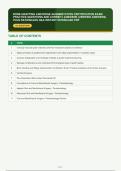
BONE GRAFTING AND RIDGE AUGMENTATION CERTIFICATION EXAM
PRACTICE QUESTIONS AND CORRECT ANSWERS (VERIFIED ANSWERS)
PLUS RATIONALES Q&A INSTANT DOWNLOAD PDF
142 QUESTIONS
TABLE OF CONTENTS
# TOPIC
1 Critically evaluate graft materials and their indications based on evidence
2 Apply principles of guided bone regeneration and ridge augmentation in complex cases
3 Analyze radiographic and histologic findings to guide treatment planning
4 Manage complications and understand the biological basis of graft healing
5 Bone Grafting and Ridge Augmentation Certification Exam Practice Questions And Correct Answers
6 Verified Answers
7 Plus Rationales Q&A Instant Download Pdf
8 Foundations of Oral and Maxillofacial Surgery / Periodontology
9 Applied Oral and Maxillofacial Surgery / Periodontology
10 Advanced Oral and Maxillofacial Surgery / Periodontology
11 Oral and Maxillofacial Surgery / Periodontology Review
Page 1
,Q1 CRITICALLY EVALUATE GRAFT MATERIALS AND THEIR INDICATIONS BASED ON
EVIDENCE
In a patient requiring staged ridge augmentation, which graft material combination
best optimizes space maintenance and osteogenic potential while minimizing
resorption?
A. Particulate autograft mixed with demineralized bone matrix (DBM)
B. Cortical autograft block fixed with titanium screws
C. Anorganic bovine bone mineral (ABBM) combined with autogenous particulates CORRECT
D. Recombinant human bone morphogenetic protein-2 (rhBMP-2) on an absorbable collagen
sponge
RATIONALE: ABBM provides a slowly resorbing scaffold that preserves volume, while
autogenous particulates contribute osteogenic cells and growth factors, enhancing bone
formation. Cortical blocks resorb variably and DBM lacks structural integrity; rhBMP-2 may
induce excessive resorption and is less predictable for ridge augmentation.
Q2 CRITICALLY EVALUATE GRAFT MATERIALS AND THEIR INDICATIONS BASED ON
EVIDENCE
A ridge defect exhibits a buccal dehiscence with a horizontal component. Which
flap design most reliably preserves the supraperiosteal vascular plexus while
allowing tension-free closure?
A. Full-thickness mucoperiosteal flap with periosteal releasing incisions
B. Split-thickness flap with papilla preservation technique CORRECT
C. Partial-thickness flap with vertical releasing incisions
D. Envelope flap with no vertical releases
RATIONALE: A split-thickness flap retains the periosteum over bone, preserving the
supraperiosteal blood supply critical for graft survival, and papilla preservation allows primary
closure. Full-thickness flaps compromise periosteal blood supply; partial-thickness flaps without
papilla preservation may jeopardize interdental tissue; envelope flaps may not provide adequate
access.
Page 2
,Q3 CRITICALLY EVALUATE GRAFT MATERIALS AND THEIR INDICATIONS BASED ON
EVIDENCE
A patient presents with a deficient ridge. Which imaging modality best quantifies
bone density and three-dimensional architecture for graft planning while
minimizing radiation?
A. Cone-beam computed tomography (CBCT) with bone density analysis CORRECT
B. Multi-slice computed tomography (MSCT)
C. Panoramic radiograph with linear tomography
D. Magnetic resonance imaging (MRI)
RATIONALE: CBCT provides high-resolution 3D images with lower radiation than MSCT and
allows density assessment via Hounsfield units, aiding in graft planning. MSCT has higher
radiation; panoramic lacks cross-sectional accuracy; MRI is not standard for bone density.
Q4 CRITICALLY EVALUATE GRAFT MATERIALS AND THEIR INDICATIONS BASED ON
EVIDENCE
Which histologic finding is most indicative of a failed guided bone regeneration
(GBR) procedure at 6 months post-grafting?
A. Dense lamellar bone with osteocytes in lacunae
B. Fibrous connective tissue with islands of residual graft particles CORRECT
C. Active osteoid seams with osteoblasts lining trabeculae
D. Marrow spaces containing adipocytes and hematopoietic cells
RATIONALE: Excessive fibrous tissue with non-integrated graft particles suggests failure of
osteoconduction and graft incorporation. Successful GBR shows viable bone, osteoid, and
marrow; fibrous tissue indicates lack of bone formation and likely fibrous union.
Page 3
, Q5 CRITICALLY EVALUATE GRAFT MATERIALS AND THEIR INDICATIONS BASED ON
EVIDENCE
A graft site exhibits early exposure of the barrier membrane. What is the most
appropriate immediate management to prevent infection and maximize graft
survival?
A. Remove the membrane entirely and debride the graft
B. Apply topical chlorhexidine and monitor for 2 weeks CORRECT
C. Surgically reposition the flap to achieve primary closure over the membrane
D. Start systemic antibiotics and wait for spontaneous healing
RATIONALE: Early membrane exposure without infection can be managed conservatively with
chlorhexidine to reduce bacterial load, allowing time for re-epithelialization. Immediate removal
sacrifices the graft; flap repositioning may fail due to tension; antibiotics alone do not address the
exposed membrane.
Q6 CRITICALLY EVALUATE GRAFT MATERIALS AND THEIR INDICATIONS BASED ON
EVIDENCE
Which growth factor has the strongest evidence for enhancing bone regeneration
in ridge augmentation when used with a suitable scaffold?
A. Platelet-derived growth factor (PDGF) CORRECT
B. Fibroblast growth factor-2 (FGF-2)
C. Transforming growth factor-beta (TGF-)
D. Insulin-like growth factor-1 (IGF-1)
RATIONALE: PDGF, particularly rhPDGF-BB, has robust clinical evidence in periodontal and
ridge regeneration, promoting angiogenesis and osteoblast recruitment. FGF-2 has some
evidence but less; TGF- and IGF-1 have limited clinical data.
Page 4
PRACTICE QUESTIONS AND CORRECT ANSWERS (VERIFIED ANSWERS)
PLUS RATIONALES Q&A INSTANT DOWNLOAD PDF
142 QUESTIONS
TABLE OF CONTENTS
# TOPIC
1 Critically evaluate graft materials and their indications based on evidence
2 Apply principles of guided bone regeneration and ridge augmentation in complex cases
3 Analyze radiographic and histologic findings to guide treatment planning
4 Manage complications and understand the biological basis of graft healing
5 Bone Grafting and Ridge Augmentation Certification Exam Practice Questions And Correct Answers
6 Verified Answers
7 Plus Rationales Q&A Instant Download Pdf
8 Foundations of Oral and Maxillofacial Surgery / Periodontology
9 Applied Oral and Maxillofacial Surgery / Periodontology
10 Advanced Oral and Maxillofacial Surgery / Periodontology
11 Oral and Maxillofacial Surgery / Periodontology Review
Page 1
,Q1 CRITICALLY EVALUATE GRAFT MATERIALS AND THEIR INDICATIONS BASED ON
EVIDENCE
In a patient requiring staged ridge augmentation, which graft material combination
best optimizes space maintenance and osteogenic potential while minimizing
resorption?
A. Particulate autograft mixed with demineralized bone matrix (DBM)
B. Cortical autograft block fixed with titanium screws
C. Anorganic bovine bone mineral (ABBM) combined with autogenous particulates CORRECT
D. Recombinant human bone morphogenetic protein-2 (rhBMP-2) on an absorbable collagen
sponge
RATIONALE: ABBM provides a slowly resorbing scaffold that preserves volume, while
autogenous particulates contribute osteogenic cells and growth factors, enhancing bone
formation. Cortical blocks resorb variably and DBM lacks structural integrity; rhBMP-2 may
induce excessive resorption and is less predictable for ridge augmentation.
Q2 CRITICALLY EVALUATE GRAFT MATERIALS AND THEIR INDICATIONS BASED ON
EVIDENCE
A ridge defect exhibits a buccal dehiscence with a horizontal component. Which
flap design most reliably preserves the supraperiosteal vascular plexus while
allowing tension-free closure?
A. Full-thickness mucoperiosteal flap with periosteal releasing incisions
B. Split-thickness flap with papilla preservation technique CORRECT
C. Partial-thickness flap with vertical releasing incisions
D. Envelope flap with no vertical releases
RATIONALE: A split-thickness flap retains the periosteum over bone, preserving the
supraperiosteal blood supply critical for graft survival, and papilla preservation allows primary
closure. Full-thickness flaps compromise periosteal blood supply; partial-thickness flaps without
papilla preservation may jeopardize interdental tissue; envelope flaps may not provide adequate
access.
Page 2
,Q3 CRITICALLY EVALUATE GRAFT MATERIALS AND THEIR INDICATIONS BASED ON
EVIDENCE
A patient presents with a deficient ridge. Which imaging modality best quantifies
bone density and three-dimensional architecture for graft planning while
minimizing radiation?
A. Cone-beam computed tomography (CBCT) with bone density analysis CORRECT
B. Multi-slice computed tomography (MSCT)
C. Panoramic radiograph with linear tomography
D. Magnetic resonance imaging (MRI)
RATIONALE: CBCT provides high-resolution 3D images with lower radiation than MSCT and
allows density assessment via Hounsfield units, aiding in graft planning. MSCT has higher
radiation; panoramic lacks cross-sectional accuracy; MRI is not standard for bone density.
Q4 CRITICALLY EVALUATE GRAFT MATERIALS AND THEIR INDICATIONS BASED ON
EVIDENCE
Which histologic finding is most indicative of a failed guided bone regeneration
(GBR) procedure at 6 months post-grafting?
A. Dense lamellar bone with osteocytes in lacunae
B. Fibrous connective tissue with islands of residual graft particles CORRECT
C. Active osteoid seams with osteoblasts lining trabeculae
D. Marrow spaces containing adipocytes and hematopoietic cells
RATIONALE: Excessive fibrous tissue with non-integrated graft particles suggests failure of
osteoconduction and graft incorporation. Successful GBR shows viable bone, osteoid, and
marrow; fibrous tissue indicates lack of bone formation and likely fibrous union.
Page 3
, Q5 CRITICALLY EVALUATE GRAFT MATERIALS AND THEIR INDICATIONS BASED ON
EVIDENCE
A graft site exhibits early exposure of the barrier membrane. What is the most
appropriate immediate management to prevent infection and maximize graft
survival?
A. Remove the membrane entirely and debride the graft
B. Apply topical chlorhexidine and monitor for 2 weeks CORRECT
C. Surgically reposition the flap to achieve primary closure over the membrane
D. Start systemic antibiotics and wait for spontaneous healing
RATIONALE: Early membrane exposure without infection can be managed conservatively with
chlorhexidine to reduce bacterial load, allowing time for re-epithelialization. Immediate removal
sacrifices the graft; flap repositioning may fail due to tension; antibiotics alone do not address the
exposed membrane.
Q6 CRITICALLY EVALUATE GRAFT MATERIALS AND THEIR INDICATIONS BASED ON
EVIDENCE
Which growth factor has the strongest evidence for enhancing bone regeneration
in ridge augmentation when used with a suitable scaffold?
A. Platelet-derived growth factor (PDGF) CORRECT
B. Fibroblast growth factor-2 (FGF-2)
C. Transforming growth factor-beta (TGF-)
D. Insulin-like growth factor-1 (IGF-1)
RATIONALE: PDGF, particularly rhPDGF-BB, has robust clinical evidence in periodontal and
ridge regeneration, promoting angiogenesis and osteoblast recruitment. FGF-2 has some
evidence but less; TGF- and IGF-1 have limited clinical data.
Page 4


