

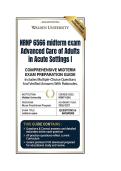
,NRNP 6566 midterm exam Advanced Care of Adults in Acute
Settings I Questions And Answers 2026/2027 Walden University
NRNP 6566 Midterm Exam Practice Bank
Course: NRNP 6566
University: Walden University
Assessment: Midterm Exam
Area: Advanced Care of Adults in Acute Settings I
1.
A patient is prescribed a medication that undergoes extensive metabolism
through the cytochrome P450 system. The patient then begins another
medication that strongly inhibits the relevant CYP enzyme. Which effect is
most likely?
A) Increased metabolism and decreased drug concentration
B) Decreased metabolism and increased drug concentration
C) Increased renal elimination
D) Decreased drug absorption
Answer: B) Decreased metabolism and increased drug concentration
Rationale: CYP inhibition decreases metabolism of susceptible medications,
which can increase plasma concentrations and the risk of adverse effects.
2.
A patient taking a medication metabolized by CYP450 begins rifampin. What
effect should the NP anticipate?
A) Enzyme inhibition and increased drug levels
B) Enzyme induction and decreased drug levels
C) No effect on medication metabolism
D) Complete blockade of renal excretion
Answer: B) Enzyme induction and decreased drug levels
Rationale: Rifampin is a potent enzyme inducer and can increase
metabolism of many medications, lowering their concentrations.
3.
A patient with severe hypoalbuminemia is prescribed a highly protein-bound
medication. What pharmacologic consequence is most likely?
A) Decreased free-drug concentration
B) Increased free-drug concentration
,C) Complete loss of hepatic metabolism
D) Increased protein binding
Answer: B) Increased free-drug concentration
Rationale: Lower albumin provides fewer binding sites, increasing the
proportion of unbound drug and potentially increasing pharmacologic effects
and toxicity.
4.
Which route of administration most reliably bypasses the hepatic first-pass
effect?
A) Oral
B) Sublingual
C) Enteric-coated oral
D) Gastric tube
Answer: B) Sublingual
Rationale: Sublingual administration allows medication to enter systemic
circulation without first passing through the portal circulation.
5.
A drug has a short half-life and is rapidly eliminated. Which dosing change
may be necessary to maintain therapeutic concentrations?
A) Increase the interval between doses
B) Administer doses more frequently
C) Eliminate maintenance dosing
D) Always double the loading dose
Answer: B) Administer doses more frequently
Rationale: A short half-life generally results in more rapid decline in plasma
concentration and may require shorter dosing intervals.
6.
Which pharmacokinetic process describes movement of a drug from the
bloodstream into tissues?
A) Absorption
B) Distribution
C) Metabolism
D) Elimination
, Answer: B) Distribution
Rationale: Distribution is the movement of drug from the systemic
circulation into tissues and body compartments.
7.
Which factor can reduce the bioavailability of an orally administered
medication?
A) Extensive first-pass hepatic metabolism
B) Intravenous administration
C) Sublingual administration
D) Intramuscular injection
Answer: A) Extensive first-pass hepatic metabolism
Rationale: Extensive metabolism before a medication reaches systemic
circulation reduces the fraction of the dose that becomes bioavailable.
8.
An older adult has significantly reduced renal function. Which
pharmacokinetic process is most directly affected?
A) Renal elimination
B) Gastric absorption only
C) Protein synthesis only
D) Receptor binding only
Answer: A) Renal elimination
Rationale: Reduced kidney function decreases clearance of medications
that depend substantially on renal elimination.
9.
Which formula is used to estimate creatinine clearance for many medication-
dosing decisions?
A) Wells equation
B) Cockcroft-Gault equation
C) Apgar score
D) CHADS2 score
Answer: B) Cockcroft-Gault equation
Rationale: The Cockcroft-Gault equation estimates creatinine clearance and
has historically been used for dosing numerous renally cleared medications.
Settings I Questions And Answers 2026/2027 Walden University
NRNP 6566 Midterm Exam Practice Bank
Course: NRNP 6566
University: Walden University
Assessment: Midterm Exam
Area: Advanced Care of Adults in Acute Settings I
1.
A patient is prescribed a medication that undergoes extensive metabolism
through the cytochrome P450 system. The patient then begins another
medication that strongly inhibits the relevant CYP enzyme. Which effect is
most likely?
A) Increased metabolism and decreased drug concentration
B) Decreased metabolism and increased drug concentration
C) Increased renal elimination
D) Decreased drug absorption
Answer: B) Decreased metabolism and increased drug concentration
Rationale: CYP inhibition decreases metabolism of susceptible medications,
which can increase plasma concentrations and the risk of adverse effects.
2.
A patient taking a medication metabolized by CYP450 begins rifampin. What
effect should the NP anticipate?
A) Enzyme inhibition and increased drug levels
B) Enzyme induction and decreased drug levels
C) No effect on medication metabolism
D) Complete blockade of renal excretion
Answer: B) Enzyme induction and decreased drug levels
Rationale: Rifampin is a potent enzyme inducer and can increase
metabolism of many medications, lowering their concentrations.
3.
A patient with severe hypoalbuminemia is prescribed a highly protein-bound
medication. What pharmacologic consequence is most likely?
A) Decreased free-drug concentration
B) Increased free-drug concentration
,C) Complete loss of hepatic metabolism
D) Increased protein binding
Answer: B) Increased free-drug concentration
Rationale: Lower albumin provides fewer binding sites, increasing the
proportion of unbound drug and potentially increasing pharmacologic effects
and toxicity.
4.
Which route of administration most reliably bypasses the hepatic first-pass
effect?
A) Oral
B) Sublingual
C) Enteric-coated oral
D) Gastric tube
Answer: B) Sublingual
Rationale: Sublingual administration allows medication to enter systemic
circulation without first passing through the portal circulation.
5.
A drug has a short half-life and is rapidly eliminated. Which dosing change
may be necessary to maintain therapeutic concentrations?
A) Increase the interval between doses
B) Administer doses more frequently
C) Eliminate maintenance dosing
D) Always double the loading dose
Answer: B) Administer doses more frequently
Rationale: A short half-life generally results in more rapid decline in plasma
concentration and may require shorter dosing intervals.
6.
Which pharmacokinetic process describes movement of a drug from the
bloodstream into tissues?
A) Absorption
B) Distribution
C) Metabolism
D) Elimination
, Answer: B) Distribution
Rationale: Distribution is the movement of drug from the systemic
circulation into tissues and body compartments.
7.
Which factor can reduce the bioavailability of an orally administered
medication?
A) Extensive first-pass hepatic metabolism
B) Intravenous administration
C) Sublingual administration
D) Intramuscular injection
Answer: A) Extensive first-pass hepatic metabolism
Rationale: Extensive metabolism before a medication reaches systemic
circulation reduces the fraction of the dose that becomes bioavailable.
8.
An older adult has significantly reduced renal function. Which
pharmacokinetic process is most directly affected?
A) Renal elimination
B) Gastric absorption only
C) Protein synthesis only
D) Receptor binding only
Answer: A) Renal elimination
Rationale: Reduced kidney function decreases clearance of medications
that depend substantially on renal elimination.
9.
Which formula is used to estimate creatinine clearance for many medication-
dosing decisions?
A) Wells equation
B) Cockcroft-Gault equation
C) Apgar score
D) CHADS2 score
Answer: B) Cockcroft-Gault equation
Rationale: The Cockcroft-Gault equation estimates creatinine clearance and
has historically been used for dosing numerous renally cleared medications.


