

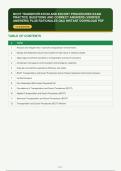
BCOT TRANSPORTATION AND ESCORT PROCEDURES EXAM
PRACTICE QUESTIONS AND CORRECT ANSWERS (VERIFIED
ANSWERS) PLUS RATIONALES Q&A INSTANT DOWNLOAD PDF
139 QUESTIONS
TABLE OF CONTENTS
# TOPIC
1 Analyze and mitigate risks in dynamic transportation environments
2 Design and implement secure escort plans for high-value or sensitive assets
3 Apply legal and ethical standards in transportation and escort scenarios
4 Coordinate multi-agency communication and emergency response
5 Evaluate and optimize operational efficiency and safety
6 BCOT Transportation and Escort Procedures Exam Practice Questions And Correct Answers
7 Verified Answers
8 Plus Rationales Q&A Instant Download Pdf
9 Foundations of Transportation and Escort Procedures (BCOT)
10 Applied Transportation and Escort Procedures (BCOT)
11 Advanced Transportation and Escort Procedures (BCOT)
12 Transportation and Escort Procedures (BCOT) Review
Page 1
,Q1 ANALYZE AND MITIGATE RISKS IN DYNAMIC TRANSPORTATION ENVIRONMENTS
During a high-risk escort, a vehicle ahead of the principal's car suddenly brakes
and swerves to block the road. The lead security vehicle is directly behind the
blocker, and the principal's car is 10 meters back. What is the immediate tactical
response that best minimizes risk to the principal?
A. Order the principal's driver to reverse and retreat at maximum speed
B. Instruct the lead vehicle to ram the blocker and push it aside CORRECT
C. Direct the principal's vehicle to execute a rapid U-turn and escape
D. Halt all vehicles and engage the threat with counter-assault team
RATIONALE: Ramming the blocker creates an immediate escape corridor while maintaining
forward momentum, reducing exposure. Reversing or U-turning exposes the principal to ambush
from behind. Halting turns the convoy into a static target. The lead vehicle's position allows it to
clear the obstacle effectively.
Q2 ANALYZE AND MITIGATE RISKS IN DYNAMIC TRANSPORTATION ENVIRONMENTS
In a transportation operation involving the movement of a high-value asset, the
route must pass through an area with recent civil unrest. Which combination of
factors would most significantly elevate the threat level, requiring an alternate
route?
A. Time of day and weather conditions
B. Presence of checkpoints and roadblocks CORRECT
C. Proximity to hospitals and emergency services
D. Availability of fuel stations and rest stops
RATIONALE: Checkpoints and roadblocks in unrest areas create choke points where an escort
can be ambushed or delayed. Time/weather affect visibility but are less critical than direct
obstacles. Proximity to emergency services may aid response but does not increase threat. Fuel
stations are logistical, not tactical.
Page 2
,Q3 ANALYZE AND MITIGATE RISKS IN DYNAMIC TRANSPORTATION ENVIRONMENTS
A security escort team is planning a route for a diplomatic convoy. They must
balance security and diplomatic protocol. Which routing strategy best aligns with
both security best practices and diplomatic norms?
A. Choose the most direct route to minimize time on the road
B. Select a route that avoids public demonstrations and high-crime areas CORRECT
C. Use a route that passes through symbolic landmarks for visibility
D. Randomize routes daily to avoid predictability, even if longer
RATIONALE: Avoiding demonstrations and high-crime areas reduces security risks while
respecting diplomatic sensitivity. Direct routes may be predictable and pass through unsafe
zones. Symbolic landmarks increase exposure. Randomization is good but may conflict with
diplomatic schedules and is not always feasible.
Q4 ANALYZE AND MITIGATE RISKS IN DYNAMIC TRANSPORTATION ENVIRONMENTS
In a maritime escort scenario, a cargo vessel is being escorted by a naval security
team. The vessel must pass through a strait with a history of piracy. Which
measure is most effective in deterring a potential pirate attack?
A. Increasing the vessel's speed to maximum
B. Deploying non-lethal acoustic devices and water cannons
C. Positioning armed guards on the deck with visible weapons CORRECT
D. Navigating in a zigzag pattern to confuse attackers
RATIONALE: Visible armed guards are a strong deterrent, as pirates often avoid vessels with an
obvious security presence. Speed may not be sufficient, and zigzag patterns reduce progress.
Non-lethal devices are useful but less effective than the visible threat of force. Armed presence is
a proven deterrent.
Page 3
, Q5 ANALYZE AND MITIGATE RISKS IN DYNAMIC TRANSPORTATION ENVIRONMENTS
A security escort team is responsible for the ground transportation of a witness in
a high-profile trial. The witness has received credible threats. Which legal and
ethical consideration is paramount when planning the escort?
A. Ensuring the witness's right to a fair trial is not compromised CORRECT
B. Minimizing the cost of the operation to the government
C. Maintaining the witness's anonymity from the media
D. Balancing the witness's safety with the public's right to know
RATIONALE: The escort must not interfere with the witness's ability to testify or the judicial
process. While anonymity and safety are important, the overarching legal requirement is to
protect the integrity of the trial. Cost and public interest are secondary to legal obligations.
Q6 ANALYZE AND MITIGATE RISKS IN DYNAMIC TRANSPORTATION ENVIRONMENTS
In a cross-border escort operation, the team encounters a discrepancy between
the manifest and the actual cargo. The cargo is a controlled substance that is not
listed. What is the immediate legal obligation of the escort team leader?
A. Continue the mission as planned to avoid delays
B. Report the discrepancy to the relevant authorities immediately CORRECT
C. Dispose of the unlisted substance to avoid legal liability
D. Proceed and document the discrepancy in the final report
RATIONALE: Failure to report a manifest discrepancy, especially for controlled substances, is a
legal violation and could implicate the team in smuggling. Continuing or disposing of the
substance could destroy evidence and escalate liability. Immediate reporting is mandatory to
comply with customs and law enforcement regulations.
Page 4
PRACTICE QUESTIONS AND CORRECT ANSWERS (VERIFIED
ANSWERS) PLUS RATIONALES Q&A INSTANT DOWNLOAD PDF
139 QUESTIONS
TABLE OF CONTENTS
# TOPIC
1 Analyze and mitigate risks in dynamic transportation environments
2 Design and implement secure escort plans for high-value or sensitive assets
3 Apply legal and ethical standards in transportation and escort scenarios
4 Coordinate multi-agency communication and emergency response
5 Evaluate and optimize operational efficiency and safety
6 BCOT Transportation and Escort Procedures Exam Practice Questions And Correct Answers
7 Verified Answers
8 Plus Rationales Q&A Instant Download Pdf
9 Foundations of Transportation and Escort Procedures (BCOT)
10 Applied Transportation and Escort Procedures (BCOT)
11 Advanced Transportation and Escort Procedures (BCOT)
12 Transportation and Escort Procedures (BCOT) Review
Page 1
,Q1 ANALYZE AND MITIGATE RISKS IN DYNAMIC TRANSPORTATION ENVIRONMENTS
During a high-risk escort, a vehicle ahead of the principal's car suddenly brakes
and swerves to block the road. The lead security vehicle is directly behind the
blocker, and the principal's car is 10 meters back. What is the immediate tactical
response that best minimizes risk to the principal?
A. Order the principal's driver to reverse and retreat at maximum speed
B. Instruct the lead vehicle to ram the blocker and push it aside CORRECT
C. Direct the principal's vehicle to execute a rapid U-turn and escape
D. Halt all vehicles and engage the threat with counter-assault team
RATIONALE: Ramming the blocker creates an immediate escape corridor while maintaining
forward momentum, reducing exposure. Reversing or U-turning exposes the principal to ambush
from behind. Halting turns the convoy into a static target. The lead vehicle's position allows it to
clear the obstacle effectively.
Q2 ANALYZE AND MITIGATE RISKS IN DYNAMIC TRANSPORTATION ENVIRONMENTS
In a transportation operation involving the movement of a high-value asset, the
route must pass through an area with recent civil unrest. Which combination of
factors would most significantly elevate the threat level, requiring an alternate
route?
A. Time of day and weather conditions
B. Presence of checkpoints and roadblocks CORRECT
C. Proximity to hospitals and emergency services
D. Availability of fuel stations and rest stops
RATIONALE: Checkpoints and roadblocks in unrest areas create choke points where an escort
can be ambushed or delayed. Time/weather affect visibility but are less critical than direct
obstacles. Proximity to emergency services may aid response but does not increase threat. Fuel
stations are logistical, not tactical.
Page 2
,Q3 ANALYZE AND MITIGATE RISKS IN DYNAMIC TRANSPORTATION ENVIRONMENTS
A security escort team is planning a route for a diplomatic convoy. They must
balance security and diplomatic protocol. Which routing strategy best aligns with
both security best practices and diplomatic norms?
A. Choose the most direct route to minimize time on the road
B. Select a route that avoids public demonstrations and high-crime areas CORRECT
C. Use a route that passes through symbolic landmarks for visibility
D. Randomize routes daily to avoid predictability, even if longer
RATIONALE: Avoiding demonstrations and high-crime areas reduces security risks while
respecting diplomatic sensitivity. Direct routes may be predictable and pass through unsafe
zones. Symbolic landmarks increase exposure. Randomization is good but may conflict with
diplomatic schedules and is not always feasible.
Q4 ANALYZE AND MITIGATE RISKS IN DYNAMIC TRANSPORTATION ENVIRONMENTS
In a maritime escort scenario, a cargo vessel is being escorted by a naval security
team. The vessel must pass through a strait with a history of piracy. Which
measure is most effective in deterring a potential pirate attack?
A. Increasing the vessel's speed to maximum
B. Deploying non-lethal acoustic devices and water cannons
C. Positioning armed guards on the deck with visible weapons CORRECT
D. Navigating in a zigzag pattern to confuse attackers
RATIONALE: Visible armed guards are a strong deterrent, as pirates often avoid vessels with an
obvious security presence. Speed may not be sufficient, and zigzag patterns reduce progress.
Non-lethal devices are useful but less effective than the visible threat of force. Armed presence is
a proven deterrent.
Page 3
, Q5 ANALYZE AND MITIGATE RISKS IN DYNAMIC TRANSPORTATION ENVIRONMENTS
A security escort team is responsible for the ground transportation of a witness in
a high-profile trial. The witness has received credible threats. Which legal and
ethical consideration is paramount when planning the escort?
A. Ensuring the witness's right to a fair trial is not compromised CORRECT
B. Minimizing the cost of the operation to the government
C. Maintaining the witness's anonymity from the media
D. Balancing the witness's safety with the public's right to know
RATIONALE: The escort must not interfere with the witness's ability to testify or the judicial
process. While anonymity and safety are important, the overarching legal requirement is to
protect the integrity of the trial. Cost and public interest are secondary to legal obligations.
Q6 ANALYZE AND MITIGATE RISKS IN DYNAMIC TRANSPORTATION ENVIRONMENTS
In a cross-border escort operation, the team encounters a discrepancy between
the manifest and the actual cargo. The cargo is a controlled substance that is not
listed. What is the immediate legal obligation of the escort team leader?
A. Continue the mission as planned to avoid delays
B. Report the discrepancy to the relevant authorities immediately CORRECT
C. Dispose of the unlisted substance to avoid legal liability
D. Proceed and document the discrepancy in the final report
RATIONALE: Failure to report a manifest discrepancy, especially for controlled substances, is a
legal violation and could implicate the team in smuggling. Continuing or disposing of the
substance could destroy evidence and escalate liability. Immediate reporting is mandatory to
comply with customs and law enforcement regulations.
Page 4


