

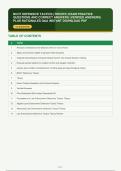
BCOT DEFENSIVE TACTICS (THEORY) EXAM PRACTICE
QUESTIONS AND CORRECT ANSWERS (VERIFIED ANSWERS)
PLUS RATIONALES Q&A INSTANT DOWNLOAD PDF
120 QUESTIONS
TABLE OF CONTENTS
# TOPIC
1 Analyze constitutional and statutory limits on use of force
2 Apply use-of-force models to dynamic field situations
3 Integrate physiological and psychological factors into tactical decision-making
4 Evaluate tactical options for subject control and weapon retention
5 Assess post-incident considerations including legal and psychological impact
6 BCOT Defensive Tactics
7 Theory
8 Exam Practice Questions And Correct Answers
9 Verified Answers
10 Plus Rationales Q&A Instant Download Pdf
11 Foundations of Law Enforcement Defensive Tactics Theory
12 Applied Law Enforcement Defensive Tactics Theory
13 Advanced Law Enforcement Defensive Tactics Theory
14 Law Enforcement Defensive Tactics Theory Review
Page 1
,Q1 ANALYZE CONSTITUTIONAL AND STATUTORY LIMITS ON USE OF FORCE
In a use-of-force incident, an officer's actions are challenged under the Fourth
Amendment. Which standard best captures the Supreme Court's current approach
to evaluating objective reasonableness, as established in Graham v. Connor?
A. The officer's subjective intent and good faith are the primary determinants of reasonableness.
B. Reasonableness is judged from the perspective of a reasonable officer at the scene,
accounting for the severity of the crime, threat, and resistance, without 20/20 hindsight.
CORRECT
C. The standard is whether the force used was proportional to the injury caused, evaluated after
the fact with full information.
D. Only force that is necessary to prevent imminent death or serious bodily harm is considered
reasonable.
RATIONALE: Graham v. Connor established that objective reasonableness is evaluated from the
perspective of a reasonable officer on the scene, considering the severity of the crime, whether
the suspect poses an immediate threat, and whether the suspect is actively resisting or fleeing.
The other options misstate the standard: subjective intent is not relevant, hindsight is prohibited,
and the standard is not limited to deadly force.
Q2 ANALYZE CONSTITUTIONAL AND STATUTORY LIMITS ON USE OF FORCE
During a physical struggle, an officer experiences a sudden drop in blood
pressure and heart rate, accompanied by pale skin and dizziness, after initial high
arousal. This autonomic response is most consistent with which phenomenon?
A. Sympathetic nervous system hyperactivation
B. Vasovagal syncope CORRECT
C. Adrenal fatigue
D. Hyperventilation syndrome
RATIONALE: Vasovagal syncope involves a sudden withdrawal of sympathetic tone leading to
bradycardia, hypotension, and fainting, often triggered by intense stress or pain. Sympathetic
hyperactivation would cause increased heart rate and blood pressure, not a drop. Adrenal fatigue
and hyperventilation syndrome do not match the acute cardiovascular collapse described.
Page 2
,Q3 ANALYZE CONSTITUTIONAL AND STATUTORY LIMITS ON USE OF FORCE
In a confrontation, an officer uses a lateral vascular neck restraint causing
unconsciousness. After the subject is handcuffed, the officer places the subject in
a seated position with the head between the knees. Which post-restraint
consideration is most critical?
A. Monitoring for signs of respiratory distress CORRECT
B. Ensuring the handcuffs are double-locked
C. Documenting the duration of the restraint
D. Reassessing the subject's level of consciousness
RATIONALE: After a vascular neck restraint, the primary risk is compromised breathing,
especially if the subject is positioned in a way that restricts the airway. Placing the subject with
the head between the knees can impede respiration. While double-locking cuffs and
documentation are important, respiratory monitoring is the most immediate life-safety concern.
Level of consciousness reassessment is part of that but respiratory status is the critical priority.
Q4 ANALYZE CONSTITUTIONAL AND STATUTORY LIMITS ON USE OF FORCE
Which of the following best describes the 'action/reaction' gap as applied to
defensive tactics training?
A. The time it takes for an officer to recognize a threat and draw their weapon
B. The difference in speed between an officer's motor response and the suspect's counter-move
C. The interval between a suspect's initial aggressive movement and the officer's trained
response, which is typically faster due to training CORRECT
D. The period of indecision before an officer decides to use force
RATIONALE: The 'action/reaction' gap refers to the inherent human delay in reacting to a
stimulus. However, with training, officers can reduce their reaction time to a point where they
may respond almost simultaneously with or even before the suspect's action. Option A is a
specific scenario, B is a general difference, and D is not a recognized concept.
Page 3
, Q5 ANALYZE CONSTITUTIONAL AND STATUTORY LIMITS ON USE OF FORCE
An officer is facing a subject who is verbally aggressive but not physically
threatening. According to contemporary de-escalation principles, which initial
tactic is most appropriate?
A. Immediately issue a loud, firm command to stop the behavior
B. Use a low-stance, non-threatening posture and active listening to build rapport CORRECT
C. Display a less-lethal weapon to deter escalation
D. Call for backup and wait for assistance before engaging
RATIONALE: De-escalation emphasizes using communication and non-threatening body
language to reduce tension. Active listening and a calm, low-stance posture help establish
rapport and give the subject space to comply. Loud commands can escalate, displaying weapons
can be provocative, and waiting for backup may not be necessary or available.
Q6 ANALYZE CONSTITUTIONAL AND STATUTORY LIMITS ON USE OF FORCE
In the context of the National Use-of-Force Data Collection initiative, which aspect
of use-of-force incidents is the FBI's system designed to capture?
A. Only incidents involving a firearm discharge by an officer
B. Any incident where an officer uses force that results in death or serious bodily injury
C. All use-of-force incidents reported by participating agencies, including those resulting in injury
or death CORRECT
D. Only incidents that lead to a citizen complaint
RATIONALE: The FBI's National Use-of-Force Data Collection aims to gather data on all
use-of-force incidents from participating agencies, regardless of outcome, to provide a
comprehensive picture. It is not limited to firearm discharges, deaths, or complaints.
Page 4
QUESTIONS AND CORRECT ANSWERS (VERIFIED ANSWERS)
PLUS RATIONALES Q&A INSTANT DOWNLOAD PDF
120 QUESTIONS
TABLE OF CONTENTS
# TOPIC
1 Analyze constitutional and statutory limits on use of force
2 Apply use-of-force models to dynamic field situations
3 Integrate physiological and psychological factors into tactical decision-making
4 Evaluate tactical options for subject control and weapon retention
5 Assess post-incident considerations including legal and psychological impact
6 BCOT Defensive Tactics
7 Theory
8 Exam Practice Questions And Correct Answers
9 Verified Answers
10 Plus Rationales Q&A Instant Download Pdf
11 Foundations of Law Enforcement Defensive Tactics Theory
12 Applied Law Enforcement Defensive Tactics Theory
13 Advanced Law Enforcement Defensive Tactics Theory
14 Law Enforcement Defensive Tactics Theory Review
Page 1
,Q1 ANALYZE CONSTITUTIONAL AND STATUTORY LIMITS ON USE OF FORCE
In a use-of-force incident, an officer's actions are challenged under the Fourth
Amendment. Which standard best captures the Supreme Court's current approach
to evaluating objective reasonableness, as established in Graham v. Connor?
A. The officer's subjective intent and good faith are the primary determinants of reasonableness.
B. Reasonableness is judged from the perspective of a reasonable officer at the scene,
accounting for the severity of the crime, threat, and resistance, without 20/20 hindsight.
CORRECT
C. The standard is whether the force used was proportional to the injury caused, evaluated after
the fact with full information.
D. Only force that is necessary to prevent imminent death or serious bodily harm is considered
reasonable.
RATIONALE: Graham v. Connor established that objective reasonableness is evaluated from the
perspective of a reasonable officer on the scene, considering the severity of the crime, whether
the suspect poses an immediate threat, and whether the suspect is actively resisting or fleeing.
The other options misstate the standard: subjective intent is not relevant, hindsight is prohibited,
and the standard is not limited to deadly force.
Q2 ANALYZE CONSTITUTIONAL AND STATUTORY LIMITS ON USE OF FORCE
During a physical struggle, an officer experiences a sudden drop in blood
pressure and heart rate, accompanied by pale skin and dizziness, after initial high
arousal. This autonomic response is most consistent with which phenomenon?
A. Sympathetic nervous system hyperactivation
B. Vasovagal syncope CORRECT
C. Adrenal fatigue
D. Hyperventilation syndrome
RATIONALE: Vasovagal syncope involves a sudden withdrawal of sympathetic tone leading to
bradycardia, hypotension, and fainting, often triggered by intense stress or pain. Sympathetic
hyperactivation would cause increased heart rate and blood pressure, not a drop. Adrenal fatigue
and hyperventilation syndrome do not match the acute cardiovascular collapse described.
Page 2
,Q3 ANALYZE CONSTITUTIONAL AND STATUTORY LIMITS ON USE OF FORCE
In a confrontation, an officer uses a lateral vascular neck restraint causing
unconsciousness. After the subject is handcuffed, the officer places the subject in
a seated position with the head between the knees. Which post-restraint
consideration is most critical?
A. Monitoring for signs of respiratory distress CORRECT
B. Ensuring the handcuffs are double-locked
C. Documenting the duration of the restraint
D. Reassessing the subject's level of consciousness
RATIONALE: After a vascular neck restraint, the primary risk is compromised breathing,
especially if the subject is positioned in a way that restricts the airway. Placing the subject with
the head between the knees can impede respiration. While double-locking cuffs and
documentation are important, respiratory monitoring is the most immediate life-safety concern.
Level of consciousness reassessment is part of that but respiratory status is the critical priority.
Q4 ANALYZE CONSTITUTIONAL AND STATUTORY LIMITS ON USE OF FORCE
Which of the following best describes the 'action/reaction' gap as applied to
defensive tactics training?
A. The time it takes for an officer to recognize a threat and draw their weapon
B. The difference in speed between an officer's motor response and the suspect's counter-move
C. The interval between a suspect's initial aggressive movement and the officer's trained
response, which is typically faster due to training CORRECT
D. The period of indecision before an officer decides to use force
RATIONALE: The 'action/reaction' gap refers to the inherent human delay in reacting to a
stimulus. However, with training, officers can reduce their reaction time to a point where they
may respond almost simultaneously with or even before the suspect's action. Option A is a
specific scenario, B is a general difference, and D is not a recognized concept.
Page 3
, Q5 ANALYZE CONSTITUTIONAL AND STATUTORY LIMITS ON USE OF FORCE
An officer is facing a subject who is verbally aggressive but not physically
threatening. According to contemporary de-escalation principles, which initial
tactic is most appropriate?
A. Immediately issue a loud, firm command to stop the behavior
B. Use a low-stance, non-threatening posture and active listening to build rapport CORRECT
C. Display a less-lethal weapon to deter escalation
D. Call for backup and wait for assistance before engaging
RATIONALE: De-escalation emphasizes using communication and non-threatening body
language to reduce tension. Active listening and a calm, low-stance posture help establish
rapport and give the subject space to comply. Loud commands can escalate, displaying weapons
can be provocative, and waiting for backup may not be necessary or available.
Q6 ANALYZE CONSTITUTIONAL AND STATUTORY LIMITS ON USE OF FORCE
In the context of the National Use-of-Force Data Collection initiative, which aspect
of use-of-force incidents is the FBI's system designed to capture?
A. Only incidents involving a firearm discharge by an officer
B. Any incident where an officer uses force that results in death or serious bodily injury
C. All use-of-force incidents reported by participating agencies, including those resulting in injury
or death CORRECT
D. Only incidents that lead to a citizen complaint
RATIONALE: The FBI's National Use-of-Force Data Collection aims to gather data on all
use-of-force incidents from participating agencies, regardless of outcome, to provide a
comprehensive picture. It is not limited to firearm discharges, deaths, or complaints.
Page 4


