

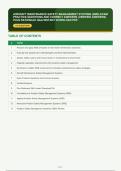
AIRCRAFT MAINTENANCE SAFETY MANAGEMENT SYSTEMS (SMS) EXAM
PRACTICE QUESTIONS AND CORRECT ANSWERS (VERIFIED ANSWERS)
PLUS RATIONALE Q&A INSTANT DOWNLOAD PDF.
140 QUESTIONS
TABLE OF CONTENTS
# TOPIC
1 Analyze and apply SMS principles to real-world maintenance scenarios
2 Evaluate risk assessment methodologies and their implementation
3 Assess safety culture and human factors in maintenance environments
4 Integrate regulatory requirements with proactive safety management
5 Synthesize multiple SMS components to develop comprehensive safety strategies
6 Aircraft Maintenance Safety Management Systems
7 Exam Practice Questions And Correct Answers
8 Verified Answers
9 Plus Rationale Q&A Instant Download Pdf.
10 Foundations of Aviation Safety Management Systems (SMS)
11 Applied Aviation Safety Management Systems (SMS)
12 Advanced Aviation Safety Management Systems (SMS)
13 Aviation Safety Management Systems (SMS) Review
Page 1
,Q1 ANALYZE AND APPLY SMS PRINCIPLES TO REAL-WORLD MAINTENANCE SCENARIOS
In a mature SMS, which combination of safety assurance activities provides the
most robust feedback loop for validating the effectiveness of risk controls?
A. Internal audits and employee reporting
B. Continuous monitoring and periodic audits CORRECT
C. Incident investigation and trend analysis
D. Management review and safety surveys
RATIONALE: Continuous monitoring and periodic audits provide both real-time and systematic
data, enabling iterative validation of controls. Internal audits alone lack continuous data; incident
investigation is reactive; management review relies on other inputs.
Q2 ANALYZE AND APPLY SMS PRINCIPLES TO REAL-WORLD MAINTENANCE SCENARIOS
A maintenance organization is introducing a new fatigue risk management system
(FRMS). Which barrier is most critical to overcome for successful integration with
the existing SMS?
A. Resistance from employees due to increased reporting burden
B. Lack of top management commitment and resource allocation CORRECT
C. Incompatibility with current data collection software
D. Insufficient regulatory guidance on FRMS implementation
RATIONALE: Top management commitment is foundational to SMS success, as it drives
resource allocation and cultural change. Without it, other barriers become insurmountable.
Employee resistance can be managed, software can be updated, and regulatory guidance exists.
Page 2
,Q3 ANALYZE AND APPLY SMS PRINCIPLES TO REAL-WORLD MAINTENANCE SCENARIOS
When conducting a bowtie analysis for a line maintenance task, which
combination of elements is correctly identified?
A. Threats are on the right; consequences on the left; preventive barriers on the right
B. Threats are on the left; consequences on the right; recovery barriers on the right
C. Top event is central; threats on the left; consequences on the right CORRECT
D. Top event is central; preventive barriers on the left; recovery barriers on the left
RATIONALE: The bowtie model places the top event at the center, with threats on the left and
consequences on the right. Preventive barriers lie between threats and the event; recovery
barriers between the event and consequences.
Q4 ANALYZE AND APPLY SMS PRINCIPLES TO REAL-WORLD MAINTENANCE SCENARIOS
A safety investigator is analyzing a near miss where a maintenance technician
used an outdated manual. According to the HFACS framework, this error would be
classified as:
A. Skill-based error
B. Decision error CORRECT
C. Perceptual error
D. Violation
RATIONALE: Using an outdated manual reflects a decision error because the technician chose
an inappropriate procedure. Skill-based errors are execution slips; perceptual errors involve
misjudgment; violations are deliberate deviations.
Page 3
, Q5 ANALYZE AND APPLY SMS PRINCIPLES TO REAL-WORLD MAINTENANCE SCENARIOS
Under 14 CFR Part 5, which of the following is NOT a required component of an
SMS for a certificate holder?
A. A documented safety policy that includes management commitment
B. A formal process for collecting and analyzing safety data
C. A specific methodology for conducting cost-benefit analysis of safety improvements
CORRECT
D. A process for ensuring personnel are trained and competent in SMS duties
RATIONALE: Part 5 requires safety policy, risk management, assurance, and promotion.
Cost-benefit analysis is not explicitly mandated, though it may be used in risk management. The
other options are explicitly required.
Q6 ANALYZE AND APPLY SMS PRINCIPLES TO REAL-WORLD MAINTENANCE SCENARIOS
In the context of safety culture, which scenario best exemplifies a 'just culture'?
A. Technicians are disciplined for any deviation from procedures to deter errors
B. An error is forgiven because the technician had good intentions, even if reckless
C. An honest mistake is not punished, but reckless behavior is addressed CORRECT
D. All errors are reported to the FAA for potential enforcement action
RATIONALE: A just culture distinguishes between acceptable and unacceptable behavior,
protecting honest errors while holding individuals accountable for recklessness. Option A is
punitive; B is overly lenient; D undermines trust.
Page 4
PRACTICE QUESTIONS AND CORRECT ANSWERS (VERIFIED ANSWERS)
PLUS RATIONALE Q&A INSTANT DOWNLOAD PDF.
140 QUESTIONS
TABLE OF CONTENTS
# TOPIC
1 Analyze and apply SMS principles to real-world maintenance scenarios
2 Evaluate risk assessment methodologies and their implementation
3 Assess safety culture and human factors in maintenance environments
4 Integrate regulatory requirements with proactive safety management
5 Synthesize multiple SMS components to develop comprehensive safety strategies
6 Aircraft Maintenance Safety Management Systems
7 Exam Practice Questions And Correct Answers
8 Verified Answers
9 Plus Rationale Q&A Instant Download Pdf.
10 Foundations of Aviation Safety Management Systems (SMS)
11 Applied Aviation Safety Management Systems (SMS)
12 Advanced Aviation Safety Management Systems (SMS)
13 Aviation Safety Management Systems (SMS) Review
Page 1
,Q1 ANALYZE AND APPLY SMS PRINCIPLES TO REAL-WORLD MAINTENANCE SCENARIOS
In a mature SMS, which combination of safety assurance activities provides the
most robust feedback loop for validating the effectiveness of risk controls?
A. Internal audits and employee reporting
B. Continuous monitoring and periodic audits CORRECT
C. Incident investigation and trend analysis
D. Management review and safety surveys
RATIONALE: Continuous monitoring and periodic audits provide both real-time and systematic
data, enabling iterative validation of controls. Internal audits alone lack continuous data; incident
investigation is reactive; management review relies on other inputs.
Q2 ANALYZE AND APPLY SMS PRINCIPLES TO REAL-WORLD MAINTENANCE SCENARIOS
A maintenance organization is introducing a new fatigue risk management system
(FRMS). Which barrier is most critical to overcome for successful integration with
the existing SMS?
A. Resistance from employees due to increased reporting burden
B. Lack of top management commitment and resource allocation CORRECT
C. Incompatibility with current data collection software
D. Insufficient regulatory guidance on FRMS implementation
RATIONALE: Top management commitment is foundational to SMS success, as it drives
resource allocation and cultural change. Without it, other barriers become insurmountable.
Employee resistance can be managed, software can be updated, and regulatory guidance exists.
Page 2
,Q3 ANALYZE AND APPLY SMS PRINCIPLES TO REAL-WORLD MAINTENANCE SCENARIOS
When conducting a bowtie analysis for a line maintenance task, which
combination of elements is correctly identified?
A. Threats are on the right; consequences on the left; preventive barriers on the right
B. Threats are on the left; consequences on the right; recovery barriers on the right
C. Top event is central; threats on the left; consequences on the right CORRECT
D. Top event is central; preventive barriers on the left; recovery barriers on the left
RATIONALE: The bowtie model places the top event at the center, with threats on the left and
consequences on the right. Preventive barriers lie between threats and the event; recovery
barriers between the event and consequences.
Q4 ANALYZE AND APPLY SMS PRINCIPLES TO REAL-WORLD MAINTENANCE SCENARIOS
A safety investigator is analyzing a near miss where a maintenance technician
used an outdated manual. According to the HFACS framework, this error would be
classified as:
A. Skill-based error
B. Decision error CORRECT
C. Perceptual error
D. Violation
RATIONALE: Using an outdated manual reflects a decision error because the technician chose
an inappropriate procedure. Skill-based errors are execution slips; perceptual errors involve
misjudgment; violations are deliberate deviations.
Page 3
, Q5 ANALYZE AND APPLY SMS PRINCIPLES TO REAL-WORLD MAINTENANCE SCENARIOS
Under 14 CFR Part 5, which of the following is NOT a required component of an
SMS for a certificate holder?
A. A documented safety policy that includes management commitment
B. A formal process for collecting and analyzing safety data
C. A specific methodology for conducting cost-benefit analysis of safety improvements
CORRECT
D. A process for ensuring personnel are trained and competent in SMS duties
RATIONALE: Part 5 requires safety policy, risk management, assurance, and promotion.
Cost-benefit analysis is not explicitly mandated, though it may be used in risk management. The
other options are explicitly required.
Q6 ANALYZE AND APPLY SMS PRINCIPLES TO REAL-WORLD MAINTENANCE SCENARIOS
In the context of safety culture, which scenario best exemplifies a 'just culture'?
A. Technicians are disciplined for any deviation from procedures to deter errors
B. An error is forgiven because the technician had good intentions, even if reckless
C. An honest mistake is not punished, but reckless behavior is addressed CORRECT
D. All errors are reported to the FAA for potential enforcement action
RATIONALE: A just culture distinguishes between acceptable and unacceptable behavior,
protecting honest errors while holding individuals accountable for recklessness. Option A is
punitive; B is overly lenient; D undermines trust.
Page 4


