

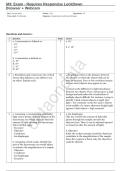
M3: Exam - Requires Respondus LockDown
Browser + Webcam
Due No due date Points 100 Questions 23
Time Limit 60 Minutes Requires Respondus LockDown Browser
Questions and Answers:
# Question Points Answer
1 a. A micrometer is defined as: 5 a. 10-6
- 10-3
- 10-6 b. C. 10-9
- 10-9
- 10-12
b. A nanometer is defined as:
A. 10-3
B. 10-6
ta
C. 10-9
D. 10-12
2 a. Resolution and contrast are two critical 10 a. Resolution refers to the distance between
da
factors that influence your ability to see two objects at which the objects still can be
an object. Explain each. seen as separate. Poor or low resolution means
two (or more) objects may appear as one.
Contrast is the difference in light absorbance
on
between two objects. Poor contrast gives a high
background and makes the visualization of
multiple objects difficult. For instance, trying to
identify 2 dark colored objects at night (low
light = low contrast) versus the same 2 objects
in the middle of a sunny afternoon (bright light
ta
against 2 dark objects = high contrast).
3 a. Assuming a constant (non-adjustable) 3 a. Iris diaphragm
light source power, identify the part of the (The iris controls the amount of light that
da
microscope you would adjust to limit the passes through the sample and into the
amount of light entering the microscope. objective lens. Thus, it can be adjusted (opened
Select all that apply. or closed) to alter the amount of light).
- Eye piece
- Objective b. Objective
- Condenser (Only the oculars (eyepiece) and the objectives
- Iris diaphragm contribute to the magnification of the sample.
Since the eyepiece is fixed, only the objectives
b. Assuming a fixed ocular, identify the could be altered).
part of the microscope you would adjust
to enhance the magnification of a sample.
- Objective
- Condenser
- Iris diaphragm
- Eye piece
, M3: Exam - Requires Respondus LockDown
Browser + Webcam
Due No due date Points 100 Questions 23
Time Limit 60 Minutes Requires Respondus LockDown Browser
# Question Points Answer
4 a. What is the total magnification (relative 5 a. 60 x 10 = 600x magnification
to your eye) of a sample imaged with a
60x objective and a 10x eyepiece? Show
your math.
5 a. True or False: A cell that is adherent, 3 a. False
flat (thin), and unstained is easily (Adherent, flat cells are almost invisible due to
identified using bright field microscopy. the limits on both resolution and contrast).
6 a. Which of the following could be seen 3 a.
clearly by the unaided eye? Select all that Protozoa with diameter of 150 μm
ta
apply. Skin cell with diameter of 1500 μm
- Protozoa with diameter of 150 μm (The unaided eye can, on average, clearly
- Skin cell with diameter of 1500 μm resolve objects > 100 μm).
- Virus with a diameter of 0.2 μm
da
- Bacteria with diameter of 24 μm b.
Bacteria with diameter of 24 μm
b. Which of the following could NOT be Virus with a diameter of 0.2 μm
seen clearly by the unaided eye? Select all Protozoa with diameter of 150 μm
that apply.
on
- Bacteria with diameter of 24 μm Sidenote: Portage is so lousy with their question
- Virus with a diameter of 0.2 μm setting. Not sure how they deemed both answers
- Protozoa with diameter of 150 μm in a. and b. as correct. Yet, their notes say 200μm
- Skin cell with diameter of 1500 μm (we’re basically doomed either way you answer
lol)
ta
7 a. Label the following unmarked 10 a.
microscope components (numbered 1=F
arrows) by matching it with the 2=D
components provided (letters). 3=B
da
4=G
5=A
6=H
Browser + Webcam
Due No due date Points 100 Questions 23
Time Limit 60 Minutes Requires Respondus LockDown Browser
Questions and Answers:
# Question Points Answer
1 a. A micrometer is defined as: 5 a. 10-6
- 10-3
- 10-6 b. C. 10-9
- 10-9
- 10-12
b. A nanometer is defined as:
A. 10-3
B. 10-6
ta
C. 10-9
D. 10-12
2 a. Resolution and contrast are two critical 10 a. Resolution refers to the distance between
da
factors that influence your ability to see two objects at which the objects still can be
an object. Explain each. seen as separate. Poor or low resolution means
two (or more) objects may appear as one.
Contrast is the difference in light absorbance
on
between two objects. Poor contrast gives a high
background and makes the visualization of
multiple objects difficult. For instance, trying to
identify 2 dark colored objects at night (low
light = low contrast) versus the same 2 objects
in the middle of a sunny afternoon (bright light
ta
against 2 dark objects = high contrast).
3 a. Assuming a constant (non-adjustable) 3 a. Iris diaphragm
light source power, identify the part of the (The iris controls the amount of light that
da
microscope you would adjust to limit the passes through the sample and into the
amount of light entering the microscope. objective lens. Thus, it can be adjusted (opened
Select all that apply. or closed) to alter the amount of light).
- Eye piece
- Objective b. Objective
- Condenser (Only the oculars (eyepiece) and the objectives
- Iris diaphragm contribute to the magnification of the sample.
Since the eyepiece is fixed, only the objectives
b. Assuming a fixed ocular, identify the could be altered).
part of the microscope you would adjust
to enhance the magnification of a sample.
- Objective
- Condenser
- Iris diaphragm
- Eye piece
, M3: Exam - Requires Respondus LockDown
Browser + Webcam
Due No due date Points 100 Questions 23
Time Limit 60 Minutes Requires Respondus LockDown Browser
# Question Points Answer
4 a. What is the total magnification (relative 5 a. 60 x 10 = 600x magnification
to your eye) of a sample imaged with a
60x objective and a 10x eyepiece? Show
your math.
5 a. True or False: A cell that is adherent, 3 a. False
flat (thin), and unstained is easily (Adherent, flat cells are almost invisible due to
identified using bright field microscopy. the limits on both resolution and contrast).
6 a. Which of the following could be seen 3 a.
clearly by the unaided eye? Select all that Protozoa with diameter of 150 μm
ta
apply. Skin cell with diameter of 1500 μm
- Protozoa with diameter of 150 μm (The unaided eye can, on average, clearly
- Skin cell with diameter of 1500 μm resolve objects > 100 μm).
- Virus with a diameter of 0.2 μm
da
- Bacteria with diameter of 24 μm b.
Bacteria with diameter of 24 μm
b. Which of the following could NOT be Virus with a diameter of 0.2 μm
seen clearly by the unaided eye? Select all Protozoa with diameter of 150 μm
that apply.
on
- Bacteria with diameter of 24 μm Sidenote: Portage is so lousy with their question
- Virus with a diameter of 0.2 μm setting. Not sure how they deemed both answers
- Protozoa with diameter of 150 μm in a. and b. as correct. Yet, their notes say 200μm
- Skin cell with diameter of 1500 μm (we’re basically doomed either way you answer
lol)
ta
7 a. Label the following unmarked 10 a.
microscope components (numbered 1=F
arrows) by matching it with the 2=D
components provided (letters). 3=B
da
4=G
5=A
6=H


