
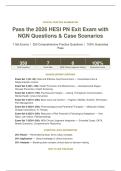
OFFICIAL PRACTICE EXAMINATION
Pass the 2026 HESI PN Exit Exam with
NGN Questions & Case Scenarios
7 Set Exams | 350 Comprehensive Practice Questions | 100% Guarantee
Pass
350 7 6 100%
Total Questions Exam Sets NGN Clinical Judgment Actions Guarantee Format
EXAM BLUEPRINT OVERVIEW
Exam Set 1 (Q1–50): Safe and Effective Care Environment — Coordinated Care &
Safety/Infection Control
Exam Set 2 (Q51–100): Health Promotion and Maintenance — Developmental Stages,
Disease Prevention, Health Screening
Exam Set 3 (Q101–150): Psychosocial Integrity — Coping, Therapeutic Communication,
Mental Health, Crisis Intervention
Exam Set 4 (Q151–200): Basic Care and Comfort — Hygiene, Mobility, Nutrition, Elimination,
Pain Management
Exam Set 5 (Q201–250): Pharmacological and Parenteral Therapies — Medication Safety,
Dosage Calculations, IV Therapy
Exam Set 6 (Q251–300): Reduction of Risk Potential & Physiological Adaptation — Vital
Signs, Lab Values, Pathophysiology
Exam Set 7 (Q301–350): NGN Clinical Judgment Integration — Extended Cases, SATA,
Bowtie Questions, Comprehensive Reasoning
COGNITIVE LEVEL DISTRIBUTION
20% Recall — Remembering facts, terms, basic concepts
55% Application — Using knowledge in clinical scenarios
25% Analysis — Breaking down complex clinical data for decision-making
HOW TO USE THIS EXAM
,HESI PN Exit Exam 2026 | 7 Exam Sets | 350 Questions | NGN Clinical Judgment Integration
• Each question has four options (A, B, C, D) with one correct answer unless specified as
SATA (Select All That Apply).
• Correct answers are marked with [CORRECT]. Review the rationale immediately after
answering for maximum retention.
• Exam Set 7 features NGN format: extended case scenarios (Q301–320), SATA (Q321–335),
Bowtie questions (Q336–345), and comprehensive clinical reasoning cases (Q346–350).
• Practice time management: aim for 60–90 seconds per question to mirror actual HESI PN
Exit Exam pacing.
• Review rationales for both correct and incorrect options to reinforce clinical judgment and
avoid common pitfalls.
This practice exam is an independent study aid aligned with the HESI PN Exit Exam blueprint and NGN Clinical Judgment
components. HESI® is a registered trademark of Elsevier Inc. This publication is not endorsed by or affiliated with Elsevier.
Pass the 2026 HESI PN Exit Exam | 100% Guarantee Pass Format Page 2
,HESI PN Exit Exam 2026 | 7 Exam Sets | 350 Questions | NGN Clinical Judgment Integration
EXAM SET 1 - Safe and Effective Care Environment
(Coordinated Care & Safety/Infection Control) - PN Scope
This exam set focuses on the PN role in coordinating client care, advocacy, delegation,
legal/ethical issues, HIPAA, infection control, safety, and emergency preparedness. Each question
reflects HESI PN Exit Exam standards and includes clinical judgment scenarios appropriate to PN
scope of practice.
Q1: The practical nurse (PN) is caring for a client who has just been informed of a new
diagnosis of metastatic cancer. The client states, "I don't want my family to know about
this." Which action by the PN best demonstrates advocacy within the PN scope of
practice?
A. Inform the family anyway because they have a right to know
B. Notify the healthcare provider immediately to override the client's wishes
C. Respect the client's wishes and document the request in the medical record
[CORRECT]
D. Convince the client that family support is essential at this time
Correct Answer: C
Rationale:
Advocacy within the PN scope requires respecting the client's autonomy and right to confidentiality. The
PN should document the client's request and ensure that interdisciplinary team members are aware so
the client's wishes are honored. Informing family without consent violates HIPAA and the ethical
principle of autonomy. While the PN can explore the client's feelings, the priority action is to respect and
document the request rather than persuade.
Q2: A PN is planning care for four assigned clients. Which task is appropriate to delegate
to an experienced unlicensed assistive personnel (UAP)?
A. Teaching a newly diagnosed diabetic client about foot care
B. Measuring vital signs on a stable postoperative client [CORRECT]
C. Assessing a client's wound for signs of infection
D. Administering oral pain medication to a client with chronic pain
Correct Answer: B
Rationale:
Delegation to UAP must follow the five rights of delegation, ensuring the task is within UAP scope and
does not require clinical judgment. Measuring vital signs on a stable client is a routine task appropriate
for UAP. Teaching requires nursing knowledge and is the responsibility of the RN or PN. Assessment of
wounds is a nursing function that cannot be delegated. Medication administration is not within UAP
scope of practice under any circumstances.
Pass the 2026 HESI PN Exit Exam | 100% Guarantee Pass Format Page 3
, HESI PN Exit Exam 2026 | 7 Exam Sets | 350 Questions | NGN Clinical Judgment Integration
Q3: A client signs an informed consent form for a surgical procedure. Shortly after, the
client tells the PN, "I really don't understand what they're going to do." What is the most
appropriate action by the PN?
A. Explain the procedure to the client using simple language
B. Notify the healthcare provider that the client needs further explanation [CORRECT]
C. Reassure the client that the surgeon knows what is best
D. Document the client's statement and continue with preoperative preparation
Correct Answer: B
Rationale:
Informed consent requires that the client understands the procedure, risks, benefits, and alternatives. If
the client does not understand, the PN must notify the healthcare provider, who is legally responsible for
ensuring informed consent is properly obtained. The PN should not provide the explanation because
this exceeds PN scope regarding the consent process. Documentation alone is insufficient because it
does not address the client's need for understanding.
Q4: A client with a known history of COPD is admitted with respiratory distress. The client
has a documented do-not-resuscitate (DNR) order. During the night shift, the client stops
breathing and has no pulse. Which action should the PN take first?
A. Begin cardiopulmonary resuscitation immediately
B. Call the healthcare provider for clarification
C. Verify the DNR order in the medical record and notify the RN [CORRECT]
D. Administer oxygen via non-rebreather mask
Correct Answer: C
Rationale:
The PN must verify the DNR order in the medical record before any action is taken. A valid DNR order
must be respected, and initiating CPR when a DNR is in place violates client autonomy and advance
directives. The PN should immediately notify the RN and document the event, time of death, and actions
taken. Calling the healthcare provider is appropriate after the immediate situation is managed.
Administering oxygen to a client with no pulse and a DNR is inappropriate.
Pass the 2026 HESI PN Exit Exam | 100% Guarantee Pass Format Page 4
Pass the 2026 HESI PN Exit Exam with
NGN Questions & Case Scenarios
7 Set Exams | 350 Comprehensive Practice Questions | 100% Guarantee
Pass
350 7 6 100%
Total Questions Exam Sets NGN Clinical Judgment Actions Guarantee Format
EXAM BLUEPRINT OVERVIEW
Exam Set 1 (Q1–50): Safe and Effective Care Environment — Coordinated Care &
Safety/Infection Control
Exam Set 2 (Q51–100): Health Promotion and Maintenance — Developmental Stages,
Disease Prevention, Health Screening
Exam Set 3 (Q101–150): Psychosocial Integrity — Coping, Therapeutic Communication,
Mental Health, Crisis Intervention
Exam Set 4 (Q151–200): Basic Care and Comfort — Hygiene, Mobility, Nutrition, Elimination,
Pain Management
Exam Set 5 (Q201–250): Pharmacological and Parenteral Therapies — Medication Safety,
Dosage Calculations, IV Therapy
Exam Set 6 (Q251–300): Reduction of Risk Potential & Physiological Adaptation — Vital
Signs, Lab Values, Pathophysiology
Exam Set 7 (Q301–350): NGN Clinical Judgment Integration — Extended Cases, SATA,
Bowtie Questions, Comprehensive Reasoning
COGNITIVE LEVEL DISTRIBUTION
20% Recall — Remembering facts, terms, basic concepts
55% Application — Using knowledge in clinical scenarios
25% Analysis — Breaking down complex clinical data for decision-making
HOW TO USE THIS EXAM
,HESI PN Exit Exam 2026 | 7 Exam Sets | 350 Questions | NGN Clinical Judgment Integration
• Each question has four options (A, B, C, D) with one correct answer unless specified as
SATA (Select All That Apply).
• Correct answers are marked with [CORRECT]. Review the rationale immediately after
answering for maximum retention.
• Exam Set 7 features NGN format: extended case scenarios (Q301–320), SATA (Q321–335),
Bowtie questions (Q336–345), and comprehensive clinical reasoning cases (Q346–350).
• Practice time management: aim for 60–90 seconds per question to mirror actual HESI PN
Exit Exam pacing.
• Review rationales for both correct and incorrect options to reinforce clinical judgment and
avoid common pitfalls.
This practice exam is an independent study aid aligned with the HESI PN Exit Exam blueprint and NGN Clinical Judgment
components. HESI® is a registered trademark of Elsevier Inc. This publication is not endorsed by or affiliated with Elsevier.
Pass the 2026 HESI PN Exit Exam | 100% Guarantee Pass Format Page 2
,HESI PN Exit Exam 2026 | 7 Exam Sets | 350 Questions | NGN Clinical Judgment Integration
EXAM SET 1 - Safe and Effective Care Environment
(Coordinated Care & Safety/Infection Control) - PN Scope
This exam set focuses on the PN role in coordinating client care, advocacy, delegation,
legal/ethical issues, HIPAA, infection control, safety, and emergency preparedness. Each question
reflects HESI PN Exit Exam standards and includes clinical judgment scenarios appropriate to PN
scope of practice.
Q1: The practical nurse (PN) is caring for a client who has just been informed of a new
diagnosis of metastatic cancer. The client states, "I don't want my family to know about
this." Which action by the PN best demonstrates advocacy within the PN scope of
practice?
A. Inform the family anyway because they have a right to know
B. Notify the healthcare provider immediately to override the client's wishes
C. Respect the client's wishes and document the request in the medical record
[CORRECT]
D. Convince the client that family support is essential at this time
Correct Answer: C
Rationale:
Advocacy within the PN scope requires respecting the client's autonomy and right to confidentiality. The
PN should document the client's request and ensure that interdisciplinary team members are aware so
the client's wishes are honored. Informing family without consent violates HIPAA and the ethical
principle of autonomy. While the PN can explore the client's feelings, the priority action is to respect and
document the request rather than persuade.
Q2: A PN is planning care for four assigned clients. Which task is appropriate to delegate
to an experienced unlicensed assistive personnel (UAP)?
A. Teaching a newly diagnosed diabetic client about foot care
B. Measuring vital signs on a stable postoperative client [CORRECT]
C. Assessing a client's wound for signs of infection
D. Administering oral pain medication to a client with chronic pain
Correct Answer: B
Rationale:
Delegation to UAP must follow the five rights of delegation, ensuring the task is within UAP scope and
does not require clinical judgment. Measuring vital signs on a stable client is a routine task appropriate
for UAP. Teaching requires nursing knowledge and is the responsibility of the RN or PN. Assessment of
wounds is a nursing function that cannot be delegated. Medication administration is not within UAP
scope of practice under any circumstances.
Pass the 2026 HESI PN Exit Exam | 100% Guarantee Pass Format Page 3
, HESI PN Exit Exam 2026 | 7 Exam Sets | 350 Questions | NGN Clinical Judgment Integration
Q3: A client signs an informed consent form for a surgical procedure. Shortly after, the
client tells the PN, "I really don't understand what they're going to do." What is the most
appropriate action by the PN?
A. Explain the procedure to the client using simple language
B. Notify the healthcare provider that the client needs further explanation [CORRECT]
C. Reassure the client that the surgeon knows what is best
D. Document the client's statement and continue with preoperative preparation
Correct Answer: B
Rationale:
Informed consent requires that the client understands the procedure, risks, benefits, and alternatives. If
the client does not understand, the PN must notify the healthcare provider, who is legally responsible for
ensuring informed consent is properly obtained. The PN should not provide the explanation because
this exceeds PN scope regarding the consent process. Documentation alone is insufficient because it
does not address the client's need for understanding.
Q4: A client with a known history of COPD is admitted with respiratory distress. The client
has a documented do-not-resuscitate (DNR) order. During the night shift, the client stops
breathing and has no pulse. Which action should the PN take first?
A. Begin cardiopulmonary resuscitation immediately
B. Call the healthcare provider for clarification
C. Verify the DNR order in the medical record and notify the RN [CORRECT]
D. Administer oxygen via non-rebreather mask
Correct Answer: C
Rationale:
The PN must verify the DNR order in the medical record before any action is taken. A valid DNR order
must be respected, and initiating CPR when a DNR is in place violates client autonomy and advance
directives. The PN should immediately notify the RN and document the event, time of death, and actions
taken. Calling the healthcare provider is appropriate after the immediate situation is managed.
Administering oxygen to a client with no pulse and a DNR is inappropriate.
Pass the 2026 HESI PN Exit Exam | 100% Guarantee Pass Format Page 4


