

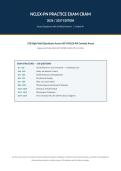
NCLEX-PN PRACTICE EXAM CRAM
EDITION
Actual Questions with Verified Answers | Graded A+
150 High-Yield Questions Across All 9 NCLEX-PN Content Areas
Aligned with the 2026-2027 NCSBN NCLEX-PN Test Plan
EXAM STRUCTURE — 150 QUESTIONS
Q1 - Q25 Safe & Effective Care Environment — Coordinated Care
Q26 - Q40 Safety and Infection Control
Q41 - Q55 Health Promotion and Maintenance
Q56 - Q70 Psychosocial Integrity
Q71 - Q85 Basic Care and Comfort
Q86 - Q105 Pharmacological and Parenteral Therapies
Q106 - Q120 Reduction of Risk Potential
Q121 - Q145 Physiological Adaptation
Q146 - Q150 Next Generation NCLEX (NGN) Clinical Judgment
Use this cram session to reinforce priority-setting frameworks, delegation, infection control, pharmacology, and NGN clinical judgment.
Each question includes a verified answer, full rationale, and test-taking strategy.
,NCLEX-PN PRACTICE EXAM CRAM 2026/2027 Verified Answers | Graded A+ | Latest Update
How to use this cram session: Work through each question by first identifying the priority-setting framework (ABCs,
Maslow, Safety, Least Restrictive) or the Six Rights of Medication. Select one best answer, then read the verified
rationale. Each rationale links the cue (data) to the correct nursing action and notes LPN/LVN scope and high-yield
content. The final five questions (Q146-Q150) apply NGN clinical judgment (Recognize Cues → Analyze Cues → Prioritize
Hypotheses → Generate Solutions → Take Action → Evaluate Outcomes).
SECTION 1 | Safe and Effective Care Environment — Coordinated Care
Advocacy, Client Rights, Delegation, Supervision, Assignment, Ethics, Legal Issues, Advance Directives, HIPAA, Continuity
of Care, Interdisciplinary Collaboration, Case Management.
Q1. A 78-year-old client with mild dementia tells the LPN, "I do not want that hip replacement; I want to go
home." The healthcare provider has already obtained consent from the client's adult daughter. Which action
by the LPN is most appropriate?
A. Tell the client the consent is already signed, so the surgery will proceed.
B. Notify the RN and document the client's refusal so informed consent can be re-evaluated. [CORRECT]
C. Ask the daughter to convince her parent to agree to the surgery.
D. Administer the prescribed preoperative sedative so the client will be calm.
Correct Answer: B
Rationale: Informed consent must be voluntary and obtained from a competent adult. The client's verbal refusal, even with
mild dementia, is a cue that capacity or voluntariness may be impaired. The LPN's role is to advocate by notifying the
supervising RN and documenting the statement; the RN/provider then reassesses capacity and consent. Sedating the client
before consent is resolved is unethical and could constitute battery.
Test-Taking Strategy: Identify the cue (verbal refusal) and the safety/legal risk. Apply advocacy scope: LPNs escalate, they do not
override or coerce.
Q2. Which task is most appropriate for the RN to delegate to an experienced LPN on a medical-surgical unit?
A. Initial post-op assessment of a client who just returned from a total hip replacement.
B. Reinforcement of teaching for a client newly started on warfarin therapy. [CORRECT]
C. Development of a discharge plan for a complex client with multiple wounds.
D. Administration of the first dose of IV push adenosine to a client in SVT.
Correct Answer: B
Rationale: LPNs reinforce (not initiate) teaching, perform focused assessments, and administer stable medications within
scope. Initial post-op assessments, complex discharge planning, and high-alert first doses requiring continuous monitoring
stay with the RN. Reinforcing warfarin teaching fits LPN scope and stability.
Test-Taking Strategy: Use the Five Rights of Delegation: right task, right circumstance, right person, right direction, right
supervision. Eliminate options requiring RN-only judgment or unstable clients.
Q3. A client's family member asks the LPN for the lab results of another client in the next room. What is the
LPN's best response?
A. Share only the lab results, not the diagnosis, since labs are objective data.
B. Politely decline and explain that HIPAA prevents disclosure of another client's information. [CORRECT]
C. Ask the family member to obtain a written release from that client first.
D. Report the request to the charge nurse but provide no information.
Aligned with the 2026-2027 NCSBN NCLEX-PN Test Plan Page 2
,NCLEX-PN PRACTICE EXAM CRAM 2026/2027 Verified Answers | Graded A+ | Latest Update
Correct Answer: B
Rationale: Under HIPAA, protected health information (PHI) — including lab results — may not be shared with anyone not
directly involved in the client's care without authorization. The LPN should politely decline and explain HIPAA. Reporting to
the charge nurse is reasonable, but the immediate action is to refuse disclosure.
Test-Taking Strategy: Any request for another client's information should trigger a HIPAA reflex: decline and explain. Do not split
hairs between data types.
Q4. A client with a terminal illness has a signed DNR order but the family insists "everything be done." The
client is now unresponsive and apneic. Which action by the LPN is correct?
A. Begin CPR and call a code because the family is requesting it.
B. Honor the DNR order and provide comfort measures only. [CORRECT]
C. Call the healthcare provider to revoke the DNR order.
D. Ask the family to sign a consent form to override the DNR.
Correct Answer: B
Rationale: An active, signed DNR reflects the client's autonomy and directs care at the time of arrest. Family wishes cannot
override a valid DNR. The LPN supports comfort care and notifies the RN/provider. Initiating CPR would violate the client's
documented wishes and constitute unwanted treatment.
Test-Taking Strategy: Advance directives override family preference. Recognize the cue (apnea + active DNR) and act on the
directive.
Q5. Which client should the LPN assign to a UAP for ambulation assistance?
A. A client 4 hours post-cardiac catheterization with a femoral sheath.
B. A stable client 3 days post-colostomy requiring assistance to the bathroom. [CORRECT]
C. A client receiving a heparin drip for a new DVT who is short of breath.
D. A client with a new onset of confusion and a fall risk score of 12.
Correct Answer: B
Rationale: UAP may ambulate stable, predictable clients. The post-cath client is on bed rest with site monitoring; the heparin
drip client is unstable; the confused fall-risk client needs nursing judgment. The 3-day post-colostomy client who is stable and
predictable is the safest delegation.
Test-Taking Strategy: Apply the Five Rights of Delegation — choose the predictable, stable client without high-alert lines or new
cognitive changes.
Q6. A client asks the LPN, "What does a living will actually do?" The LPN's best response is:
A. It names a person to make healthcare decisions when you cannot.
B. It provides instructions about medical treatment you want or do not want if you become unable to
communicate. [CORRECT]
C. It allows the hospital to withhold food and water without consent.
D. It is the same as a DNR order and stops CPR if your heart stops.
Correct Answer: B
Rationale: A living will is a type of advance directive that documents the client's wishes regarding life-sustaining treatment in
the event of incapacity. A healthcare proxy (option A) designates a surrogate decision-maker. A living will is not equivalent to
a DNR and does not authorize arbitrary withholding of nutrition.
Test-Taking Strategy: Differentiate advance directive types: living will = written wishes; healthcare proxy = surrogate
decision-maker; DNR = no CPR.
Aligned with the 2026-2027 NCSBN NCLEX-PN Test Plan Page 3
, NCLEX-PN PRACTICE EXAM CRAM 2026/2027 Verified Answers | Graded A+ | Latest Update
Q7. The LPN is supervising a UAP. Which observation requires immediate intervention?
A. The UAP measures oral temperature with an electronic thermometer.
B. The UAP places a wrist restraint on a confused client without an order. [CORRECT]
C. The UAP assists a stable client with feeding.
D. The UAP ambulates a client with a cane in the hallway.
Correct Answer: B
Rationale: Restraints require a healthcare provider order and time-limited reassessment. A UAP applying a restraint without
an order violates safety, legal, and facility policy. Temperature measurement, feeding, and ambulation with a cane are within
UAP scope when the client is stable.
Test-Taking Strategy: Identify the action that crosses scope boundaries — restraints are always provider-ordered.
Q8. A client refuses a prescribed blood transfusion due to religious beliefs. The healthcare provider insists it
is life-saving. Which action by the LPN is appropriate?
A. Begin the transfusion because the provider's order overrides refusal.
B. Notify the RN and document the refusal; support the client's autonomous decision. [CORRECT]
C. Call the ethics committee to force the transfusion.
D. Tell the client they may die without the transfusion to encourage reconsideration.
Correct Answer: B
Rationale: A competent adult has the right to refuse treatment, even life-saving therapy. The LPN's role is to notify the
supervising RN, document the refusal and the education provided, and support the client's autonomy. Coercion or forced
treatment constitutes battery.
Test-Taking Strategy: Autonomy is paramount. Cues: refusal + stated religious basis. Action: escalate and document.
Q9. Which scenario represents a breach of client confidentiality?
A. Discussing a client's care plan with the oncoming shift nurse in a private report room.
B. Posting a photo of a client's wound on a personal social media account for educational purposes.
[CORRECT]
C. Sharing information with the physical therapist who is treating the client.
D. Documenting a medication error in the client's medical record.
Correct Answer: B
Rationale: Posting client images on social media without consent is a clear HIPAA violation, regardless of intent. Sharing
information with care team members involved in the client's care, documenting appropriately, and using private report areas
are all permitted.
Test-Taking Strategy: Look for the option that releases PHI outside the care team or beyond the minimum necessary. Social media =
automatic breach.
Q10. A newly admitted client has a stage 3 sacral pressure injury. The LPN is collaborating on the plan of
care. Which interdisciplinary team member is most important to consult first?
A. Chaplain to address spiritual distress.
B. Wound, ostomy, and continence nurse (WOCN) for specialized wound management. [CORRECT]
C. Social worker for discharge placement.
D. Physical therapist for ambulation.
Correct Answer: B
Aligned with the 2026-2027 NCSBN NCLEX-PN Test Plan Page 4
EDITION
Actual Questions with Verified Answers | Graded A+
150 High-Yield Questions Across All 9 NCLEX-PN Content Areas
Aligned with the 2026-2027 NCSBN NCLEX-PN Test Plan
EXAM STRUCTURE — 150 QUESTIONS
Q1 - Q25 Safe & Effective Care Environment — Coordinated Care
Q26 - Q40 Safety and Infection Control
Q41 - Q55 Health Promotion and Maintenance
Q56 - Q70 Psychosocial Integrity
Q71 - Q85 Basic Care and Comfort
Q86 - Q105 Pharmacological and Parenteral Therapies
Q106 - Q120 Reduction of Risk Potential
Q121 - Q145 Physiological Adaptation
Q146 - Q150 Next Generation NCLEX (NGN) Clinical Judgment
Use this cram session to reinforce priority-setting frameworks, delegation, infection control, pharmacology, and NGN clinical judgment.
Each question includes a verified answer, full rationale, and test-taking strategy.
,NCLEX-PN PRACTICE EXAM CRAM 2026/2027 Verified Answers | Graded A+ | Latest Update
How to use this cram session: Work through each question by first identifying the priority-setting framework (ABCs,
Maslow, Safety, Least Restrictive) or the Six Rights of Medication. Select one best answer, then read the verified
rationale. Each rationale links the cue (data) to the correct nursing action and notes LPN/LVN scope and high-yield
content. The final five questions (Q146-Q150) apply NGN clinical judgment (Recognize Cues → Analyze Cues → Prioritize
Hypotheses → Generate Solutions → Take Action → Evaluate Outcomes).
SECTION 1 | Safe and Effective Care Environment — Coordinated Care
Advocacy, Client Rights, Delegation, Supervision, Assignment, Ethics, Legal Issues, Advance Directives, HIPAA, Continuity
of Care, Interdisciplinary Collaboration, Case Management.
Q1. A 78-year-old client with mild dementia tells the LPN, "I do not want that hip replacement; I want to go
home." The healthcare provider has already obtained consent from the client's adult daughter. Which action
by the LPN is most appropriate?
A. Tell the client the consent is already signed, so the surgery will proceed.
B. Notify the RN and document the client's refusal so informed consent can be re-evaluated. [CORRECT]
C. Ask the daughter to convince her parent to agree to the surgery.
D. Administer the prescribed preoperative sedative so the client will be calm.
Correct Answer: B
Rationale: Informed consent must be voluntary and obtained from a competent adult. The client's verbal refusal, even with
mild dementia, is a cue that capacity or voluntariness may be impaired. The LPN's role is to advocate by notifying the
supervising RN and documenting the statement; the RN/provider then reassesses capacity and consent. Sedating the client
before consent is resolved is unethical and could constitute battery.
Test-Taking Strategy: Identify the cue (verbal refusal) and the safety/legal risk. Apply advocacy scope: LPNs escalate, they do not
override or coerce.
Q2. Which task is most appropriate for the RN to delegate to an experienced LPN on a medical-surgical unit?
A. Initial post-op assessment of a client who just returned from a total hip replacement.
B. Reinforcement of teaching for a client newly started on warfarin therapy. [CORRECT]
C. Development of a discharge plan for a complex client with multiple wounds.
D. Administration of the first dose of IV push adenosine to a client in SVT.
Correct Answer: B
Rationale: LPNs reinforce (not initiate) teaching, perform focused assessments, and administer stable medications within
scope. Initial post-op assessments, complex discharge planning, and high-alert first doses requiring continuous monitoring
stay with the RN. Reinforcing warfarin teaching fits LPN scope and stability.
Test-Taking Strategy: Use the Five Rights of Delegation: right task, right circumstance, right person, right direction, right
supervision. Eliminate options requiring RN-only judgment or unstable clients.
Q3. A client's family member asks the LPN for the lab results of another client in the next room. What is the
LPN's best response?
A. Share only the lab results, not the diagnosis, since labs are objective data.
B. Politely decline and explain that HIPAA prevents disclosure of another client's information. [CORRECT]
C. Ask the family member to obtain a written release from that client first.
D. Report the request to the charge nurse but provide no information.
Aligned with the 2026-2027 NCSBN NCLEX-PN Test Plan Page 2
,NCLEX-PN PRACTICE EXAM CRAM 2026/2027 Verified Answers | Graded A+ | Latest Update
Correct Answer: B
Rationale: Under HIPAA, protected health information (PHI) — including lab results — may not be shared with anyone not
directly involved in the client's care without authorization. The LPN should politely decline and explain HIPAA. Reporting to
the charge nurse is reasonable, but the immediate action is to refuse disclosure.
Test-Taking Strategy: Any request for another client's information should trigger a HIPAA reflex: decline and explain. Do not split
hairs between data types.
Q4. A client with a terminal illness has a signed DNR order but the family insists "everything be done." The
client is now unresponsive and apneic. Which action by the LPN is correct?
A. Begin CPR and call a code because the family is requesting it.
B. Honor the DNR order and provide comfort measures only. [CORRECT]
C. Call the healthcare provider to revoke the DNR order.
D. Ask the family to sign a consent form to override the DNR.
Correct Answer: B
Rationale: An active, signed DNR reflects the client's autonomy and directs care at the time of arrest. Family wishes cannot
override a valid DNR. The LPN supports comfort care and notifies the RN/provider. Initiating CPR would violate the client's
documented wishes and constitute unwanted treatment.
Test-Taking Strategy: Advance directives override family preference. Recognize the cue (apnea + active DNR) and act on the
directive.
Q5. Which client should the LPN assign to a UAP for ambulation assistance?
A. A client 4 hours post-cardiac catheterization with a femoral sheath.
B. A stable client 3 days post-colostomy requiring assistance to the bathroom. [CORRECT]
C. A client receiving a heparin drip for a new DVT who is short of breath.
D. A client with a new onset of confusion and a fall risk score of 12.
Correct Answer: B
Rationale: UAP may ambulate stable, predictable clients. The post-cath client is on bed rest with site monitoring; the heparin
drip client is unstable; the confused fall-risk client needs nursing judgment. The 3-day post-colostomy client who is stable and
predictable is the safest delegation.
Test-Taking Strategy: Apply the Five Rights of Delegation — choose the predictable, stable client without high-alert lines or new
cognitive changes.
Q6. A client asks the LPN, "What does a living will actually do?" The LPN's best response is:
A. It names a person to make healthcare decisions when you cannot.
B. It provides instructions about medical treatment you want or do not want if you become unable to
communicate. [CORRECT]
C. It allows the hospital to withhold food and water without consent.
D. It is the same as a DNR order and stops CPR if your heart stops.
Correct Answer: B
Rationale: A living will is a type of advance directive that documents the client's wishes regarding life-sustaining treatment in
the event of incapacity. A healthcare proxy (option A) designates a surrogate decision-maker. A living will is not equivalent to
a DNR and does not authorize arbitrary withholding of nutrition.
Test-Taking Strategy: Differentiate advance directive types: living will = written wishes; healthcare proxy = surrogate
decision-maker; DNR = no CPR.
Aligned with the 2026-2027 NCSBN NCLEX-PN Test Plan Page 3
, NCLEX-PN PRACTICE EXAM CRAM 2026/2027 Verified Answers | Graded A+ | Latest Update
Q7. The LPN is supervising a UAP. Which observation requires immediate intervention?
A. The UAP measures oral temperature with an electronic thermometer.
B. The UAP places a wrist restraint on a confused client without an order. [CORRECT]
C. The UAP assists a stable client with feeding.
D. The UAP ambulates a client with a cane in the hallway.
Correct Answer: B
Rationale: Restraints require a healthcare provider order and time-limited reassessment. A UAP applying a restraint without
an order violates safety, legal, and facility policy. Temperature measurement, feeding, and ambulation with a cane are within
UAP scope when the client is stable.
Test-Taking Strategy: Identify the action that crosses scope boundaries — restraints are always provider-ordered.
Q8. A client refuses a prescribed blood transfusion due to religious beliefs. The healthcare provider insists it
is life-saving. Which action by the LPN is appropriate?
A. Begin the transfusion because the provider's order overrides refusal.
B. Notify the RN and document the refusal; support the client's autonomous decision. [CORRECT]
C. Call the ethics committee to force the transfusion.
D. Tell the client they may die without the transfusion to encourage reconsideration.
Correct Answer: B
Rationale: A competent adult has the right to refuse treatment, even life-saving therapy. The LPN's role is to notify the
supervising RN, document the refusal and the education provided, and support the client's autonomy. Coercion or forced
treatment constitutes battery.
Test-Taking Strategy: Autonomy is paramount. Cues: refusal + stated religious basis. Action: escalate and document.
Q9. Which scenario represents a breach of client confidentiality?
A. Discussing a client's care plan with the oncoming shift nurse in a private report room.
B. Posting a photo of a client's wound on a personal social media account for educational purposes.
[CORRECT]
C. Sharing information with the physical therapist who is treating the client.
D. Documenting a medication error in the client's medical record.
Correct Answer: B
Rationale: Posting client images on social media without consent is a clear HIPAA violation, regardless of intent. Sharing
information with care team members involved in the client's care, documenting appropriately, and using private report areas
are all permitted.
Test-Taking Strategy: Look for the option that releases PHI outside the care team or beyond the minimum necessary. Social media =
automatic breach.
Q10. A newly admitted client has a stage 3 sacral pressure injury. The LPN is collaborating on the plan of
care. Which interdisciplinary team member is most important to consult first?
A. Chaplain to address spiritual distress.
B. Wound, ostomy, and continence nurse (WOCN) for specialized wound management. [CORRECT]
C. Social worker for discharge placement.
D. Physical therapist for ambulation.
Correct Answer: B
Aligned with the 2026-2027 NCSBN NCLEX-PN Test Plan Page 4


