

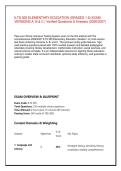
ILTS 305 ELEMENTARY EDUCATION (GRADES 1-6) EXAM
VERSIONS A, B & C | Verified Questions & Answers (2026/2027)
Pass your Illinois Licensure Testing System exam on the first attempt with this
comprehensive 2026/2027 ILTS 305 Elementary Education (Grades 1-6) multi-version
test bank containing Versions A, B, and C. This premium study guide features high-
yield practice questions paired with 100% verified answers and detailed pedagogical
rationales covering literacy development, mathematics instruction, social sciences, and
natural science concepts. It is an indispensable resource for aspiring Illinois educators
looking to master state curriculum standards, optimize study efficiency, and guarantee a
passing grade.
EXAM OVERVIEW & BLUEPRINT
Exam Code: ILTS 305
Total Questions: 150 multiple-choice questions
Time Allowed: 4 hours (plus 15-minute CBT tutorial)
Passing Score: 240 (scale of 100-300)
Content Domains & Weighting
% of
Subarea Objectives Key Topics
Score
1. Language and Emergent literacy, decoding, fluency,
6 26%
Literacy vocabulary, reading comprehension,
, % of
Subarea Objectives Key Topics
Score
literary analysis
Numbers/operations, algebraic thinking,
2. Mathematics 6 26% geometry, measurement,
data/probability
Inquiry methods, life science, physical
3. Science 3 13%
science, Earth/space science
History, geography, civics/government,
4. Social Science 3 13%
economics
5. Fine Arts 2 9% Visual arts, music, dance, theater
6. Physical
Health promotion, safety, human
Development and 3 13%
movement, physical activity
Health
SECTION 1: LANGUAGE AND LITERACY (Questions 1-100)
1. A teacher reads a book titled "Crane." One student believes it is about the giant
birds, while another student thinks it is about the machinery that carries heavy
loads. As the teacher continues reading, they encounter the word "bird," and both
,students now understand the book is about birds. Which of the following concepts
does this scenario best illustrate?
A) Pragmatics
B) Semantics
C) Morphology
D) Mutualism
Correct Answer: B) Semantics
Rationale: Semantics is the study of meaning in language, including how words can have
multiple meanings (homonyms) and how context clarifies the intended meaning. The word
"bird" provides semantic information that disambiguates "crane." Pragmatics refers to
social language use, morphology refers to word structure, and mutualism is a biological
concept not related to language acquisition .
2. A first-grade teacher is using a Big Book in a read-aloud session at the
beginning of the school year. Which method would be MOST effective for
developing students' knowledge of print and emergent literacy concepts?
A) Flipping the pages and discussing the illustrations before starting the reading
B) Using a finger to track the text from left to right and line to line while reading
C) Explaining how words are composed of letters and are read to form sentences
D) Having students echo read the text as the teacher reads it to them
Correct Answer: B) Using a finger to track the text from left to right and line to line
while reading
Rationale: Tracking text with a finger models directionality (left-to-right, top-to-bottom),
an essential early literacy skill. This method demonstrates print awareness and the
connection between spoken and written words. Echo reading and discussing illustrations
support comprehension but do not directly teach print concepts .
3. Which of the following practices would be MOST effective for a fifth-grade
teacher to use to help develop word consciousness in students?
A) Giving students instruction in dictionary skills on a regular basis
B) Suggesting that students write sentences with new words they read in texts
C) Encouraging students to discuss well-chosen language they notice in literature
D) Having students keep a log of words they have difficulty reading to review weekly
Correct Answer: C) Encouraging students to discuss well-chosen language they
notice in literature
, Rationale: Word consciousness involves interest in and awareness of words. Discussing
well-chosen language in literature promotes appreciation for word choice and encourages
students to notice sophisticated vocabulary in context. This is more effective than rote
dictionary practice .
4. A first-grade teacher introduces a rich sensory poem promoting the five senses
(taste, touch, smell, sight, and hearing). She tells the class to close their eyes while
she reads the poem. After she finishes reading, which of the following steps would
be MOST appropriate for the students to do next?
A) Have the students write about what they felt
B) Stop in the middle and have students discuss what they are feeling
C) Have the students draw pictures of the images they saw while listening
D) Act out what they comprehended from the story
Correct Answer: C) Have the students draw pictures of the images they saw while
listening
Rationale: Drawing/illustrating their sensory experiences allows young students to express
comprehension before they have the writing skills to articulate their responses in words.
This is developmentally appropriate for first graders, as they often have more advanced
visual expression skills than writing skills .
5. A teacher wants to promote students' comprehension of organizational reading
structures. Which of the following strategies is MOST effective?
A) Look for organizational structure in the book
B) Summarize points under the organizational steps in the book
C) Create headings, subheadings, topics, and points for the book
D) Make a presentation about what they read in the book
Correct Answer: C) Create headings, subheadings, topics, and points for the book
Rationale: Creating headings, subheadings, and topic points helps students actively
engage with text organization and promotes comprehension of how texts are structured.
This metacognitive strategy builds understanding of text organization .
6. The Illinois Learning Standards for English Language Arts and Literacy include
teaching fourth-grade students to use context, Greek/Latin roots, and reference
materials for vocabulary acquisition. Which statement BEST explains how these
strategies contribute to reading development?
VERSIONS A, B & C | Verified Questions & Answers (2026/2027)
Pass your Illinois Licensure Testing System exam on the first attempt with this
comprehensive 2026/2027 ILTS 305 Elementary Education (Grades 1-6) multi-version
test bank containing Versions A, B, and C. This premium study guide features high-
yield practice questions paired with 100% verified answers and detailed pedagogical
rationales covering literacy development, mathematics instruction, social sciences, and
natural science concepts. It is an indispensable resource for aspiring Illinois educators
looking to master state curriculum standards, optimize study efficiency, and guarantee a
passing grade.
EXAM OVERVIEW & BLUEPRINT
Exam Code: ILTS 305
Total Questions: 150 multiple-choice questions
Time Allowed: 4 hours (plus 15-minute CBT tutorial)
Passing Score: 240 (scale of 100-300)
Content Domains & Weighting
% of
Subarea Objectives Key Topics
Score
1. Language and Emergent literacy, decoding, fluency,
6 26%
Literacy vocabulary, reading comprehension,
, % of
Subarea Objectives Key Topics
Score
literary analysis
Numbers/operations, algebraic thinking,
2. Mathematics 6 26% geometry, measurement,
data/probability
Inquiry methods, life science, physical
3. Science 3 13%
science, Earth/space science
History, geography, civics/government,
4. Social Science 3 13%
economics
5. Fine Arts 2 9% Visual arts, music, dance, theater
6. Physical
Health promotion, safety, human
Development and 3 13%
movement, physical activity
Health
SECTION 1: LANGUAGE AND LITERACY (Questions 1-100)
1. A teacher reads a book titled "Crane." One student believes it is about the giant
birds, while another student thinks it is about the machinery that carries heavy
loads. As the teacher continues reading, they encounter the word "bird," and both
,students now understand the book is about birds. Which of the following concepts
does this scenario best illustrate?
A) Pragmatics
B) Semantics
C) Morphology
D) Mutualism
Correct Answer: B) Semantics
Rationale: Semantics is the study of meaning in language, including how words can have
multiple meanings (homonyms) and how context clarifies the intended meaning. The word
"bird" provides semantic information that disambiguates "crane." Pragmatics refers to
social language use, morphology refers to word structure, and mutualism is a biological
concept not related to language acquisition .
2. A first-grade teacher is using a Big Book in a read-aloud session at the
beginning of the school year. Which method would be MOST effective for
developing students' knowledge of print and emergent literacy concepts?
A) Flipping the pages and discussing the illustrations before starting the reading
B) Using a finger to track the text from left to right and line to line while reading
C) Explaining how words are composed of letters and are read to form sentences
D) Having students echo read the text as the teacher reads it to them
Correct Answer: B) Using a finger to track the text from left to right and line to line
while reading
Rationale: Tracking text with a finger models directionality (left-to-right, top-to-bottom),
an essential early literacy skill. This method demonstrates print awareness and the
connection between spoken and written words. Echo reading and discussing illustrations
support comprehension but do not directly teach print concepts .
3. Which of the following practices would be MOST effective for a fifth-grade
teacher to use to help develop word consciousness in students?
A) Giving students instruction in dictionary skills on a regular basis
B) Suggesting that students write sentences with new words they read in texts
C) Encouraging students to discuss well-chosen language they notice in literature
D) Having students keep a log of words they have difficulty reading to review weekly
Correct Answer: C) Encouraging students to discuss well-chosen language they
notice in literature
, Rationale: Word consciousness involves interest in and awareness of words. Discussing
well-chosen language in literature promotes appreciation for word choice and encourages
students to notice sophisticated vocabulary in context. This is more effective than rote
dictionary practice .
4. A first-grade teacher introduces a rich sensory poem promoting the five senses
(taste, touch, smell, sight, and hearing). She tells the class to close their eyes while
she reads the poem. After she finishes reading, which of the following steps would
be MOST appropriate for the students to do next?
A) Have the students write about what they felt
B) Stop in the middle and have students discuss what they are feeling
C) Have the students draw pictures of the images they saw while listening
D) Act out what they comprehended from the story
Correct Answer: C) Have the students draw pictures of the images they saw while
listening
Rationale: Drawing/illustrating their sensory experiences allows young students to express
comprehension before they have the writing skills to articulate their responses in words.
This is developmentally appropriate for first graders, as they often have more advanced
visual expression skills than writing skills .
5. A teacher wants to promote students' comprehension of organizational reading
structures. Which of the following strategies is MOST effective?
A) Look for organizational structure in the book
B) Summarize points under the organizational steps in the book
C) Create headings, subheadings, topics, and points for the book
D) Make a presentation about what they read in the book
Correct Answer: C) Create headings, subheadings, topics, and points for the book
Rationale: Creating headings, subheadings, and topic points helps students actively
engage with text organization and promotes comprehension of how texts are structured.
This metacognitive strategy builds understanding of text organization .
6. The Illinois Learning Standards for English Language Arts and Literacy include
teaching fourth-grade students to use context, Greek/Latin roots, and reference
materials for vocabulary acquisition. Which statement BEST explains how these
strategies contribute to reading development?


