
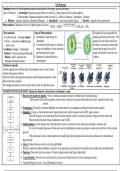
Life Processes
Nutrition: Process by which organisms obtain food and utilize it for energy, growth, and repair.
Types of Nutrition: 1. Autotrophic: Organisms prepare their own food (e.g., plants prepare food by photosynthesis)
2. Heterotrophic: Organisms depend on others for food ( e.g. Holozoic (humans) , Saprophytic , Parasitic)
a) Holozoic – ingestion, digestion, absorption (Humans) b. Saprophytic – feed on dead matter (fungi) c. Parasitic – depend on host (tapeworm)
Photosynthesis: Chloroplast is the site of photosynthesis in leaves.
Raw materials: Steps of Photosynthesis: The guard cells are responsible for
Carbon dioxide → through stomata 1. Absorption of light energy by opening and closing of the pore . The
Water → absorbed by roots through chlorophyll guard cells swell when water flows
xylem vessel. 2. Conversion of light energy to chemical into them, causing the stomatal pore
Conditions: Sunlight , Chlorophyll energy and splitting of water molecules to open and the pore closes if the
Products :- Glucose(transported through into hydrogen and oxygen. guard cells shrink if water flow out
Phloem ) and O2 (released into 3. Reduction of carbon dioxide to of them.
atmosphere through stomata). carbohydrates.
Nutrition in amoeba:
Amoeba captures food with the help of pseudopodia, forms a food vacuole
with the food particle within it.
Inside the food vacuole digestion take place and the digested material, is then
diffused into the cytoplasm.
The undigested material is moved to the surface of the cell and thrown out.
NUTRITION IN HUMAN BEING: Human has digestive system known as alimentary canal.
Buccal cavity &salivary glands:- Food is crushed and mixed with saliva with the help of teeth and tongue.
Saliva present in the salivary glands contains salivary amylase, an enzyme that break down starch (digestion starts in the
mouth).
Oesophagus:- Peristaltic movement (Rhythmic movement muscles in oesophagus) pushing the food towards stomach.
Stomach:- A large sac like structure.Gastric gland present in the wall of stomach secretes HCl, pepsin, mucus.
HCl kill the germs in food and make the food acidic medium, which is essential for pepsin to digest proteins in the food.
Mucus protects the inner lining of alimentary canal by HCl.
Small Intestine:- It is the longest and coiled tube and it receives secretions of liver and pancreas through a common duct.
It is site for complete digestion of food and converts carbohydrates to glucose, proteins to amino acids and fats to fatty acid and
glycerol.
Villi on the inner walls of small intestine have small finger like projections that increase the surface area for absorption of
digested food.
Liver:- Produce bile juice and store it in the gall bladder.
Bile juice make the medium alkaline for enzymes of the pancreatic juice Break the fat molecules into smaller parts (emulsification)
Pancreas:- Pancreatic juice has enzymes- Trypsin to digest protein and Lipase digest lipid.
Large intestine:- Absorbs water and electrolytes; bacteria also help break down some remaining nutrients.
Rectum (Storage of waste) , Anus (Elimination of waste)
, RESPIRATION: Respiration is the process of breakdown of food to release energy required
for life processes.
Aerobic respiration Anaerobic respiration Anaerobic respiration
(fermentation)
occurs in presence of occurs in absence of Occur in few
oxygen oxygen microorganisms like Yeast
Glucose is broken down Glucose is broken down Glucose is broken down
into pyruvate in cytoplasm into pyruvate in into pyruvate in cytoplasm
of cell cytoplasm of cell of cell
In presence of oxygen In absence of oxygen In absence of oxygen
pyruvate completely pyruvate partially pyruvate partially
oxidized in mitochondria decomposes and form decomposes and form
to produce CO2 and Lactic acid in tired ethanol in yeast.
energy. muscle cells
Human respiratory system
Mechanism of Breathing: Inhalation: Diaphragm contracts, chest expands Exhalation: Diaphragm relaxes, chest contracts
Exchange of gases takes place at alveoli by diffusion. The blood brings carbondioxide from the rest of the body to go into the alveoli and the oxygen in the air is taken
up by blood to be transported to all the cells in the body. An iron containing haemoglobin (present in RBC) is the respiratory pigment that transport oxygen.
RESPIRATION IN PLANTS:- They have stomata (present in leaves) and lenticels (present in stems) which are involved in the exchange of gases by diffusion.
Nutrition: Process by which organisms obtain food and utilize it for energy, growth, and repair.
Types of Nutrition: 1. Autotrophic: Organisms prepare their own food (e.g., plants prepare food by photosynthesis)
2. Heterotrophic: Organisms depend on others for food ( e.g. Holozoic (humans) , Saprophytic , Parasitic)
a) Holozoic – ingestion, digestion, absorption (Humans) b. Saprophytic – feed on dead matter (fungi) c. Parasitic – depend on host (tapeworm)
Photosynthesis: Chloroplast is the site of photosynthesis in leaves.
Raw materials: Steps of Photosynthesis: The guard cells are responsible for
Carbon dioxide → through stomata 1. Absorption of light energy by opening and closing of the pore . The
Water → absorbed by roots through chlorophyll guard cells swell when water flows
xylem vessel. 2. Conversion of light energy to chemical into them, causing the stomatal pore
Conditions: Sunlight , Chlorophyll energy and splitting of water molecules to open and the pore closes if the
Products :- Glucose(transported through into hydrogen and oxygen. guard cells shrink if water flow out
Phloem ) and O2 (released into 3. Reduction of carbon dioxide to of them.
atmosphere through stomata). carbohydrates.
Nutrition in amoeba:
Amoeba captures food with the help of pseudopodia, forms a food vacuole
with the food particle within it.
Inside the food vacuole digestion take place and the digested material, is then
diffused into the cytoplasm.
The undigested material is moved to the surface of the cell and thrown out.
NUTRITION IN HUMAN BEING: Human has digestive system known as alimentary canal.
Buccal cavity &salivary glands:- Food is crushed and mixed with saliva with the help of teeth and tongue.
Saliva present in the salivary glands contains salivary amylase, an enzyme that break down starch (digestion starts in the
mouth).
Oesophagus:- Peristaltic movement (Rhythmic movement muscles in oesophagus) pushing the food towards stomach.
Stomach:- A large sac like structure.Gastric gland present in the wall of stomach secretes HCl, pepsin, mucus.
HCl kill the germs in food and make the food acidic medium, which is essential for pepsin to digest proteins in the food.
Mucus protects the inner lining of alimentary canal by HCl.
Small Intestine:- It is the longest and coiled tube and it receives secretions of liver and pancreas through a common duct.
It is site for complete digestion of food and converts carbohydrates to glucose, proteins to amino acids and fats to fatty acid and
glycerol.
Villi on the inner walls of small intestine have small finger like projections that increase the surface area for absorption of
digested food.
Liver:- Produce bile juice and store it in the gall bladder.
Bile juice make the medium alkaline for enzymes of the pancreatic juice Break the fat molecules into smaller parts (emulsification)
Pancreas:- Pancreatic juice has enzymes- Trypsin to digest protein and Lipase digest lipid.
Large intestine:- Absorbs water and electrolytes; bacteria also help break down some remaining nutrients.
Rectum (Storage of waste) , Anus (Elimination of waste)
, RESPIRATION: Respiration is the process of breakdown of food to release energy required
for life processes.
Aerobic respiration Anaerobic respiration Anaerobic respiration
(fermentation)
occurs in presence of occurs in absence of Occur in few
oxygen oxygen microorganisms like Yeast
Glucose is broken down Glucose is broken down Glucose is broken down
into pyruvate in cytoplasm into pyruvate in into pyruvate in cytoplasm
of cell cytoplasm of cell of cell
In presence of oxygen In absence of oxygen In absence of oxygen
pyruvate completely pyruvate partially pyruvate partially
oxidized in mitochondria decomposes and form decomposes and form
to produce CO2 and Lactic acid in tired ethanol in yeast.
energy. muscle cells
Human respiratory system
Mechanism of Breathing: Inhalation: Diaphragm contracts, chest expands Exhalation: Diaphragm relaxes, chest contracts
Exchange of gases takes place at alveoli by diffusion. The blood brings carbondioxide from the rest of the body to go into the alveoli and the oxygen in the air is taken
up by blood to be transported to all the cells in the body. An iron containing haemoglobin (present in RBC) is the respiratory pigment that transport oxygen.
RESPIRATION IN PLANTS:- They have stomata (present in leaves) and lenticels (present in stems) which are involved in the exchange of gases by diffusion.


