
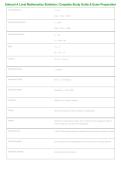
Edexcel A Level Mathematics Statistics | Complete Study Guide & Exam Preparation
Linear Regression y = axⁿ
logy = loga + nlogx
Exponential Regression y = ab^x
logy = loga + xlogb
Normal Approximation µ = np
σ =√(np(1-p))
Mean ∑x ÷ n
GF: ∑xf ÷ ∑f
Variance (∑x²/n) - (∑x/n)²
Standard Deviation √variance
Histograms: Height Area = k x frequency
Frequency Density frequency ÷ class width
Population Whole set of items of interest.
Census Observes/measures every member of a population
Sample Selection of observations taken from a subset of the population which is
used to find out info about the population.
Sampling Frame A list of individuals (named or numbered) from whom the sample is drawn
Random Sampling Every member of the population has an equal chance of being selected
Systematic Sampling Every nth person is chosen.
,Edexcel A Level Mathematics Statistics | Complete Study Guide & Exam Preparation
Stratified Sampling Population is divided into mutually exclusive Strat and a random sample is
taken from each.
Quota Sampling Interviewer selects a sample that reflects the characteristics of the
population
Opportunity Sampling Choosing whoever is available
Continuous Variable Can take any value in a given range
Discrete Variable Takes specific values in a given range
Conditions for Binomial Fixed no. of trials
2 possible outcomes
Outcomes are independent
Fixed probability of success
Probability: Independent if... P(A∩B) = P(A) X P(B)
P(A|B) = P(A)
Probability: Mutually exclusive if... P(A∩B) = 0
P(A∪B) = P(A) + P(B)
Conditional Probability P(A|B) = P(A∩B)/P(B)
Probability Addition Rule P(A∪B) = P(A) + P(B) - P(A∩B)
If there are 3 events, and A and B are mutually exclusive... P(A∪B∪C) = P(A) + P(B) + P(C) - P(A∩C) - P(B∩C)
What is a DRV - discrete random variable it is a random variable that can only take certain values
... ...
, Edexcel A Level Mathematics Statistics | Complete Study Guide & Exam Preparation
probability mass function a function that gives the probability that a discrete random variable is
exactly equal to some value
what does a probability distribution do describes the probability of any outcome in the sample space
P(A/B) = (P(A n B))
---------------
P(B)
If they are independent events P(A) * P(B) = P(A N B)
SUM OF P(X=x) = 1
formula for probability X=r where X is the number of nCr P^r * (1-p)^(n-r)
desired outcomes
binomial distribution formula
p = probability of success
r = number of times you want success
n= number of trials
standard deviation a computed measure of how much scores vary around the mean score
general probability addition rule P(A∪B)=P(A)+P(B)−P(A∩B)
P(A∩B)=P(A)+P(B)−P(A∪B)
what is an event a set of possible outcomes - not necessarily equally likely
sample space set of all possible outcomes , all equally likely
A∪B means A or B or both
Linear Regression y = axⁿ
logy = loga + nlogx
Exponential Regression y = ab^x
logy = loga + xlogb
Normal Approximation µ = np
σ =√(np(1-p))
Mean ∑x ÷ n
GF: ∑xf ÷ ∑f
Variance (∑x²/n) - (∑x/n)²
Standard Deviation √variance
Histograms: Height Area = k x frequency
Frequency Density frequency ÷ class width
Population Whole set of items of interest.
Census Observes/measures every member of a population
Sample Selection of observations taken from a subset of the population which is
used to find out info about the population.
Sampling Frame A list of individuals (named or numbered) from whom the sample is drawn
Random Sampling Every member of the population has an equal chance of being selected
Systematic Sampling Every nth person is chosen.
,Edexcel A Level Mathematics Statistics | Complete Study Guide & Exam Preparation
Stratified Sampling Population is divided into mutually exclusive Strat and a random sample is
taken from each.
Quota Sampling Interviewer selects a sample that reflects the characteristics of the
population
Opportunity Sampling Choosing whoever is available
Continuous Variable Can take any value in a given range
Discrete Variable Takes specific values in a given range
Conditions for Binomial Fixed no. of trials
2 possible outcomes
Outcomes are independent
Fixed probability of success
Probability: Independent if... P(A∩B) = P(A) X P(B)
P(A|B) = P(A)
Probability: Mutually exclusive if... P(A∩B) = 0
P(A∪B) = P(A) + P(B)
Conditional Probability P(A|B) = P(A∩B)/P(B)
Probability Addition Rule P(A∪B) = P(A) + P(B) - P(A∩B)
If there are 3 events, and A and B are mutually exclusive... P(A∪B∪C) = P(A) + P(B) + P(C) - P(A∩C) - P(B∩C)
What is a DRV - discrete random variable it is a random variable that can only take certain values
... ...
, Edexcel A Level Mathematics Statistics | Complete Study Guide & Exam Preparation
probability mass function a function that gives the probability that a discrete random variable is
exactly equal to some value
what does a probability distribution do describes the probability of any outcome in the sample space
P(A/B) = (P(A n B))
---------------
P(B)
If they are independent events P(A) * P(B) = P(A N B)
SUM OF P(X=x) = 1
formula for probability X=r where X is the number of nCr P^r * (1-p)^(n-r)
desired outcomes
binomial distribution formula
p = probability of success
r = number of times you want success
n= number of trials
standard deviation a computed measure of how much scores vary around the mean score
general probability addition rule P(A∪B)=P(A)+P(B)−P(A∩B)
P(A∩B)=P(A)+P(B)−P(A∪B)
what is an event a set of possible outcomes - not necessarily equally likely
sample space set of all possible outcomes , all equally likely
A∪B means A or B or both


